Bar Exam Questions & Tests
Walk Into Bar Exam Day With Confidence
Practice with realistic MBE and NextGen questions, build custom practice tests, and review detailed explanations that help you understand why each answer is right or wrong.
Realistic Bar Exam Questions
Attorney-Written Explanations
Personalized Performance Analytics
Free MBE & NextGen Bar Exam Sample Questions
Explore free sample questions across MBE and NextGen formats to build legal reasoning, improve issue spotting, and see how concepts are tested on the bar exam.
Try real MBE-style questions and review detailed answer explanations that teach the legal reasoning behind every answer choice. Experience exam-level questions, attorney-written rationales, and customizable study tools designed to help you improve accuracy and build confidence.
A husband and wife were married in State A and lived there for 10 years before separating. One month later, the wife permanently moved to State B and immediately filed for divorce in a federal court in State B. The wife claims that she is entitled to $300,000 in alimony. The husband appeared in the action and has filed a motion to dismiss for lack of subject-matter jurisdiction.
Should the court grant the motion?
| A. No, because the court has diversity jurisdiction over the case. | ||
| B. No, because the husband waived a subject-matter jurisdiction challenge by appearing in the case. | ||
| C. Yes, because state courts have exclusive jurisdiction over this type of action. | ||
| D. Yes, because the wife did not establish a domicile in State B. |
Explanation:
| Federal diversity jurisdiction exceptions |
|
Federal courts cannot exercise diversity jurisdiction over cases involving:
|
A federal court must possess subject-matter jurisdiction to hear the merits of a case before it. Subject-matter jurisdiction can be established through either:
- federal-question jurisdiction – when a claim arises under the U.S. Constitution, a treaty, or federal law (not seen here) or
- diversity jurisdiction – when the amount in controversy exceeds $75,000 and the opposing parties are citizens of different states.
Here, diversity jurisdiction is established since the wife claims that she is entitled to $300,000 and the parties are citizens of different states (States A and B). However, federal courts cannot exercise diversity jurisdiction over cases involving probate matters or domestic relations. Instead, state courts have exclusive jurisdiction over these types of actions (Choice A).* Therefore, the husband's motion to dismiss should be granted.
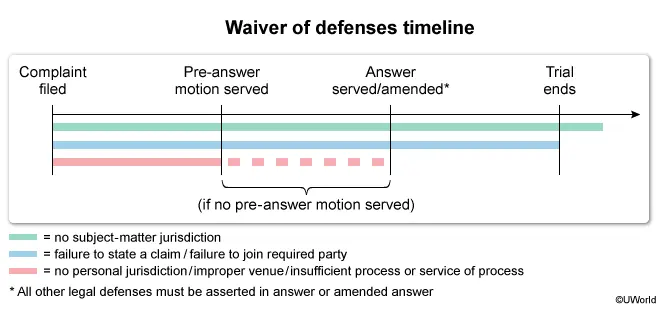
(Choice B) A challenge to subject-matter jurisdiction is never waived. However, a challenge to personal jurisdiction is waived if the defendant has voluntarily appeared in the case, unless it was a special appearance for the express purpose of objecting to personal jurisdiction.
(Choice D) An individual is a citizen of the state where he/she is domiciled—ie, physically present with the intent to remain indefinitely. Since the wife permanently moved to State B, she has established her domicile there.
Educational objective:
Federal courts cannot exercise diversity jurisdiction
over cases involving probate matters or domestic relations. Instead, state courts have exclusive
jurisdiction over these types of cases.
A congressional committee investigated the pharmaceutical industry and found that the high cost of prescription drugs purchased and sold in the United States negatively impacted the nation's economy and the health of its citizens. In response, Congress passed a statute that regulates "the retail prices of every purchase or sale of prescription drugs in the United States."
A group of pharmaceutical companies challenged the constitutionality of this statute in federal court.
What is the strongest argument in support of the constitutionality of this statute?
| A. Congress may enact statutes for the general welfare. | ||
| B. Congress may regulate the prices of all domestic purchases and sales of goods. | ||
| C. The Constitution grants Congress the power to regulate the interstate transportation of prescription drugs. | ||
| D. The purchases and sales of prescription drugs in the United States substantially impact interstate commerce in the aggregate. |
Explanation:
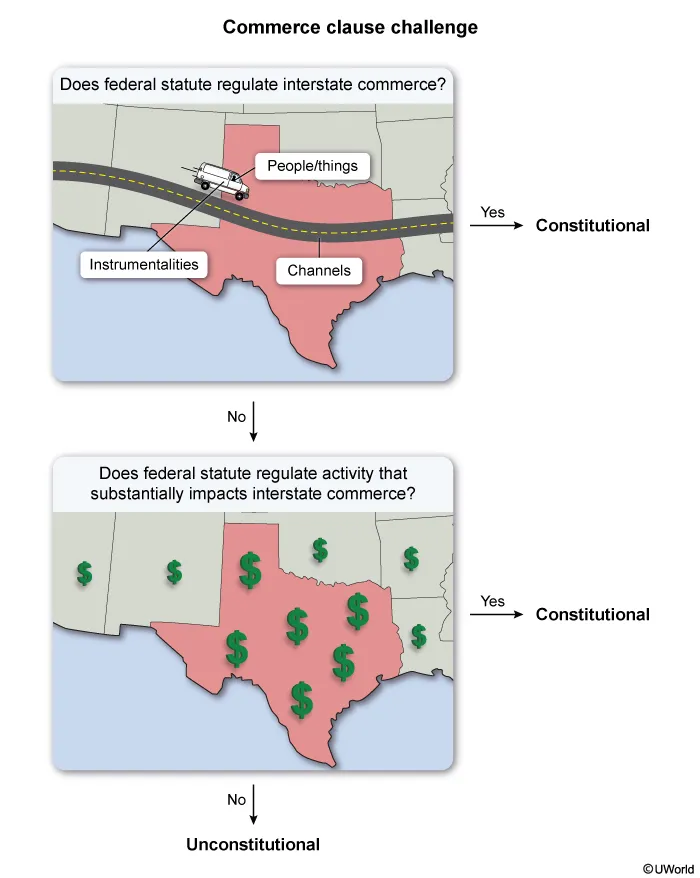
The commerce clause gives Congress broad power to regulate interstate and foreign commerce. This includes:
- the channels of interstate and foreign commerce (eg, roadways)
- the instrumentalities of interstate and foreign commerce (eg, vehicles)
- persons and things moving in interstate or foreign commerce (eg, goods and services) and
- in-state activities that, singly or in the aggregate, substantially impact interstate or foreign commerce.
Since Congress's commerce power is broad, federal statutes are constitutional if there is any rational basis for concluding that the regulated activity substantially affects interstate or foreign commerce. This can be shown through express congressional findings.
Here, the federal statute regulates the retail prices of prescription drugs in the United States. Congress has the authority to regulate such products' interstate transportation, but this statute also regulates in-state purchases and sales (Choice C). Since the congressional committee found that the high cost of prescription drugs negatively impacted the nation's economy, it is rational to conclude that their aggregated in-state purchases and sales substantially impact interstate commerce. Therefore, this is the strongest argument to support this statute.
(Choice A) The taxing and spending clause empowers Congress to tax and spend for the general welfare. But regulating prices is not equivalent to taxing or spending.
(Choice B) Congress cannot regulate the prices of every domestic purchase and sale of goods since it cannot regulate purely in-state sales that do not substantially affect interstate commerce.
Educational objective:
The commerce clause empowers Congress to regulate (1)
channels and instrumentalities of, (2) persons and things moving in, and (3) in-state activities
that—singly or in the aggregate—substantially affect interstate or foreign commerce.
The owner of a new office building contracted with a well-known landscaper to design and install landscaping around the building for $30,000. The agreement was memorialized in writing, was signed by both parties, and called for a budget of $5,000 for trees, shrubs, sod, and materials. The contract required the landscaper to complete the work within six months. Due to an unexpected increase in the price of trees and shrubs, the landscaper abandoned the project and never completed any of the work.
Three years after the landscaper's deadline, the building owner sued the landscaper for breach of contract. In the jurisdiction, the statute of limitations for breach of a services contract is two years after the breach, and the statute of limitations for breach of a sale-of-goods contract is four years.
Can the owner recover damages from the landscaper?
| A. No, because the contract is divisible with respect to the services and goods, and the landscaper's breach is therefore subject to the two-year statute of limitations. | ||
| B. No, because the contract primarily calls for services, and the landscaper's breach is therefore subject to the two-year statute of limitations. | ||
| C. Yes, because the landscaper's breach was a result of an increase in the price of goods, and his breach is therefore subject to the four-year statute of limitations. | ||
| D. Yes, because the landscaper's breach was willful, and he is therefore estopped from denying that his breach is subject to the four-year statute of limitations. |
Explanation:
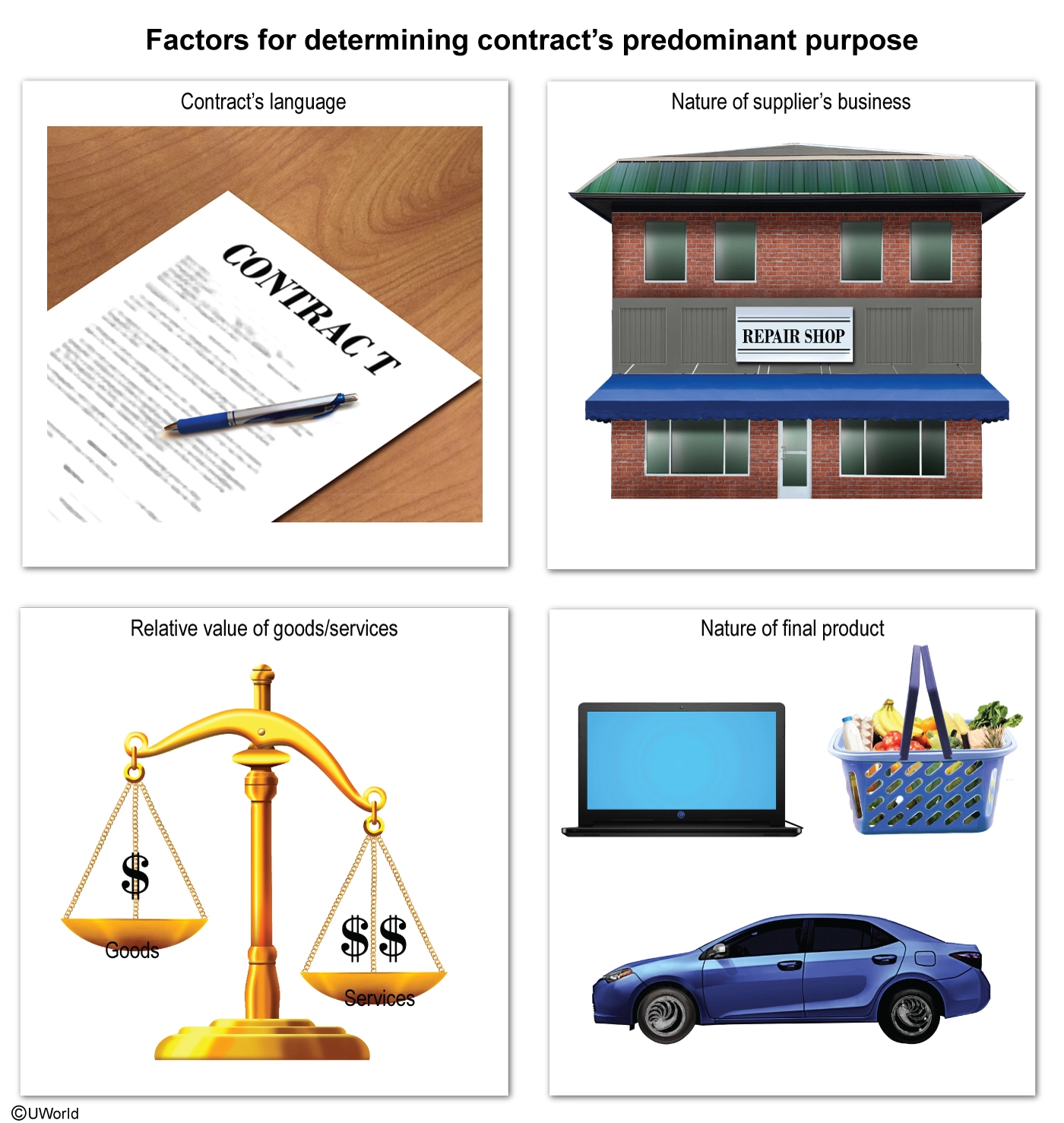
Contracts for the sale of goods are governed by Article 2 of the Uniform Commercial Code (UCC), while contracts for services are governed by common law. However, some contracts involve the sale of goods and the rendering of services. To determine which law applies to a "mixed" or "hybrid" contract, courts ask whether its predominant purpose was the sale of goods or the rendering of services. The following factors are relevant to this determination:
- The contract's language
- The nature of the supplier's business (ie, whether it typically provides goods or services)
- The relative value of the goods and services
- The nature of the final product (ie, whether it can be described as a good or service)
Here, the building owner contracted to buy goods (eg, trees, shrubs, sod) and services (ie, designing and installing the landscaping). The owner likely hired the well-known landscaper due to his skill in performing landscaping services, and the $5,000 budget for goods was just one-sixth of the $30,000 contract price. Therefore, the contract primarily calls for services and is subject to the jurisdiction's two-year statute of limitations. And since the owner sued three years after the breach, the owner cannot recover damages from the landscaper.
(Choice A) The predominant-purpose test is unnecessary when a contract is divisible—ie, when the payment for goods can easily be separated from the payment for services. But here, the contract is likely indivisible since it combined the sale of the trees, shrubs, and sod with their installation.
(Choices C & D) The predominant-purpose test focuses on the parties' reason for entering the contract—not for breaching it. Therefore, it is irrelevant that the landscaper's breach was (1) a result of an increase in the price of goods or (2) willful.
Educational objective:
Sale-of-goods contracts are governed by the UCC, while
services contracts are governed by common law. When a contract calls for the sale of goods AND the
rendering of services, the contract's primary purpose determines whether the UCC or common law
applies.
A man and a woman dated for several weeks. During that time, the man repeatedly asked the woman to have sex. Each time, the woman responded that she would not have sex with the man unless they were married. One evening, the man promised the woman that they would elope the following weekend if she would agree to have sex. The woman agreed and the couple had sex. The following weekend, the man told the woman that he had no intention of eloping and only made that promise to get the woman's consent. The woman reported the man to the police, who later arrested and charged the man with rape.
Is the man guilty of rape?
| A. No, because fraud in factum did not negate the woman's consent. | ||
| B. No, because fraud in the inducement did not negate the woman's consent. | ||
| C. Yes, because the woman's consent was obtained by fraud in factum. | ||
| D. Yes, because the woman's consent was obtained by fraud in the inducement. |
Explanation:
| Consent to sexual intercourse obtained by fraud | ||
| Type of fraud | Definition | Effect |
| In factum |
|
Negates victim's consent |
| In inducement |
|
Does not negate victim's consent |
In most modern jurisdictions, rape is defined as sexual intercourse with another without that person's consent.* This means that rape did not occur if the victim consented to sexual intercourse. However, a victim's consent may be ineffective if it was obtained by fraud. There are two types of fraud:
- Fraud in factum – when consent is obtained by fraud regarding the nature of the act itself, leaving the victim unaware that he/she consented to sexual intercourse and negating the victim's consent
- Fraud in the inducement – when consent is obtained by fraud regarding what the victim knows is an act of sexual intercourse, which does not negate the victim's consent
As a result, consent obtained by fraud in factum is not a valid defense to rape, but consent obtained by fraud in the inducement is a valid defense.
Here, the man falsely promised the woman that they would elope if she agreed to have sex with him. Since the woman knew that the act to which she consented was sexual intercourse, her consent was obtained by fraud in the inducement (Choices A & C). This type of fraud did not negate the woman's consent, so the man is not guilty of rape (Choice D).
Educational objective:
Fraud in factum occurs when the fraud pertains to the nature of the act itself and negates a rape
victim's consent. In contrast, fraud in the inducement occurs when fraud is used to gain consent to
what the victim knows is an act of sexual intercourse and does not negate the victim's consent.
A plaintiff sued a defendant for negligence to recover damages that the plaintiff suffered as a result of a crash between the two parties. At trial, the plaintiff's attorney called the plaintiff's wife to testify as to what she witnessed on the day of the crash. On cross-examination of the wife, the defendant's lawyer elicited several responses that tended to show that the plaintiff's actions constituted contributory negligence. The plaintiff's attorney seeks to ask the wife several questions on redirect examination, but the defendant's attorney objected.
What is the strongest argument that the court must allow redirect examination of the wife?
| A. The plaintiff's attorney failed to provide all significant information on direct examination. | ||
| B. The plaintiff's attorney seeks to reiterate the necessary elements of the claim. | ||
| C. The plaintiff's attorney seeks to reply to all matters raised on cross-examination. | ||
| D. The plaintiff's attorney seeks to reply to significant new matters raised on cross-examination. |
Explanation:
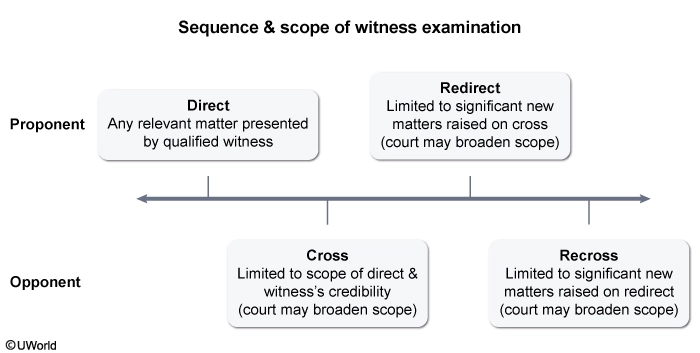
Federal Rule of Evidence 611 gives trial courts the authority to exercise reasonable control over the mode and order of examining witnesses at trial. This includes the discretion to determine whether—and to what extent—redirect examination of witnesses should be permitted. But when a party raises a significant new matter while cross-examining a witness, the court must allow the opposing party to address that matter through redirect examination.
Therefore, the strongest argument for allowing redirect examination of the plaintiff's wife is that the plaintiff's attorney seeks to reply to significant new matters that were raised on cross-examination.
(Choice A) A party is expected to elicit all significant information during direct examination of a witness. Therefore, a court need not permit redirect examination to allow the party to provide information inadvertently omitted on direct examination.
(Choices B & C) Redirect examination is generally limited to significant new matters raised on cross-examination. Therefore, a party is not entitled to redirect examination to (1) reiterate information like the necessary elements of the claim or (2) reply to all matters addressed in cross-examination.
Educational objective:
When a party raises a significant new matter on
cross-examination of a witness, the court must allow redirect examination by the opposing party to
address that matter.
Explore free NextGen Bar Exam sample questions, including MCQs and Integrated Question Sets (IQs), with detailed explanations that demonstrate how legal concepts are tested and applied in realistic client-focused scenarios.
You represent a woman who broke into her ex-husband's house late one night when she knew he was away on business, intending to take a sculpture that he had been awarded in their divorce settlement. She searched the entire house but was unable to find the sculpture. She figured he had probably sold the sculpture, which made her furious because he knew how much she loved it. In a rage, she slashed a painting of his new girlfriend before leaving the house.
Larceny is defined as the trespassory taking and carrying away of the personal property of another with the intent to permanently deprive that person of the property. Burglary is defined as the breaking and entering of the dwelling of another at nighttime with the specific intent to commit a felony in the dwelling. Attempt requires proof of a substantial step toward the commission of a crime and the specific intent to commit the crime. Larceny and burglary are felonies in the jurisdiction.
Of which of the following crimes is the woman guilty?
Select one response option.
| A. Attempted larceny only. | ||
| B. Larceny only. | ||
| C. Burglary only. | ||
| D. Burglary and attempted larceny. |
Explanation:
In this jurisdiction (and at common law), burglary requires proof of the following:
- an unlawful breaking and entering of another's dwelling at night and
- the specific intent to commit a felony (e.g., larceny) therein.
Once the defendant enters the dwelling with the requisite intent, the burglary is complete. This means that there is no need to prove that the defendant completed the underlying felony to obtain a burglary conviction.
A burglary defendant who did not complete the underlying felony is also guilty of the attempted commission of that felony. That is because the defendant (1) specifically intended to commit the felony and (2) performed a substantial step in furtherance of the felony—the unlawful breaking and entering.
Here, the woman is guilty of burglary because she broke into her ex-husband's home at night with the specific intent to commit larceny (Choices A and B). Larceny is the unlawful taking and carrying away of another's personal property (sculpture) with the specific intent to permanently deprive that person of the property. Although the woman did not complete the larceny, because she did not actually steal the sculpture, she is still guilty of attempted larceny (Choice C). Therefore, the woman is guilty of both burglary and attempted larceny.
Educational objective:
Common-law burglary is complete when the defendant
unlawfully breaks and enters a dwelling at night with the intent to commit a felony therein.
Commission of the underlying felony is unnecessary. However, a burglary defendant who fails to
complete the underlying felony is also guilty of the attempted commission of that felony.
You represent a defendant on trial for wire fraud. The prosecution alleged that the defendant, a small business owner, ran an online investment scheme promising high returns but instead he pocketed the funds. The defendant takes the stand in his own defense and testifies: "I have always been an honest businessman. I would never lie to my customers or cheat anyone."
On cross-examination, the prosecutor seeks to impeach the defendant's credibility with (1) his felony conviction for burglary almost 10 years ago and (2) his misdemeanor conviction 12 years ago for defrauding investors through a false loan scheme.
You object to the admission of both convictions.
How is the court likely to rule?
Select one response option.
| A. The court should admit both convictions, because criminal convictions are generally admissible to impeach a testifying defendant. | ||
| B. The court should admit the more recent burglary conviction but exclude the fraud conviction that is more than 10 years old. | ||
| C. The court should exclude both convictions, because prior convictions are generally inadmissible. | ||
| D. The court should exclude the burglary conviction but may admit the fraud conviction if its probative value substantially outweighs its prejudicial effect. |
Explanation:
Federal Rule of Evidence 609 provides that a witness's character for truthfulness can be impeached with a prior criminal conviction. However, the standards for admission vary depending on:
- the age of the conviction
- the type of conviction and
- the witness against whom the conviction is offered.
A conviction for fraud—a crime of dishonesty—is highly probative of truthfulness. When a fraud conviction is more than 10 years old, the conviction is admissible only if its probative value substantially outweighs its prejudicial effect. Even so, a fraud conviction is likely admissible because of its high probative value.
However, because burglary does not involve dishonesty or a false statement, a burglary conviction has minimal probative value as to a witness's credibility. And when the witness is a criminal defendant, a burglary conviction is likely inadmissible to impeach the witness because its probative value is unlikely to substantially exceed its prejudicial effect. Therefore, the court here should exclude the burglary conviction but may admit the fraud conviction if its probative value substantially outweighs its prejudicial effect (Choices A, B, and C).
Educational objective:
Evidence of a conviction for a crime of dishonesty that
occurred more than 10 years prior is admissible to impeach a defendant witness's credibility if the
probative value of the evidence substantially outweighs its prejudicial effect.
Your client is an attorney with a family law practice. The client's niece is a recent law school graduate, and her nephew is an attorney. The client recently decided to retire, and, upon her request, you drafted a document conveying the historic building that houses her law practice "to [Niece], but if she fails to pass the bar exam within one year of her law school graduation, then to [Nephew]."
Which of the following accurately describes the property interests created?
Select two response options.
| A. The nephew and the client each have a possibility of reverter. | ||
| B. The nephew has an executory interest, and the client has a right of entry. | ||
| C. The nephew has an executory interest, and the client has no interest. | ||
| D. The niece has a fee simple determinable. | ||
| E. The niece has a fee simple subject to a condition subsequent. | ||
| F. The niece has a fee simple subject to an executory interest. |
Explanation:
A defeasible fee is a fee simple estate that may be terminated when a stated event or condition occurs. One type of defeasible fee is a fee simple subject to a condition subsequent (FSSCS), which is created with conditional language (e.g., "but if"). If the stated condition occurs, title will automatically pass to the future interest holder. If the future interest is held by a third party (as opposed to the grantor), then the estate is called a fee simple subject to an executory interest.
Here, the client conveyed the building to her niece, with conditional language ("but if") that the niece must pass the bar exam within a year of her law school graduation. If she fails to pass the exam, then title will pass to the nephew (third party)—not to the client (grantor). As a result, the niece has a fee simple subject to an executory interest and the nephew holds the executory interest. And because the client reserved no right in the property for herself (e.g., a right of entry), she has no interest.
(Choices A and D) A fee simple determinable is a defeasible fee that is created by specific durational language (e.g., "so long as," "during," "until"—none seen here). When the estate terminates, it automatically reverts back to the grantor.
(Choices B and E) A right of entry is a future interest that is held by the grantor (client) if the grantor specifically retained this right (not seen here). It follows an FSSCS and gives the grantor the right to terminate the FSSCS when the stated condition occurs.
Educational objective:
A fee simple subject to an executory interest is a present
estate limited by durational or conditional language. If the stated event or condition occurs, title
automatically passes to a third party who holds a future, executory interest.
A woman purchased a new car from a car dealer. The car's engine contained a defectively manufactured computer chip, causing the woman to lose control of the car and suffer injuries. The chip was manufactured by a component company and then purchased by an engine builder. The engine builder then incorporated the chip into the engine and sold the engine to a car manufacturer. The car manufacturer then incorporated the engine into the car and sold the car to the car dealer.
The woman has scheduled a meeting with you to discuss options for bringing a strict products liability claim against the component company, the engine builder, the car manufacturer, and the car dealer.
Which of the prospective defendants may be held strictly liable to the woman?
Select one response option.
| A. Only the car dealer, because the woman was not in privity with the other prospective defendants. | ||
| B. Only the component company, because the company is responsible for manufacturing the defective chip. | ||
| C. Any of the prospective defendants that negligently failed to inspect the defective chip. | ||
| D. Any of the prospective defendants, regardless of whether that prospective defendant was negligent. |
Explanation:
Any commercial seller in the distribution chain—e.g., manufacturer, distributor, retailer—is subject to strict products liability if (1) the product was defective when it left the commercial seller's control and (2) that defect caused the plaintiff harm. Strict liability is imposed even if the commercial seller did not create or know about that defect.
Here, a manufacturing defect in the computer chip caused the woman to lose control of her car and suffer injuries. The defect existed at the time the component company manufactured the chip, and the defect continued to exist when it left the engine builder's, the car manufacturer's, and the car dealer's control (Choice B). Therefore, any of these prospective defendants may be held strictly liable to the woman for her injuries—regardless of whether they were negligent.
(Choice A) Although the woman was in privity (i.e., had a contractual relationship) with the car dealer only, privity is not required in a strict liability action. Every commercial supplier in the distribution chain—even those not in privity with the plaintiff—is subject to strict liability if the defect existed when the product left the supplier's control.
(Choice C) Since strict liability is imposed without proof of fault, any party in the distribution chain is strictly liable regardless of whether it could have discovered the defect by a reasonable inspection of the computer chip.
Educational objective:
Strict products liability is imposed on any commercial
seller in the chain of distribution if (1) the product contained a defect when it left the
commercial seller's control and (2) that defect caused the plaintiff harm.
As an associate in a transactional law firm, you represent a client, the owner of a technology company that creates new cellular phone technology. Recently, the client came to you about a partnership agreement he made with two creators of a cellular phone application.
The following is an excerpt from the partnership agreement:
THIS PARTNERSHIP AGREEMENT is made between CLIENT, CREATOR 1, and CREATOR 2. The partners listed above hereby agree that they shall be considered partners in business for developing new applications for CLIENT'S cellular phone technology corporation.
. . .
Termination. No partner may withdraw from the partnership without a unanimous vote by the other partners. Should the partnership be terminated, the partnership's assets and cash must be used to pay all creditors, and the remaining amounts must be distributed to the partners in accordance with their proportionate share.
End of excerpt
The client tells you that on May 30, Creator 1 informed the client and Creator 2 in writing that he was withdrawing from the partnership because of creative differences. Citing the above agreement, the client stated that Creator 1 could not withdraw without a unanimous vote by the partners. Nevertheless, Creator 1 filed his written withdrawal notice with the secretary of state on June 1.
The client asks whether Creator 1's withdrawal was effective. You find Franklin Revised Partnership Act § 25.15.131, as follows:
Section 25.15.13
(1) A person is dissociated as a partner of a general partnership upon the occurrence of one or more of the following events:
(a) The partner dies during the partner's tenure in the partnership;
(b) The partner withdraws in accordance with the provisions of the partnership agreement;
(c) The partner is removed by a majority of the remaining partners; or
(d) The partner withdraws by providing written notice to the remaining partners. In addition, the partner must file a written notice with the Franklin secretary of state's office within ten (10) days of notice to the remaining partners for dissociation to be effective.
Now answer Component 1.
Based on your advice, the client does not contest Creator 1's withdrawal from the partnership. Subsequently, the client tells you that now that Creator 1 has dissociated from the partnership with the client and Creator 2, Creator 1 has announced that he intends to form a partnership with a rival company.
Question
Provide one answer in each answer field. The length of each answer should be about one sentence.
Answer
Explanation:
Under the Franklin Revised Partnership Act, a person is dissociated as a partner of a general partnership upon the occurrence of one or more of the following events:
- the partner dies
- the partner withdraws in compliance with the provisions of the partnership agreement
- the partner is removed by a majority of the remaining partners or
- the partner withdraws by providing written notice to the remaining partners and files the withdrawal notice with the secretary of state within 10 days of notice to the remaining partners.
Here, on May 30, Creator 1 provided written notice of his withdrawal from the partnership to the client and Creator 2 (i.e., the remaining partners). On June 1, Creator 1 filed this notice with the secretary of state. And though the partnership agreement provides another method (unanimous vote) for Creator 1 to withdraw, his written notice and filing with the secretary of state support his position that his withdrawal was effective under the statute.
As an associate in a transactional law firm, you represent a client, the owner of a technology company that creates new cellular phone technology. Recently, the client came to you about a partnership agreement he made with two creators of a cellular phone application.
The following is an excerpt from the partnership agreement:
THIS PARTNERSHIP AGREEMENT is made between CLIENT, CREATOR 1, and CREATOR 2. The partners listed above hereby agree that they shall be considered partners in business for developing new applications for CLIENT'S cellular phone technology corporation.
. . .
Termination. No partner may withdraw from the partnership without a unanimous vote by the other partners. Should the partnership be terminated, the partnership's assets and cash must be used to pay all creditors, and the remaining amounts must be distributed to the partners in accordance with their proportionate share.
End of excerpt
The client tells you that on May 30, Creator 1 informed the client and Creator 2 in writing that he was withdrawing from the partnership because of creative differences. Citing the above agreement, the client stated that Creator 1 could not withdraw without a unanimous vote by the partners. Nevertheless, Creator 1 filed his written withdrawal notice with the secretary of state on June 1.
The client asks whether Creator 1's withdrawal was effective. You find Franklin Revised Partnership Act § 25.15.131, as follows:
Section 25.15.13
(1) A person is dissociated as a partner of a general partnership upon the occurrence of one or more of the following events:
(a) The partner dies during the partner's tenure in the partnership;
(b) The partner withdraws in accordance with the provisions of the partnership agreement;
(c) The partner is removed by a majority of the remaining partners; or
(d) The partner withdraws by providing written notice to the remaining partners. In addition, the partner must file a written notice with the Franklin secretary of state's office within ten (10) days of notice to the remaining partners for dissociation to be effective.
Now answer Component 2.
The client and Creator 2 immediately file a statement of dissociation with the state indicating Creator 1's dissociation. Five months later, the client audits the partnership's contracts, revealing a contract with a parts manufacturer that neither the client nor Creator 2 recognizes. It appears that Creator 1 entered into this transaction after his dissociation from the partnership.
Another associate helps you gather more information about the contract by calling the executive officer of the parts manufacturer. The following is an excerpt from the transcript of the call:
[Associate]: When you entered into the contract with Creator 1, were you aware that he was no longer a partner in the partnership?
[Executive officer]: No, I honestly believed that he was still a partner at the time because he represented himself as a partner to me.
[Associate]: Did you conduct a search with the secretary of state's office to determine whether Creator 1 had filed a statement of dissociation?
[Executive officer]: No, I did not. We usually operate on the good-faith assumption that a partner is a partner if he purports to be one.
[Associate]: And you were unaware of Creator 1's inability to act on behalf of the partnership?
[Executive officer]: As I stated before, I was unaware that he no longer had authority to act on behalf of the partnership.
End of excerpt
Question
Component 2: May Creator 1 form a partnership with the rival company without breaching any duties to the partnership?
The length of the answer should be about one sentence or phrase.
Answer
Explanation:
When a partner dissociates from the partnership, the partner's duty not to compete with the partnership terminates. This means that a partner may work for a competing employer or start a competing business upon dissociation from the partnership.
Here, Creator 1 intends to form a partnership with a rival company because he has dissociated from the partnership with the client and Creator 2. Because Creator 1 dissociated from the partnership with the client and Creator 2, his duty not to compete with the partnership terminated. Therefore, he may form a partnership with the rival company without breaching any duties to the partnership.
Educational objective:
A partner's duty not to compete with the partnership
terminates when the partner dissociates from the partnership.
As an associate in a transactional law firm, you represent a client, the owner of a technology company that creates new cellular phone technology. Recently, the client came to you about a partnership agreement he made with two creators of a cellular phone application.
The following is an excerpt from the partnership agreement:
THIS PARTNERSHIP AGREEMENT is made between CLIENT, CREATOR 1, and CREATOR 2. The partners listed above hereby agree that they shall be considered partners in business for developing new applications for CLIENT'S cellular phone technology corporation.
. . .
Termination. No partner may withdraw from the partnership without a unanimous vote by the other partners. Should the partnership be terminated, the partnership's assets and cash must be used to pay all creditors, and the remaining amounts must be distributed to the partners in accordance with their proportionate share.
End of excerpt
The client tells you that on May 30, Creator 1 informed the client and Creator 2 in writing that he was withdrawing from the partnership because of creative differences. Citing the above agreement, the client stated that Creator 1 could not withdraw without a unanimous vote by the partners. Nevertheless, Creator 1 filed his written withdrawal notice with the secretary of state on June 1.
The client asks whether Creator 1's withdrawal was effective. You find Franklin Revised Partnership Act § 25.15.131, as follows:
Section 25.15.13
(1) A person is dissociated as a partner of a general partnership upon the occurrence of one or more of the following events:
(a) The partner dies during the partner's tenure in the partnership;
(b) The partner withdraws in accordance with the provisions of the partnership agreement;
(c) The partner is removed by a majority of the remaining partners; or
(d) The partner withdraws by providing written notice to the remaining partners. In addition, the partner must file a written notice with the Franklin secretary of state's office within ten (10) days of notice to the remaining partners for dissociation to be effective.
Now answer Component 3.
The client also asks whether Creator 1 will likely be liable if the contract with the parts manufacturer is binding on the partnership.
Question
Identify one gap in the information above that would help you determine whether the partnership is liable for the contract with the parts manufacturer.
The length of the answer should be about one sentence or phrase.
Answer
Explanation:
If a partner dissociates from a partnership but the partnership is not dissolved, the dissociated partner can enter into a transaction with a third party that binds not only the dissociated partner as a partner but also the partnership. This is the case if—at the time of the transaction—the third party:
- reasonably believes that the dissociated partner is a partner
- does not have notice of the partner's dissociation and
- is not deemed to have knowledge of the dissociated partner's lack of authority.
Partnership liability for a disassociated partner's transactions with a third party is generally limited to transactions entered into within two years of the partner's dissociation. But if the partnership files a statement of dissociation with the state, the partnership may reduce the window of liability to 90 days post-filing.
Here, Creator 1 entered a contract with a manufacturer after dissociating from the partnership. The manufacturer's executive officer believed that Creator 1 was a partner at that time and did not have notice of his dissociation or knowledge of his lack of authority. But since filing a statement of disassociation reduces a partnership's window of liability for a dissociated partner's transactions to 90 days post-filing, determining when the contract was formed is important.
Educational objective:
Partnership liability for a dissociated partner's
transactions with a third party is generally limited to those entered within two years of the
dissociation. But if the partnership files a statement of dissociation with the state, the
partnership may reduce the window of liability to 90 days.
As an associate in a transactional law firm, you represent a client, the owner of a technology company that creates new cellular phone technology. Recently, the client came to you about a partnership agreement he made with two creators of a cellular phone application.
The following is an excerpt from the partnership agreement:
THIS PARTNERSHIP AGREEMENT is made between CLIENT, CREATOR 1, and CREATOR 2. The partners listed above hereby agree that they shall be considered partners in business for developing new applications for CLIENT'S cellular phone technology corporation.
. . .
Termination. No partner may withdraw from the partnership without a unanimous vote by the other partners. Should the partnership be terminated, the partnership's assets and cash must be used to pay all creditors, and the remaining amounts must be distributed to the partners in accordance with their proportionate share.
End of excerpt
The client tells you that on May 30, Creator 1 informed the client and Creator 2 in writing that he was withdrawing from the partnership because of creative differences. Citing the above agreement, the client stated that Creator 1 could not withdraw without a unanimous vote by the partners. Nevertheless, Creator 1 filed his written withdrawal notice with the secretary of state on June 1.
The client asks whether Creator 1's withdrawal was effective. You find Franklin Revised Partnership Act § 25.15.131, as follows:
Section 25.15.13
(1) A person is dissociated as a partner of a general partnership upon the occurrence of one or more of the following events:
(a) The partner dies during the partner's tenure in the partnership;
(b) The partner withdraws in accordance with the provisions of the partnership agreement;
(c) The partner is removed by a majority of the remaining partners; or
(d) The partner withdraws by providing written notice to the remaining partners. In addition, the partner must file a written notice with the Franklin secretary of state's office within ten (10) days of notice to the remaining partners for dissociation to be effective.
Now answer Component 4.
The client contacts you about the purchase of a storage facility for some of the component parts of his company's cellular devices. He explains that there are few facilities in Franklin large enough for that purpose. However, he recently reached an oral agreement with the owner of one such facility to purchase it for $175,000. After the client paid the owner $50,000, the owner gave him the keys. The client then changed the locks on the doors of the facility.
Two days later, the owner received a $250,000 offer from another buyer. The owner returned the $50,000 to the client and demanded that he return the keys, denying the existence of any contract between them.
Question
Component 4: Which of the following is your best response to the client's question?
Select one response option.
| A. No, because Creator 1 had no power to bind the partnership when he entered into the contract. | ||
| B.No, because Creator 1 was no longer liable for partnership obligations after his dissociation. | ||
| C. Yes, because Creator 1 owes a continuing duty of care to the partnership. | ||
| D. Yes, because the executive believed that Creator 1, as a partner, had the authority to enter into the contract. |
Explanation:
| Liability of dissociated partner | |
|---|---|
| Pre-dissociation liability |
Liable for partnership obligations incurred before dissociation unless:
|
| Post-dissociation liability |
Liable for partnership obligations incurred after dissociation only if, at time
of transaction, third party to transaction:
|
A dissociated partner is generally liable for partnership obligations incurred before the partner dissociates. However, a dissociated partner may also be liable for partnership obligations incurred after dissociation if the dissociated partner enters into a transaction with a third party and, at the time of the transaction, the third party:
- reasonably believes that the dissociated partner is a partner
- does not have notice of the partner's dissociation and
- is not deemed to have knowledge of the dissociated partner's lack of authority.
Here, Creator 1 entered into the contract after dissociation. The third party's executive officer reasonably believed that Creator 1 was a partner at the time of the transaction. Additionally, the executive officer did not have notice of Creator 1's dissociation (Choice B). And because the executive officer believed that Creator 1, as a partner, had the authority to enter into the contract, Creator 1 will likely be liable under the contract if it is binding on the partnership.
(Choice A) Although Creator 1, as a dissociated partner, did not have actual authority to enter into the contract, he had apparent authority to do so based on the executive officer's belief that Creator 1 was still a partner with authority to bind the partnership.
(Choice C) A partner's duty of care terminates upon dissociation unless the partnership dissolves and the dissociated partner is engaged in winding up the partnership's business (not seen here).
Educational objective:
A dissociated partner may be liable for post-dissociation
partnership obligations if, at the time of the transaction, the third party reasonably believes that
the dissociated partner is still a partner, does not have notice of the dissociation, and is not
deemed to know of his lack of authority.
As an associate in a transactional law firm, you represent a client, the owner of a technology company that creates new cellular phone technology. Recently, the client came to you about a partnership agreement he made with two creators of a cellular phone application.
The following is an excerpt from the partnership agreement:
THIS PARTNERSHIP AGREEMENT is made between CLIENT, CREATOR 1, and CREATOR 2. The partners listed above hereby agree that they shall be considered partners in business for developing new applications for CLIENT'S cellular phone technology corporation.
. . .
Termination. No partner may withdraw from the partnership without a unanimous vote by the other partners. Should the partnership be terminated, the partnership's assets and cash must be used to pay all creditors, and the remaining amounts must be distributed to the partners in accordance with their proportionate share.
End of excerpt
The client tells you that on May 30, Creator 1 informed the client and Creator 2 in writing that he was withdrawing from the partnership because of creative differences. Citing the above agreement, the client stated that Creator 1 could not withdraw without a unanimous vote by the partners. Nevertheless, Creator 1 filed his written withdrawal notice with the secretary of state on June 1.
The client asks whether Creator 1's withdrawal was effective. You find Franklin Revised Partnership Act § 25.15.131, as follows:
Section 25.15.13
(1) A person is dissociated as a partner of a general partnership upon the occurrence of one or more of the following events:
(a) The partner dies during the partner's tenure in the partnership;
(b) The partner withdraws in accordance with the provisions of the partnership agreement;
(c) The partner is removed by a majority of the remaining partners; or
(d) The partner withdraws by providing written notice to the remaining partners. In addition, the partner must file a written notice with the Franklin secretary of state's office within ten (10) days of notice to the remaining partners for dissociation to be effective.
Now answer Component 5.
The client tells you that acquiring a storage facility is time-sensitive. His production team is slated to begin production on a new product so that it will be available for retail before the holiday season. The client has since found another storage facility large enough to store the components. However, the asking price is $225,000. Additionally, that facility is 10 miles from the production site, while the first facility is 2 miles from the site. For these reasons, the client wants the owner of the first facility to honor their oral agreement.
Question
Component 5: Which of the following facts demonstrate that the client and the owner made an enforceable contract for the sale of the facility?
Select two response options.
| A. The client and the owner orally agreed on the sale of the facility. | ||
| B. The client changed the locks on the doors of the facility. | ||
| C. The client paid the owner $50,000. | ||
| D. The owner admitted that a contract existed between the parties. | ||
| E. The owner fully performed by giving the client the keys. | ||
| F. The owner gave possession of the facility to the client. |
Explanation:
The statute of frauds applies to contracts for the sale of land (e.g., the storage facility). It requires that the contract (1) be in writing, (2) be signed by the party against whom enforcement is sought, and (3) contain all essential terms. Here, the oral agreement between the client and the owner for the sale of the facility violated this statute (Choice A).
However, a contract for the sale of land that violates the statute of frauds may still be enforceable if the part-performance exception applies. This requires proof that the buyer has done at least two of the following:
- taken possession of the property
- made substantial improvements to the property
- paid some or all of the purchase price
Here, the client took possession of the facility by receiving the keys from the owner. Additionally, the client paid the owner $50,000 of the $175,000 purchase price. Together, these facts demonstrate that the part-performance exception applies and that, as a result, the client and the owner made an enforceable contract for the sale of the facility.
(Choice B) Although making substantial improvements supports a finding of part performance, changing the locks on the facility is not a substantial improvement.
(Choice D) A party may be able to enforce an oral contract for the sale of land when the other party admits that a contract exists. But here, the owner did not admit to the existence of a contract.
(Choice E) Full performance occurs when a party to an oral contract who promised to convey real property performs (i.e., transfers the deed). But giving the client keys to the facility is merely a factor for partial performance—not full performance.
Educational objective:
A contract for the sale of land that violates the statute
of frauds may still be enforceable based on the part-performance exception if the buyer has done at
least two of the following: (1) taken possession of the property, (2) substantially improved it, and
(3) paid any of the purchase price.
As an associate in a transactional law firm, you represent a client, the owner of a technology company that creates new cellular phone technology. Recently, the client came to you about a partnership agreement he made with two creators of a cellular phone application.
The following is an excerpt from the partnership agreement:
THIS PARTNERSHIP AGREEMENT is made between CLIENT, CREATOR 1, and CREATOR 2. The partners listed above hereby agree that they shall be considered partners in business for developing new applications for CLIENT'S cellular phone technology corporation.
. . .
Termination. No partner may withdraw from the partnership without a unanimous vote by the other partners. Should the partnership be terminated, the partnership's assets and cash must be used to pay all creditors, and the remaining amounts must be distributed to the partners in accordance with their proportionate share.
End of excerpt
The client tells you that on May 30, Creator 1 informed the client and Creator 2 in writing that he was withdrawing from the partnership because of creative differences. Citing the above agreement, the client stated that Creator 1 could not withdraw without a unanimous vote by the partners. Nevertheless, Creator 1 filed his written withdrawal notice with the secretary of state on June 1.
The client asks whether Creator 1's withdrawal was effective. You find Franklin Revised Partnership Act § 25.15.131, as follows:
Section 25.15.13
(1) A person is dissociated as a partner of a general partnership upon the occurrence of one or more of the following events:
(a) The partner dies during the partner's tenure in the partnership;
(b) The partner withdraws in accordance with the provisions of the partnership agreement;
(c) The partner is removed by a majority of the remaining partners; or
(d) The partner withdraws by providing written notice to the remaining partners. In addition, the partner must file a written notice with the Franklin secretary of state's office within ten (10) days of notice to the remaining partners for dissociation to be effective.
Question
Component 6: Identify the remedy the client should seek to achieve his objectives.
The length of the answer should be about one sentence or phrase.
Answer
Explanation:
When the remedy at law (i.e., monetary damages) is inadequate, a party may pursue specific performance. Because specific performance is an extraordinary equitable remedy, it is available only under limited circumstances. This includes when a seller breaches a contract for the sale of land, because every parcel of land is considered unique.
Here, monetary damages would not provide the client with the ability to begin production on the new product (inadequate remedy). Rather, because the matter is time-sensitive (holiday season) and the first facility is unique (proximity to production site), he wants the owner to perform the oral agreement to sell it. This can be accomplished by seeking the remedy of specific performance of the agreement.
Educational objective:
When monetary damages would be an inadequate remedy, a
contracting party may pursue specific performance. This includes when a seller breaches a contract for the
sale of land, because every parcel of land is considered unique.
Ready to Practice 4,000+ Bar Exam Questions?
Practice smarter with thousands of MBE and NextGen questions, in-depth explanations, personalized study sessions, and powerful performance insights.
Practice Designed for Bar Exam Success
Build exam-day confidence with realistic MBE questions, NextGen practice, and integrated
legal analysis exercises designed to strengthen your skills.
MBE Questions
Prepare for the Multistate Bar Examination with realistic practice questions covering all MBE subjects. Learn how legal rules are tested, identify common traps, and build the analytical skills needed to answer questions efficiently and accurately under timed conditions.
- Practice 1,900+ questions across all MBE subjects
- Strengthen legal reasoning and issue recognition
- Review detailed explanations for every answer choice
NextGen Practice Questions
Build legal reasoning and analytical skills with realistic NextGen multiple-choice questions, integrated question sets, and detailed explanations designed for exam-day success.
- Reinforce foundational legal concepts and legal reasoning
- Practice realistic client-centered scenarios and fact patterns
- Strengthen issue spotting, analysis, and rule application
- Learn from detailed explanations and visual learning tools
Bar Exam Practice Tests
Create unlimited practice tests with MBE and NextGen-style questions, detailed answer explanations, and advanced analytics. Customize your tests by subject, topic, or question type, then use your results to identify weak areas and build exam-day confidence.
- Create unlimited custom practice tests
- Practice with MBE and NextGen-style questions
- Track weak areas with advanced analytics
Stay on Track for Exam Day
Monitor your performance with detailed analytics that help you identify strengths, uncover weak areas, and focus your study time where it matters most. Track results by subject and question type, review past performance, and make data-driven adjustments to your bar exam preparation strategy.
- Track performance across subjects and question types
- Identify strengths and opportunities for improvement
- Use detailed analytics to guide smarter study sessions
Master MBE & NextGen Practice With UWorld Study Tools
Build confidence for the bar exam with practice tests, performance analytics, and study tools that help you focus on your weakest areas.
Personalized Study Plans
Remove the guesswork from bar prep with a flexible study planner and adaptive calendar that creates a personalized schedule based on your exam date, study availability, and progress. Stay organized, focused, and confident as you work toward exam day.
- Personalized daily study assignments
- Flexible scheduling and automatic recalibration
- Adaptive pacing based on your progress
- Built-in accountability throughout your prep journey
Unlimited Essay Feedback
Develop stronger essay-writing skills with AI-assisted essay grading technology trained by bar exam experts and supported by dedicated attorney feedback.
- Unlimited essay grading opportunities
- Personalized writing feedback
- Detailed scoring and improvement guidance
- Dedicated attorney grading support
Build Foundational Skills
Strengthen legal analysis and foundational lawyering skills with focused learning resources designed to reinforce key concepts and support long-term bar exam success.
- Concise breakdowns of essential legal topics
- Coverage across NextGen and traditional bar exam subjects
- Supplemental reinforcement for difficult concepts
- Designed to support active learning and retention
Focused Video Learning
Study more efficiently with short, focused lecture segments that simplify complex legal concepts and make it easier to absorb, review, and retain information.
- Short, easy-to-follow lecture modules
- Visual explanations and concept-driven learning
- Integrated assessments and study materials
- Designed to reduce information overload
Learn Through Visuals
Understand complex legal concepts faster with charts, diagrams, illustrations, and visual explanations integrated throughout your study experience. Visual learning tools help simplify difficult topics, reinforce key rules, and improve long-term retention.
- Visual explanations embedded in answer rationales
- Charts, diagrams, and concept illustrations
- Simplified breakdowns of complex legal topics
- Learn faster with a more engaging study experience
Reinforce Key Concepts
Improve retention with digital flashcards built around active recall and spaced repetition. Review expert-created content or build your own custom decks to focus on the concepts that matter most.
- Expert-created ReadyDeck™ flashcards
- Customizable MyDeck™ flashcards
- Active recall and spaced repetition learning
- Study anywhere, anytime
Keep Key Concepts in One Place
Organize rules, explanations, and study insights in a digital notebook that helps you review key concepts and build a personalized library of bar exam knowledge.
- Save and organize important notes
- Tag and categorize content for easy review
- Link notes to questions and explanations
- Create a personalized study resource
Learn On-the-Go
Access questions, explanations, flashcards, and study tools from your mobile device so you can stay productive whether you're at home, on campus, or on the go.
- Practice from any device
- Sync progress across platforms
- Review questions and explanations anywhere
- Turn downtime into study time
Why Students Choose UWorld
Thousands of law students and bar exam candidates rely on UWorld and Themis to build confidence, strengthen legal reasoning, and prepare for exam day with realistic practice and proven study tools.
Ready to Build Bar Exam Confidence?
What Sets UWorld Apart
Explore the tools and features designed to help you learn more efficiently, stay organized, and prepare with confidence throughout your bar exam journey.
| Feature | UWorld | Other Providers |
|---|---|---|
|
Practice Questions
|
Detailed explanations and visual learning tools.
|
Practice questions and explanations.
|
|
Practice Tests
|
Flexible customization and performance insights.
|
Practice tests and self-assessments.
|
|
Answer Explanations
|
In-depth rationales that reinforce understanding.
|
Question explanations and answer rationales.
|
|
Visual Learning
|
Charts, diagrams, and illustrations that simplify learning.
|
Primarily text-based learning resources.
|
|
Study Planner
|
Personalized planning and progress-based support.
|
Study schedules and planning resources.
|
|
Video Learning
|
Structured lessons that simplify complex concepts.
|
Video lectures and instructional content.
|
|
Flashcards
|
Active recall tools are designed for retention.
|
Flashcards and review resources.
|
|
Digital Notes
|
Integrated note-taking and organization tools.
|
Note-taking and study resources.
|
|
Performance Analytics
|
Detailed insights to guide your studies.
|
Performance reporting and score tracking.
|
|
Mobile Access
|
Seamless studying across devices.
|
Mobile learning options.
|
|
Progress Tracking
|
Real-time visibility into your preparation.
|
Progress monitoring tools.
|
|
Study Support
|
Resources available throughout your prep journey.
|
Student support and learning resources.
|
Practice Questions
Detailed explanations and visual learning tools.
Practice questions and explanations.
Practice Tests
Flexible customization and performance insights.
Practice tests and self-assessments.
Answer Explanations
In-depth rationales that reinforce understanding.
Question explanations and answer rationales.
Visual Learning
Charts, diagrams, and illustrations that simplify learning.
Primarily text-based learning resources.
Study Planner
Personalized planning and progress-based support.
Study schedules and planning resources.
Video Learning
Structured lessons that simplify complex concepts.
Video lectures and instructional content.
Flashcards
Active recall tools are designed for retention.
Flashcards and review resources.
Digital Notes
Integrated note-taking and organization tools.
Note-taking and study resources.
Performance Analytics
Detailed insights to guide your studies.
Performance reporting and score tracking.
Mobile Access
Seamless studying across devices.
Mobile learning options.
Progress Tracking
Real-time visibility into your preparation.
Progress monitoring tools.
Study Support
Resources available throughout your prep journey.
Student support and learning resources.
Bar Exam Practice Questions: FAQs
How are UWorld bar exam questions and practice tests different from other providers?
UWorld combines realistic bar exam practice questions, customizable practice tests, detailed answer explanations, visual learning tools, and performance analytics in one study experience. Instead of only showing whether an answer is right or wrong, UWorld helps explain how legal rules apply to the facts and why each answer choice works or fails. Students can use sample questions to preview the learning experience, then build practice tests around specific subjects, topics, or weak areas. The platform also supports both MBE preparation and NextGen-style question formats, helping students build legal reasoning and practical application skills. This makes UWorld useful not only for practice, but also for learning, review, and ongoing performance improvement.
Are these bar exam sample questions free?
Yes. You can explore bar exam sample questions before purchasing a subscription to experience the quality of UWorld’s content, explanations, and study tools. These sample questions give you a preview of how bar exam questions are presented and how detailed answer rationales support learning. Each sample question is designed to help reinforce key legal concepts, improve rule application, and strengthen legal reasoning skills. The sample experience also lets you see how UWorld integrates visual learning tools, answer-choice explanations, and performance-focused study features into the preparation process. It is a helpful way to evaluate the platform before moving into the full bar exam question bank or customizable practice tests.
What types of bar exam questions are included?
UWorld provides practice questions designed to support both traditional MBE preparation and NextGen Bar Exam readiness. Students can practice MBE-style multiple-choice questions, NextGen-style multiple-choice questions, and integrated question sets that require legal analysis and application. These question formats help reinforce foundational legal knowledge while developing skills such as issue spotting, rule application, and practical problem-solving. Detailed explanations accompany questions to help students understand why each answer is correct or incorrect. Together, these question types support a more complete bar exam practice experience across current and evolving exam formats.
Can I create custom bar exam practice tests?
Yes. UWorld allows you to build customized bar exam practice tests that align with your study goals, subject priorities, and weak areas. You can create practice sessions based on specific subjects, topics, question history, and study preferences. This flexibility helps you focus on the areas where additional review is needed instead of practicing randomly. Practice tests can also be used to build stamina, simulate timed conditions, and reinforce concepts you have already studied. When combined with detailed explanations and performance analytics, custom practice tests help turn every session into a more targeted learning opportunity.
How do answer explanations help me learn?
Every question includes detailed explanations designed to teach the legal reasoning behind both correct and incorrect answer choices. Rather than simply providing the right answer, the explanations help you understand how legal rules are applied to specific fact patterns. Many explanations also incorporate visual learning elements that simplify complex concepts. This approach helps reinforce understanding, improve retention, and strengthen analytical skills. Over time, these explanations turn practice questions into meaningful learning opportunities.
Can I review questions I have already attempted?
Yes. UWorld allows you to revisit completed questions and practice sessions so you can review your answers, explanations, and performance patterns. Reviewing previously attempted questions helps reinforce key legal concepts and identify recurring mistakes. It also allows you to compare how your understanding improves over time as you continue studying. This is especially useful for difficult topics, missed questions, or concepts that require repeated review. By returning to past questions, students can strengthen retention and make their bar exam preparation more focused and efficient.
Is the UWorld Bar Prep platform available on mobile devices?
Yes. UWorld Bar Prep is available on mobile devices, making it easier to study wherever your schedule allows. The mobile experience gives students access to practice questions, explanations, flashcards, notes, and performance tracking tools on the go. Progress syncs across devices so students can move between desktop and mobile without losing their place. This flexibility helps make short study sessions more productive, whether you are commuting, traveling, or reviewing between other commitments. Mobile access supports a more consistent study routine throughout bar exam preparation.
How do performance analytics support bar exam preparation?
UWorld performance analytics help students understand how they are progressing across subjects, topics, and question types. The platform highlights strengths and weaknesses so students can identify where additional review may be needed. These insights make it easier to prioritize study time and focus on the areas most likely to improve performance. Analytics also help students measure progress over time and adjust their study strategy as exam day approaches. By turning practice results into actionable study decisions, performance analytics make bar exam preparation more efficient and personalized.
Bar Practice Questions by Subject
Explore subjects covered in the Bar Examination, with focused question sets for each topic.