Every Themis Bar Review course includes FREE access to the MBE® QBank. Pricing & Enrollment >
Your Path to MBE Success

Everything You Need in 1 MBE® QBank

The UWorld MBE Question Bank combines authentic exam-level questions, attorney-written explanations, visual learning aids, and customizable practice tools to help bar candidates strengthen legal reasoning and build exam-day confidence.

1
Exam Level Questions

Practice Like the Real MBE

Master the MBE Format

Every question is designed to mirror the format, complexity, and reasoning tested on the Multistate Bar Examination. Build familiarity with exam-style questions before test day.

  • 1,900+ exam-level questions
  • 1,150+ licensed National Conference of Bar Examiners (NCBE®) questions
  • Written at or above exam difficulty
  • Covers all 7 MBE subjects
2
Deep Explanations

Learn with Visuals, Not Just Text

Understand Every Step Clearly

Detailed explanations help you understand both correct and incorrect answers so you can strengthen legal analysis and avoid repeating mistakes. Visual aids simplify complex legal concepts and improve retention.

  • Attorney-written explanations
  • Visual charts and illustrations
  • Clear rule statements
  • Improve legal reasoning skills
3
Exam-Day Experience

Realistic Practice Tests

Train Like It's Test Day

Create customized practice exams that match your study goals and focus areas. Simulate real MBE testing conditions with timed assessments and tutor mode. Track progress, build endurance, and gain confidence before exam day.

  • Unlimited practice tests
  • Timed and tutor modes
  • Subject-specific assessments
  • Self-assessment exam included

Ready to Practice all 1,900+ MBE Questions?

Get full access to every MBE subject, 1,150+ licensed NCBE questions, detailed explanations, customizable practice tests, and performance tracking tools.

Smart Tools That Accelerate Retention

MBE QBank, Every Study Tool You Need to Pass

From your first practice question to exam day, built-in study tools help you learn efficiently and retain more. Review with flashcards, organize notes in My Notebook, monitor performance, and continue studying on the go.

Study Smarter, Retain More

Move content directly from your MBE question bank (QBank) into custom flashcard decks and add your own notes to capture key rules and legal principles. Organize your cards to create a personalized study system that makes review more effective and efficient.

  • Create flashcards directly from MBE QBank questions and explanations.
  • Add personal notes to reinforce important rules and legal concepts.
  • Organize cards by subject, topic, or custom tags for targeted review.

Track Progress. Improve Results

Track your progress across subjects, topics, and question types with detailed performance analytics designed to help you study more efficiently. Identify strengths, uncover learning gaps, and use data-driven insights to focus your preparation where it will have the greatest impact.

  • Monitor performance by subject, topic, and question type.
  • Identify strengths and opportunities for improvement.
  • Use personalized insights to guide your study strategy.

1 Place for Every Key Concept

As you work through MBE practice questions, My Notebook provides a dedicated space to capture insights, annotate content, and build a personalized study reference. Keep important concepts organized and easy to access, creating a valuable resource you can revisit throughout your bar exam preparation.

  • Take notes directly from practice questions and explanations.
  • Add custom tags to search, filter, and retrieve content quickly.
  • Organize entries by subject or topic for more efficient review.

Learn Smarter with Active Learning

Active learning helps you move beyond passive reading by engaging directly with exam-style questions and detailed explanations. By actively applying legal concepts and reinforcing them through review, you build the skills and confidence needed to perform on test day.

  • Practice with realistic MBE questions to strengthen application skills.
  • Learn from detailed explanations that reinforce key legal principles.
  • Improve retention and recall through repeated review and active engagement.

Study on Your Schedule

Your MBE preparation doesn't have to stop when you're away from your desk. The UWorld mobile app gives you access to your full study experience on iOS and Android, making it easy to stay productive wherever you are.

  • Practice MBE questions anytime with full QBank access on mobile.
  • Review flashcards and track performance from anywhere.
  • Seamlessly sync progress so you can continue studying across devices.
Real experiences from test takers

What Our Users Are Saying

Choose your prep access plan

Ready to Achieve Your Dream MBE Score?

Start studying with 1,900+ MBE exam questions, including 1,150+ licensed NCBE questions.
February 2027 Exam
$449
Immediate Access
July 2027 Early Prep
$549
July 2027 exam
$449
Got any questions about subscriptions/renewals? Click here.
Why Candidates Choose UWorld

MBE QBank Comparison: Key Differences

Explore how UWorld's MBE questions, practice tests, and study tools work together to help you learn efficiently, retain key concepts, and prepare with confidence.

Comparison Feature UWorld MBE QBank Other Providers
Question Bank
  • 1,900+ exam-style questions
  • 1,150+ NCBE questions
Question bank size and sources vary
Question Quality
Designed to mirror MBE standards and reasoning
Difficulty and exam alignment may vary
Answer Explanations
Step-by-step reasoning with visual aids
Often shorter and less comprehensive
Content Coverage
Covers all 7 MBE subjects
Depth and subject balance differ
Practice Experience
Create tests by subject, topic, or tag
Customization options differ by platform
Learning Approach
Combines practice, review, and analytics
Tools may be spread across products
Performance Analytics
Track accuracy, progress, and weak areas
Limited performance tracking capabilities
Study Tools
Includes flashcards, My Notebook, and practice tests
Supplemental resources may be unavailable
Question Bank
UWorld MBE QBank
  • 2,000+ exam-style questions
  • 1,350+ NCBE questions
Other Providers

Question bank size and sources vary

Question Quality
UWorld MBE QBank

Designed to mirror MBE standards and reasoning

Other Providers

Difficulty and exam alignment may vary

Answer Explanations
UWorld MBE QBank

Step-by-step reasoning with visual aids

Other Providers

Often shorter and less comprehensive

Content Coverage
UWorld MBE QBank

Covers all 7 MBE subjects

Other Providers

Depth and subject balance differ

Practice Experience
UWorld MBE QBank

Create tests by subject, topic, or tag

Other Providers

Customization options differ by platform

Learning Approach
UWorld MBE QBank

Combines practice, review, and analytics

Other Providers

Tools may be spread across products

Performance Analytics
UWorld MBE QBank

Track accuracy, progress, and weak areas

Other Providers

Limited performance tracking capabilities

Study Tools
UWorld MBE QBank

Includes flashcards, My Notebook, and practice tests

Other Providers

Supplemental resources may be unavailable

Common Questions

MBE QBank: Frequently Asked Questions (FAQs)

NextGen Bar Exam Ready

Preparing for the NextGen UBE? UWorld Has You Covered.

The NextGen Uniform Bar Examination™ focuses on both practical skills and foundational law. UWorld’s platform supports this evolving format to guide your preparation.
Practice Before You Commit

MBE Sample Questions by Subject

Explore subjects covered in the Multistate Bar Examination, with focused question sets for each topic.
Scroll to Top
Please select a state to continue.

A husband and wife were married in State A and lived there for 10 years before separating. One month later, the wife permanently moved to State B and immediately filed for divorce in a federal court in State B. The wife claims that she is entitled to $300,000 in alimony. The husband appeared in the action and has filed a motion to dismiss for lack of subject-matter jurisdiction.

Should the court grant the motion?

A. No, because the court has diversity jurisdiction over the case.
B. No, because the husband waived a subject-matter jurisdiction challenge by appearing in the case.
C. Yes, because state courts have exclusive jurisdiction over this type of action.
D. Yes, because the wife did not establish a domicile in State B.

Explanation:

Federal diversity jurisdiction exceptions

Federal courts cannot exercise diversity jurisdiction over cases involving:

  • probate matters (eg, authenticating wills, administering estates) or
  • domestic relations (eg, issuing divorce, alimony, or child-custody decrees)

A federal court must possess subject-matter jurisdiction to hear the merits of a case before it. Subject-matter jurisdiction can be established through either:

  • federal-question jurisdiction – when a claim arises under the U.S. Constitution, a treaty, or federal law (not seen here) or
  • diversity jurisdiction – when the amount in controversy exceeds $75,000 and the opposing parties are citizens of different states.

Here, diversity jurisdiction is established since the wife claims that she is entitled to $300,000 and the parties are citizens of different states (States A and B). However, federal courts cannot exercise diversity jurisdiction over cases involving probate matters or domestic relations. Instead, state courts have exclusive jurisdiction over these types of actions (Choice A).* Therefore, the husband's motion to dismiss should be granted.

*The probate and domestic-relations exceptions exist because states have a strong interest in these substantive areas and are more qualified to deal with the constant judicial involvement these types of cases require.

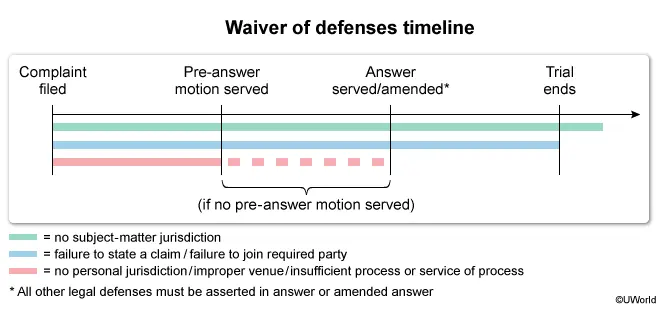
(Choice B) A challenge to subject-matter jurisdiction is never waived. However, a challenge to personal jurisdiction is waived if the defendant has voluntarily appeared in the case, unless it was a special appearance for the express purpose of objecting to personal jurisdiction.

(Choice D) An individual is a citizen of the state where he/she is domiciled—ie, physically present with the intent to remain indefinitely. Since the wife permanently moved to State B, she has established her domicile there.

Educational objective:
Federal courts cannot exercise diversity jurisdiction over cases involving probate matters or domestic relations. Instead, state courts have exclusive jurisdiction over these types of cases.

A congressional committee investigated the pharmaceutical industry and found that the high cost of prescription drugs purchased and sold in the United States negatively impacted the nation's economy and the health of its citizens. In response, Congress passed a statute that regulates "the retail prices of every purchase or sale of prescription drugs in the United States."

A group of pharmaceutical companies challenged the constitutionality of this statute in federal court.

What is the strongest argument in support of the constitutionality of this statute?

A. Congress may enact statutes for the general welfare.
B. Congress may regulate the prices of all domestic purchases and sales of goods.
C. The Constitution grants Congress the power to regulate the interstate transportation of prescription drugs.
D. The purchases and sales of prescription drugs in the United States substantially impact interstate commerce in the aggregate.

Explanation:

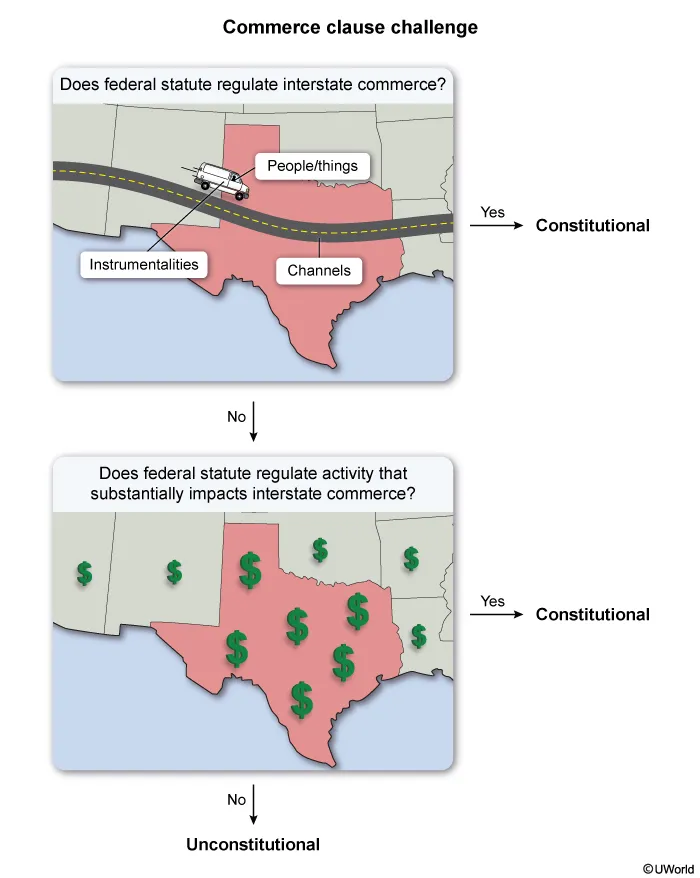
Commerce clause challenge

The commerce clause gives Congress broad power to regulate interstate and foreign commerce. This includes:

  • the channels of interstate and foreign commerce (eg, roadways)
  • the instrumentalities of interstate and foreign commerce (eg, vehicles)
  • persons and things moving in interstate or foreign commerce (eg, goods and services) and
  • in-state activities that, singly or in the aggregate, substantially impact interstate or foreign commerce.

Since Congress's commerce power is broad, federal statutes are constitutional if there is any rational basis for concluding that the regulated activity substantially affects interstate or foreign commerce. This can be shown through express congressional findings.

Here, the federal statute regulates the retail prices of prescription drugs in the United States. Congress has the authority to regulate such products' interstate transportation, but this statute also regulates in-state purchases and sales (Choice C). Since the congressional committee found that the high cost of prescription drugs negatively impacted the nation's economy, it is rational to conclude that their aggregated in-state purchases and sales substantially impact interstate commerce. Therefore, this is the strongest argument to support this statute.

(Choice A) The taxing and spending clause empowers Congress to tax and spend for the general welfare. But regulating prices is not equivalent to taxing or spending.

(Choice B) Congress cannot regulate the prices of every domestic purchase and sale of goods since it cannot regulate purely in-state sales that do not substantially affect interstate commerce.

Educational objective:
The commerce clause empowers Congress to regulate (1) channels and instrumentalities of, (2) persons and things moving in, and (3) in-state activities that—singly or in the aggregate—substantially affect interstate or foreign commerce.

The owner of a new office building contracted with a well-known landscaper to design and install landscaping around the building for $30,000. The agreement was memorialized in writing, was signed by both parties, and called for a budget of $5,000 for trees, shrubs, sod, and materials. The contract required the landscaper to complete the work within six months. Due to an unexpected increase in the price of trees and shrubs, the landscaper abandoned the project and never completed any of the work.

Three years after the landscaper's deadline, the building owner sued the landscaper for breach of contract. In the jurisdiction, the statute of limitations for breach of a services contract is two years after the breach, and the statute of limitations for breach of a sale-of-goods contract is four years.

Can the owner recover damages from the landscaper?

A. No, because the contract is divisible with respect to the services and goods, and the landscaper's breach is therefore subject to the two-year statute of limitations.
B. No, because the contract primarily calls for services, and the landscaper's breach is therefore subject to the two-year statute of limitations.
C. Yes, because the landscaper's breach was a result of an increase in the price of goods, and his breach is therefore subject to the four-year statute of limitations.
D. Yes, because the landscaper's breach was willful, and he is therefore estopped from denying that his breach is subject to the four-year statute of limitations.

Explanation:

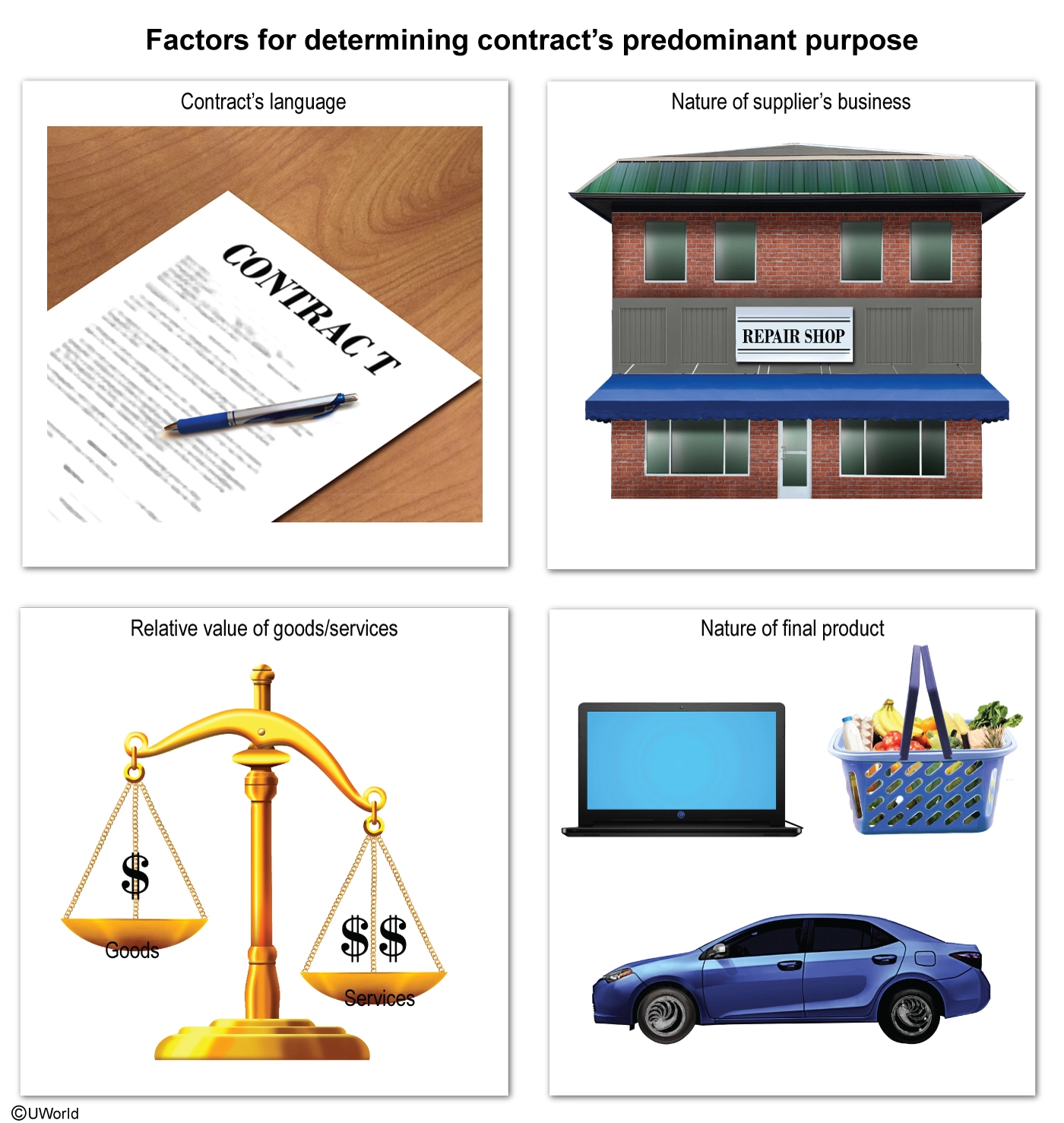
Factors for determining contract's predominant purpose

Contracts for the sale of goods are governed by Article 2 of the Uniform Commercial Code (UCC), while contracts for services are governed by common law. However, some contracts involve the sale of goods and the rendering of services. To determine which law applies to a "mixed" or "hybrid" contract, courts ask whether its predominant purpose was the sale of goods or the rendering of services. The following factors are relevant to this determination:

  • The contract's language
  • The nature of the supplier's business (ie, whether it typically provides goods or services)
  • The relative value of the goods and services
  • The nature of the final product (ie, whether it can be described as a good or service)

Here, the building owner contracted to buy goods (eg, trees, shrubs, sod) and services (ie, designing and installing the landscaping). The owner likely hired the well-known landscaper due to his skill in performing landscaping services, and the $5,000 budget for goods was just one-sixth of the $30,000 contract price. Therefore, the contract primarily calls for services and is subject to the jurisdiction's two-year statute of limitations. And since the owner sued three years after the breach, the owner cannot recover damages from the landscaper.

(Choice A) The predominant-purpose test is unnecessary when a contract is divisible—ie, when the payment for goods can easily be separated from the payment for services. But here, the contract is likely indivisible since it combined the sale of the trees, shrubs, and sod with their installation.

(Choices C & D) The predominant-purpose test focuses on the parties' reason for entering the contract—not for breaching it. Therefore, it is irrelevant that the landscaper's breach was (1) a result of an increase in the price of goods or (2) willful.

Educational objective:
Sale-of-goods contracts are governed by the UCC, while services contracts are governed by common law. When a contract calls for the sale of goods AND the rendering of services, the contract's primary purpose determines whether the UCC or common law applies.

A man and a woman dated for several weeks. During that time, the man repeatedly asked the woman to have sex. Each time, the woman responded that she would not have sex with the man unless they were married. One evening, the man promised the woman that they would elope the following weekend if she would agree to have sex. The woman agreed and the couple had sex. The following weekend, the man told the woman that he had no intention of eloping and only made that promise to get the woman's consent. The woman reported the man to the police, who later arrested and charged the man with rape.

Is the man guilty of rape?

A. No, because fraud in factum did not negate the woman's consent.
B. No, because fraud in the inducement did not negate the woman's consent.
C. Yes, because the woman's consent was obtained by fraud in factum.
D. Yes, because the woman's consent was obtained by fraud in the inducement.

Explanation:

Consent to sexual intercourse obtained by fraud
Type of fraud Definition Effect
In factum
  • Fraud pertains to nature of act—eg, doctor convinces patient that sexual act is part of medical exam
  • Victim is unaware that he/she is consenting to sexual intercourse
Negates victim's consent
In inducement
  • Fraud pertains to what victim knows is an act of sexual intercourse—eg, defendant promises marriage in exchange for sex
  • Victim is aware that he/she is consenting to sexual intercourse
Does not negate victim's consent

In most modern jurisdictions, rape is defined as sexual intercourse with another without that person's consent.* This means that rape did not occur if the victim consented to sexual intercourse. However, a victim's consent may be ineffective if it was obtained by fraud. There are two types of fraud:

  • Fraud in factum – when consent is obtained by fraud regarding the nature of the act itself, leaving the victim unaware that he/she consented to sexual intercourse and negating the victim's consent
  • Fraud in the inducement – when consent is obtained by fraud regarding what the victim knows is an act of sexual intercourse, which does not negate the victim's consent

As a result, consent obtained by fraud in factum is not a valid defense to rape, but consent obtained by fraud in the inducement is a valid defense.

Here, the man falsely promised the woman that they would elope if she agreed to have sex with him. Since the woman knew that the act to which she consented was sexual intercourse, her consent was obtained by fraud in the inducement (Choices A & C). This type of fraud did not negate the woman's consent, so the man is not guilty of rape (Choice D).

*At common law, rape was defined as (1) unlawful sexual intercourse (2) with a female who is not the defendant's wife (3) against her will by force or threat of force.

Educational objective:
Fraud in factum occurs when the fraud pertains to the nature of the act itself and negates a rape victim's consent. In contrast, fraud in the inducement occurs when fraud is used to gain consent to what the victim knows is an act of sexual intercourse and does not negate the victim's consent.

A plaintiff sued a defendant for negligence to recover damages that the plaintiff suffered as a result of a crash between the two parties. At trial, the plaintiff's attorney called the plaintiff's wife to testify as to what she witnessed on the day of the crash. On cross-examination of the wife, the defendant's lawyer elicited several responses that tended to show that the plaintiff's actions constituted contributory negligence. The plaintiff's attorney seeks to ask the wife several questions on redirect examination, but the defendant's attorney objected.

What is the strongest argument that the court must allow redirect examination of the wife?

A. The plaintiff's attorney failed to provide all significant information on direct examination.
B. The plaintiff's attorney seeks to reiterate the necessary elements of the claim.
C. The plaintiff's attorney seeks to reply to all matters raised on cross-examination.
D. The plaintiff's attorney seeks to reply to significant new matters raised on cross-examination.

Explanation:

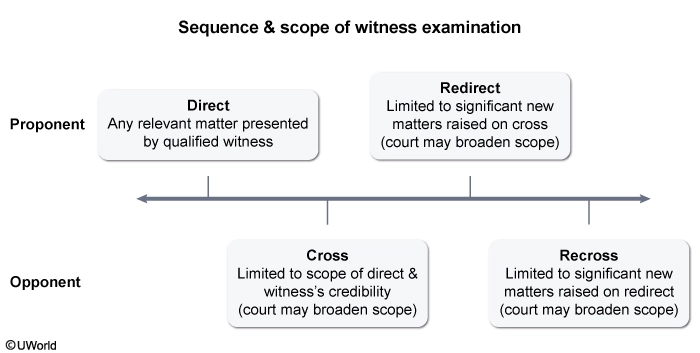
Sequence and scope of witness examination

Federal Rule of Evidence 611 gives trial courts the authority to exercise reasonable control over the mode and order of examining witnesses at trial. This includes the discretion to determine whether—and to what extent—redirect examination of witnesses should be permitted. But when a party raises a significant new matter while cross-examining a witness, the court must allow the opposing party to address that matter through redirect examination.

Therefore, the strongest argument for allowing redirect examination of the plaintiff's wife is that the plaintiff's attorney seeks to reply to significant new matters that were raised on cross-examination.

(Choice A) A party is expected to elicit all significant information during direct examination of a witness. Therefore, a court need not permit redirect examination to allow the party to provide information inadvertently omitted on direct examination.

(Choices B & C) Redirect examination is generally limited to significant new matters raised on cross-examination. Therefore, a party is not entitled to redirect examination to (1) reiterate information like the necessary elements of the claim or (2) reply to all matters addressed in cross-examination.

Educational objective:
When a party raises a significant new matter on cross-examination of a witness, the court must allow redirect examination by the opposing party to address that matter.

Twenty years ago, a man who owned a 20-acre ranch agreed to sell all of his mineral rights to his neighbor. The man executed a warranty deed conveying the mineral estate to the neighbor, who failed to record the deed.

The following year, a woman moved her mobile home onto an undeveloped five-acre portion of the man's ranch. After the woman had lived on the property for 10 years, a local drilling company began operations on a nearby tract to drill a natural gas well. Believing that the woman owned the property, the drilling company approached the woman about leasing the mineral rights on her property and requested that the woman sign a lease of her mineral rights. The woman signed the lease as requested, and it was promptly and properly recorded. The drilling operations were successful, and the drilling company prepared to distribute profits from royalties. However, a dispute arose between the neighbor and the woman, as both parties claim ownership of the minerals.

The period of time to acquire title by adverse possession in the jurisdiction is 10 years.

In an action to determine title, is the court likely to award title to the mineral estate to the woman?

A. No, because the woman actually possessed only the surface estate that had previously been severed from the mineral estate.
B. No, because the woman did not actually possess the mineral estate until she signed the lease of the mineral rights.
C. Yes, because the neighbor failed to record the warranty deed conveying the mineral estate.
D. Yes, because the woman adversely possessed both the surface estate and the mineral estate for the statutory period.

Explanation:

Adverse possession of a mineral state

An adverse possessor can acquire title to land owned by another if his/her possession of the land is:

  • Open and notorious – apparent or visible to a reasonable owner
  • Continuous – uninterrupted for the statutory period
  • Exclusive – not shared with the owner
  • Actual – physical presence on the land and
  • Nonpermissive – hostile and adverse to the owner.

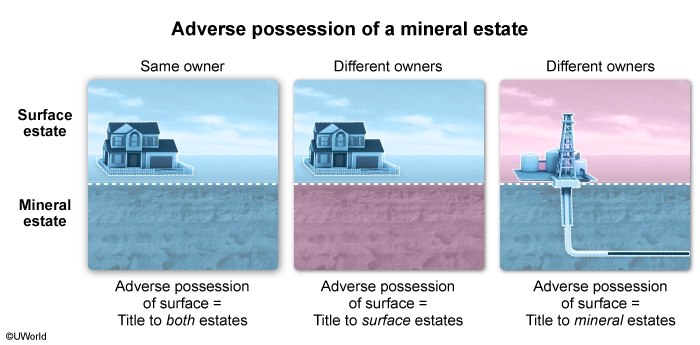
If the surface and mineral estates are owned by the same party, then the adverse possessor will acquire title to both estates—even if only one estate is actually possessed. But if the mineral estate has been severed from the surface estate (ie, the surface and mineral estates are owned by different parties), then the adverse possessor will only acquire title to the estate that is actually possessed. The mineral estate is actually possessed when the adverse possessor mines or drills wells on the land.

Here, the neighbor purchased the mineral estate from the man, thereby severing the mineral estate from the surface estate. And since the woman merely lived on the property for the 10-year statutory period—she did not attempt to mine or drill a well on the mineral estate—she actually possessed only the surface estate during that time (Choice D). This means that the woman did not adversely possess the mineral estate, and the court is not likely to award her title to that estate.

(Choice B) Adverse possession of a mineral estate requires the commencement of drilling or mining operations. Merely signing a lease of the mineral rights is not enough.

(Choice C) A deed need not be recorded to be valid, so the neighbor's failure to record has no impact on whether the woman adversely possessed the mineral estate.

Educational objective:
If a mineral estate has previously been severed from the surface estate (ie, surface and minerals owned by different persons), then an adverse possessor can only acquire title to the mineral estate by actually possessing the minerals (eg, by mining or drilling wells).

A teenager was riding a bicycle when she saw a classmate walking toward her. The teenager rode quickly toward the classmate, knowing that he would think she would run into him on her current trajectory. The teenager was not purposefully trying to harm or touch him. The classmate saw the teenager riding toward him and yelled at her to stop. The teenager swerved at the last moment and avoided hitting him. The classmate had a panic attack because he thought that the teenager would hit him.

Is the classmate likely to succeed if he sues the teenager for assault?

A. No, because the teenager did not make contact with the classmate.
B. No, because the teenager did not purposefully try to harm or touch the classmate.
C. Yes, because the teenager acted with the requisite intent.
D. Yes, because the teenager's conduct was extreme and outrageous.

Explanation

Two types of intent

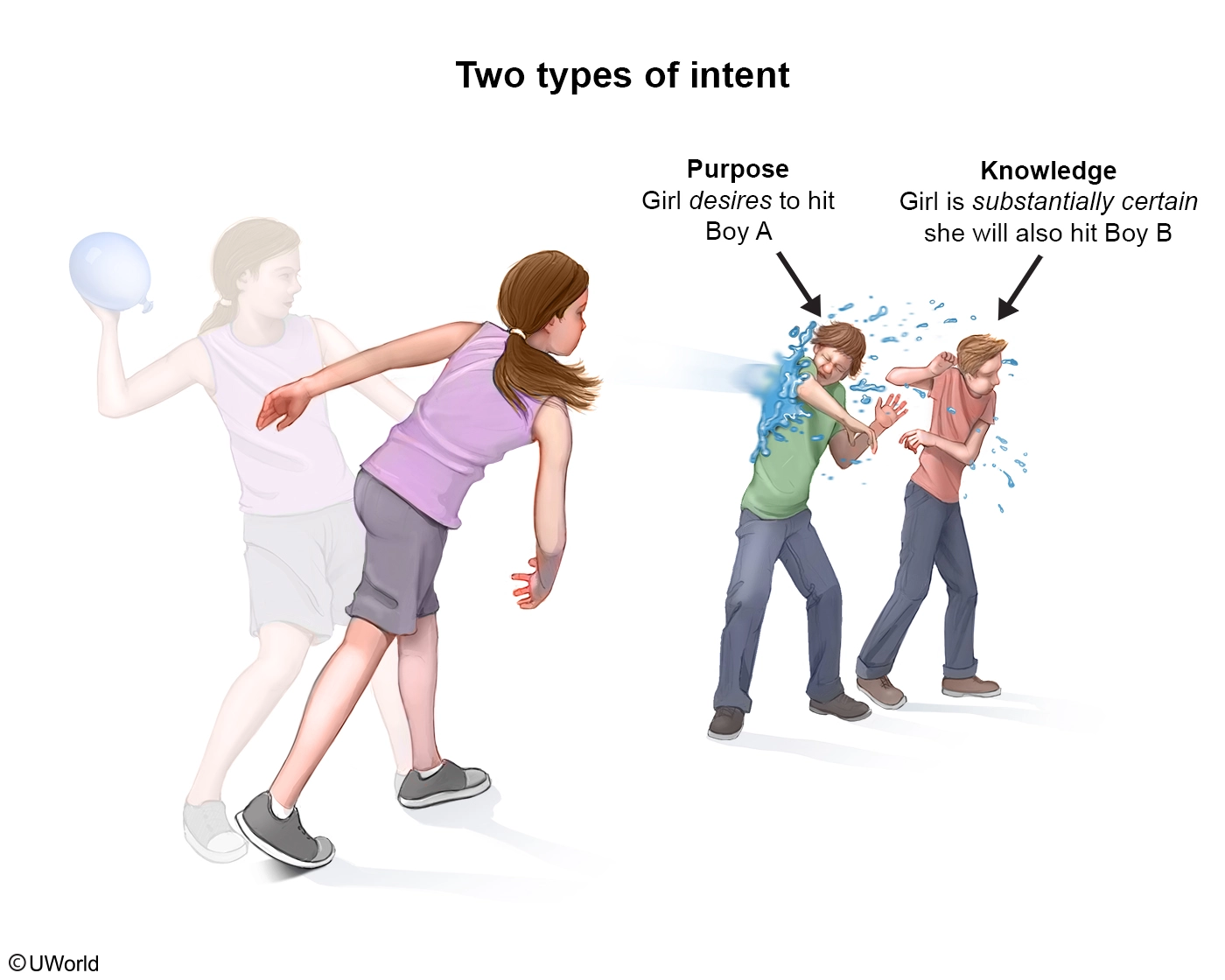
Assault occurs when (1) a defendant intends to cause the plaintiff to anticipate an imminent, and harmful or offensive, contact with the plaintiff's person and (2) the defendant's affirmative conduct causes the plaintiff to anticipate such contact.  The intent requirement is met when the defendant acts with either:

  • purpose – the desire to cause anticipation of an imminent harmful or offensive contact or
  • knowledge – the substantial certainty that the plaintiff will suffer such anticipation.

Here, the teenager rode her bicycle directly at her classmate, causing him to think that she would hit him (anticipation of imminent contact).  And since the teenager knew with substantial certainty that the classmate would think she would run into him, she acted with the requisite intent.  As a result, the classmate is likely to succeed in a suit against the teenager for assault.

(Choice A)  Assault merely requires that the plaintiff be placed in anticipation of imminent contact.  Actual bodily contact is not required.  Therefore, the fact that the teenager did not make contact with the classmate is irrelevant.

(Choice B)  The intent to make contact with the plaintiff is a requirement for battery, but assault merely requires the intent to cause the plaintiff to anticipate imminent contact.  Therefore, the fact that the teenager did not purposefully try to harm or touch the classmate does not absolve her of liability for assault.

(Choice D)  Extreme and outrageous conduct (i.e., conduct that is unacceptable in civilized society) is an element of intentional infliction of emotional distress, which only requires intentional conduct.

Educational objective:
For assault, intent exists when a defendant acts with the purpose (desire) or knowledge (substantial certainty) that his/her conduct will cause the plaintiff to anticipate an imminent, and harmful or offensive, contact.

Please select a state to continue.

Frequently Asked Questions

Yes. You can try UWorld for free with 50 sample practice questions, enough to get a feel for the question style and interface before committing to a paid subscription.

Every question and answer explanation is written by experienced legal educators and licensed attorneys. Our team focuses on high-yield, bar exam-relevant content that reflects real-world US legal concepts and practice. We continuously update our QBank to ensure it meets the highest standard of accuracy and rigor.

Our questions are aligned with the NCBE testing blueprint and mirror the style, structure, and difficulty of the actual bar exam. Whether you’re preparing for the MBE, MEE, or MPT, you won’t just be reviewing content; you’ll be building the legal reasoning skills you need for test day.

UWorld+Themis gives you more than just practice questions. You get challenging, exam-style questions, in-depth explanations for every answer choice, real-time performance tracking, high-quality visual aids, and targeted study tools. It’s everything you need to build strong legal reasoning and walk into test day with confidence.

If your subscription has been active for 180 consecutive days or more, you’re eligible for a 1-time reset. Once used, the reset cannot be applied again, even if you renew or extend your subscription.

Yes. You can access your UWorld Legal subscription on any device with an internet connection. Your progress and performance data will sync automatically across devices.

Yes. You’ll receive email reminders before your subscription expires. To ensure you receive alerts, make sure your contact information is up to date in your account settings.

No. We currently do not offer a pause or freeze option for nursing subscriptions. We recommend selecting a subscription length that fits your study timeline.

Now Featuring 200 Newly Released NCBE® Licensed Questions

Our MBE QBank features an Assessment exam with 200 recently released questions by the NCBE. This assessment is designed to simulate a full-length MBE and includes an answer key and detailed explanations for correct and incorrect answer choices.

Total QBank Questions: 1,816

Self-Assessment Questions: 400

NCBE® Licensed Questions: 1,575+

Subjects

Topics

Ready to Enroll?

Go to UWorld Checkout