

About the MPRE® | A Comprehensive Guide
The Multistate Professional Responsibility Examination (MPRE®) is not about broad legal knowledge or case law, but ethical dilemmas and professional behavior. For example, if a lawyer at your law firm does something unethical, like mishandling a client's money, are you required to report them? What happens if you don’t? The MPRE tests your ability to apply the rules of professional conduct to such real-life situations.
Read on for all the information you need to understand, register, and prepare for the MPRE.
What is the Purpose of the MPRE?
The purpose of the MPRE is to ensure an ethical standard in the legal profession by assessing a candidate's understanding and ability to apply the American Bar Association's ethical standards and mandates as outlined in the Model Rules of Professional Conduct and Model Code of Judicial Conduct.
What jurisdictions require the MPRE?
Admission to every US jurisdiction’s bar requires a passing MPRE score with the exception of Wisconsin and Puerto Rico. However, details like the minimum passing score and when that passing score must be achieved vary, so check the website of the appropriate board of bar examiners.
MPRE Subjects and Structure
Examinees have 2 hours to complete 60 multiple-choice questions, 10 of which are ungraded pilot questions for future exams. Each question includes a scenario, a question prompt, and 4 possible choices.
See MPRE Sample Test Questions.
Subjects are broken down as follows:
- Regulation of the legal profession (6-12%)
- The client lawyers relationship (10-16%)
- Client confidentiality (6-12%)
- Conflicts of interest (6-12%)
- Competence, legal malpractice, and other civil liability (6-12%)
- Litigation and other forms of advocacy (10-16%)
- Transactions and communications with persons other than clients (2-8%)
- Different roles of the lawyers (4-10%)
- Safekeeping funds and other property (2-8%)
- Communications about legal services (4-10%)
- Lawyers duties to the public and the legal system (2-4%)
- Judicial conduct (2-8%)
Check out our MPRE Outline for a deep dive into MPRE subjects.
Registration Dates, Deadlines, and Fees
The MPRE is administered 3 times a year—in March, August, and November—via computer at Pearson VUE testing centers across the country. However, seats fill up, and your preferred choice can’t be guaranteed, so schedule your appointment to test and pay the fee as soon as you can.
Also, note that not every testing center administers the MPRE. For information regarding specific testing centers, call Pearson VUE (888-205-1855) or visit their online customer service center.
Registration Process
- Create an NCBE account
- Select MPRE Registration, complete the NCBE portion, and request your “Authorization to Test”
- Check email for “Authorization to Test” from Pearson VUE (sent within 24 hours).
- Schedule your test appointment with Pearson VUE and pay the $160 test fee by 11:59 pm CT on the registration deadline
- Check email for “Confirmation of Pearson Vue Exam Appointment” and “Confirmation of Payment” from Pearson VUE
Check out our detailed guide on MPRE eligibility registration and fees.
Requesting Testing Accommodations
If you have a disability recognized under the Americans with Disabilities Act (ADA) that requires modification of the testing environment, you must request accommodations when you register for the MPRE through the NCBE. Check the Pearson Vue Comfort Aid List for items that do not require pre-approval.
You must request accommodation before you request your “Authorization to Test”. If the NCBE accepts your request, an “Accommodations Confirmation” will be posted to your NCBE Account File Cabinet. Contact MPRE Test Accommodations Services ([email protected]) if your determination has not been posted within 25 business days.
Finally, make sure that your “Authorization to Test'' email lists your approved accommodations correctly.
Registration Dates and Deadlines
| 2024 Test Dates | Apply for Accommodations by: | Registration Deadline |
|---|---|---|
| March 16 or 27 | December 5, 2023 | January 25, 2024 |
| August 13 or 14 | April 24, 2024 | June 12, 2024 |
| November 7 or 8 | July 24, 2024 | September 18, 2024 |
Registration Fees
| MPRE Fees | |
|---|---|
| Action | Fee |
| Schedule | $160 |
| Reschedule | $25 |
| Cancel | $80 refund |
MPRE Test Day Policies
Please see the up-to-date list of MPRE test day policies. Some important things to note:
- You may be prohibited from taking the exam if you arrive more than 15 minutes after your scheduled appointment time.
- You must present a government-issued primary ID and a secondary ID (e.g., credit card, library card, school ID). Both must be original, and unexpired.
- You must empty your pockets, remove jewelry and hair accessories, show your ears, roll up your sleeves, and pat yourself down before entering the testing room. Small lockers are provided to store personal items.
- There are no scheduled breaks. If you need to stretch or use the restroom, you must raise your hand and wait from the TA’s instructions. Your test time will not stop.
MPRE Scoring
The NCBE converts your raw MPRE score into a scaled score ranging from 50 to 150 via a statistical method known as equating. This ensures fairness across test versions. In other words, more difficult versions may require less correct answers to achieve the same score as an easier version.
See our detailed guide on MPRE pass rates, minimum passing scores, and grading.
How to Prepare + Free MPRE Prep Resources
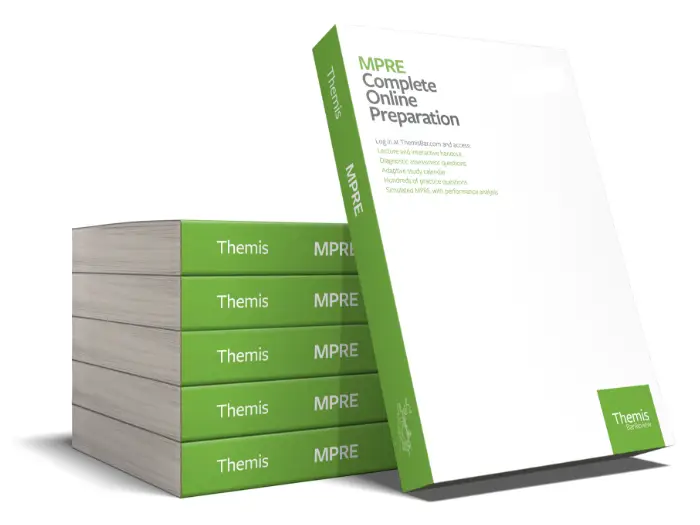
- Study with practice questions, study guides, and engaging lectures provided by Themis Bar Review’s free MPRE course.
- Review the MPRE Subject Matter Outline
- Study the Model Rules of Professional Conduct and Model Code of Judicial Conduct
- Memorize MPRE Key Words and Phrases

Frequently Asked Questions
Do you have to take the MPRE before the bar exam?
Most jurisdictions require that you pass the MPRE within a specified time frame before or after passing the bar exam. Check with your jurisdiction’s board of bar website for details.
How difficult is the MPRE?
The MPRE is not as difficult as law school exams and the bar exam. It has higher pass rates and is more straightforward. However, it certainly isn’t a walk in the park. Examinees routinely report that the MPRE is tricky due to its emphasis on the nuances of legal ethics and responsibility.
How many times can you take the MPRE?
There is no limit to the number of times you can take the MPRE.