Pennsylvania Bar Exam | The Ultimate Guide 2026-27

Planning to take the 2026 Pennsylvania Bar Exam? Learn about exam dates, costs, scores, pass rates, results, requirements, subjects, and practice questions to help you prepare.
Independence National Historic Park - Home of the Pennsylvania Bar

The Pennsylvania Bar Exam uses the Uniform Bar Examination (UBE®) format, which includes 3 components: the Multistate Bar Examination (MBE®), the Multistate Essay Examination (MEE®), and the Multistate Performance Test (MPT®).

Because Pennsylvania is a UBE jurisdiction, your score can be transferred to other participating states, allowing greater flexibility if you plan to practice law elsewhere.

This article covers everything you need to know about exam dates, deadlines, fees, pass rates, results, requirements, and more.

The Pennsylvania Bar Association has announced that it will begin administering the NextGen bar exam in July 2028.

Pennsylvania Bar Exam Structure

The Pennsylvania Bar Exam is administered on the last Tuesday and Wednesday of February and July, with approximately 6 hours of testing each day.

Pennsylvania 2026 Bar Exam Structure
Tuesday Wednesday
Morning
(3-hour session)
2 MPTs 100 MBE multiple-choice questions
Afternoon
(3-hour session)
6 essay questions 100 MBE multiple-choice questions

Pennsylvania Bar Exam Subjects and Topics

The Pennsylvania Bar Exam tests an examinee's ability to analyze and reason alongside their knowledge and understanding of fundamental legal principles. Furthermore, since Pennsylvania has adopted the UBE, a successful exam score represents one's competency and readiness to practice law in the other participating jurisdictions.

Multistate Essay Exam (MEE)

The MEE consists of 6 essay questions. Each question involves 1 or more of the subjects listed below. Some subjects may be paired together. Other subjects could be omitted. While it's impossible to know which subjects the National Conference of Bar Examiners (NCBE®) will choose on any given exam version, some have been tested more frequently than others, historically.

For example, Civil Procedure has appeared on nearly every MEE in the past decade, while Criminal Law has only appeared several times. However, subjects that occur less frequently on their own may be paired with others.

  • Business Associations
  • Civil Procedure
  • Conflict of Laws
  • Constitutional Law
  • Contracts
  • Criminal Law and Procedure
  • Evidence
  • Family Law
  • Real Property
  • Secured Transactions
  • Torts
  • Trusts and Estates

Check out our MEE Subject Matter Outline for detailed explanations of MEE subjects and sub-topics.

Learn More

Multistate Bar Exam (MBE)

The MBE tests the following subjects across 2 100-question sessions:

  • Constitutional Law
  • Contracts/Sales
  • Criminal Law/Procedure
  • Evidence
  • Federal Civil Procedure
  • Real Property
  • Torts

You may find a complete list of subjects and subtopics here: MBE Subject Matter Outline.

Learn More

Multistate Performance Test (MPT)

The Pennsylvania Bar Exam tests applicants with 2 90-minute performance legal case scenarios, challenging them to determine the correct course of action an attorney should take in response to the case details. The questions will provide detailed instructions, factual data, statutes, and other references to assess your ability to use legal analysis to distinguish between relevant and irrelevant case facts. In a nutshell, the MPT assesses your ability to think like a lawyer.

Learn More

UWorld MBE Sample Questions

Quality speaks for itself. Try some of our free MBE sample questions below.

Select a Question sample.

Select a Question sample.

A husband and wife were married in State A and lived there for 10 years before separating. One month later, the wife permanently moved to State B and immediately filed for divorce in a federal court in State B. The wife claims that she is entitled to $300,000 in alimony. The husband appeared in the action and has filed a motion to dismiss for lack of subject-matter jurisdiction.

Should the court grant the motion?

  1. No, because the court has diversity jurisdiction over the case.
  2. No, because the husband waived a subject-matter jurisdiction challenge by appearing in the case.
  3. Yes, because state courts have exclusive jurisdiction over this type of action.
  4. Yes, because the wife did not establish a domicile in State B.
Submit Next Question

Explanation:

Federal diversity jurisdiction exceptions

Federal courts cannot exercise diversity jurisdiction over cases involving:

  • probate matters (eg, authenticating wills, administering estates) or
  • domestic relations (eg, issuing divorce, alimony, or child-custody decrees)

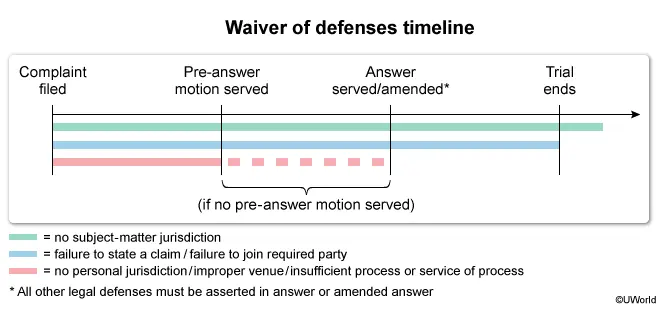
A federal court must possess subject-matter jurisdiction to hear the merits of a case before it. Subject-matter jurisdiction can be established through either:

  • federal-question jurisdiction – when a claim arises under the U.S. Constitution, a treaty, or federal law (not seen here) or
  • diversity jurisdiction – when the amount in controversy exceeds $75,000 and the opposing parties are citizens of different states.

Here, diversity jurisdiction is established since the wife claims that she is entitled to $300,000 and the parties are citizens of different states (States A and B). However, federal courts cannot exercise diversity jurisdiction over cases involving probate matters or domestic relations. Instead, state courts have exclusive jurisdiction over these types of actions (Choice A).* Therefore, the husband's motion to dismiss should be granted.

*The probate and domestic-relations exceptions exist because states have a strong interest in these substantive areas and are more qualified to deal with the constant judicial involvement these types of cases require.

(Choice B) A challenge to subject-matter jurisdiction is never waived. However, a challenge to personal jurisdiction is waived if the defendant has voluntarily appeared in the case, unless it was a special appearance for the express purpose of objecting to personal jurisdiction.

(Choice D) An individual is a citizen of the state where he/she is domiciled—ie, physically present with the intent to remain indefinitely. Since the wife permanently moved to State B, she has established her domicile there.

Educational objective:
Federal courts cannot exercise diversity jurisdiction over cases involving probate matters or domestic relations. Instead, state courts have exclusive jurisdiction over these types of cases.

Bluebook Citations :

  • Ankenbrandt v. Richards, 504 U.S. 689, 703–04 (1992) (explaining the domestic-relations exception to diversity jurisdiction).

A congressional committee investigated the pharmaceutical industry and found that the high cost of prescription drugs purchased and sold in the United States negatively impacted the nation's economy and the health of its citizens. In response, Congress passed a statute that regulates "the retail prices of every purchase or sale of prescription drugs in the United States."

A group of pharmaceutical companies challenged the constitutionality of this statute in federal court.

What is the strongest argument in support of the constitutionality of this statute?

  1. Congress may enact statutes for the general welfare.
  2. Congress may regulate the prices of all domestic purchases and sales of goods.
  3. The Constitution grants Congress the power to regulate the interstate transportation of prescription drugs.
  4. The purchases and sales of prescription drugs in the United States substantially impact interstate commerce in the aggregate.
Submit Next Question

Explanation:

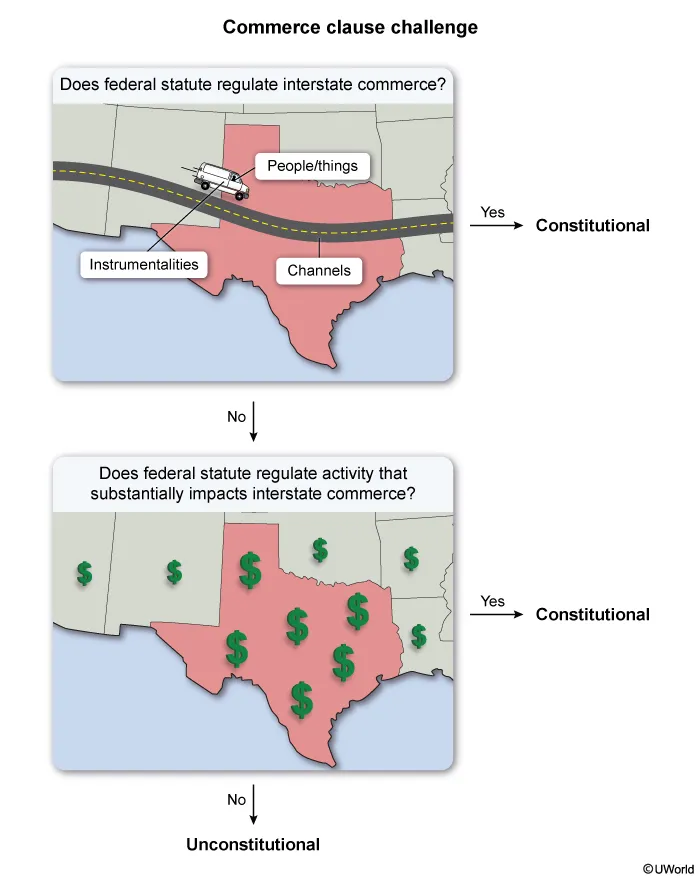
Commerce clause challenge

The commerce clause gives Congress broad power to regulate interstate and foreign commerce. This includes:

  • the channels of interstate and foreign commerce (eg, roadways)
  • the instrumentalities of interstate and foreign commerce (eg, vehicles)
  • persons and things moving in interstate or foreign commerce (eg, goods and services) and
  • in-state activities that, singly or in the aggregate, substantially impact interstate or foreign commerce.

Since Congress's commerce power is broad, federal statutes are constitutional if there is any rational basis for concluding that the regulated activity substantially affects interstate or foreign commerce. This can be shown through express congressional findings.

Here, the federal statute regulates the retail prices of prescription drugs in the United States. Congress has the authority to regulate such products' interstate transportation, but this statute also regulates in-state purchases and sales (Choice C). Since the congressional committee found that the high cost of prescription drugs negatively impacted the nation's economy, it is rational to conclude that their aggregated in-state purchases and sales substantially impact interstate commerce. Therefore, this is the strongest argument to support this statute.

(Choice A) The taxing and spending clause empowers Congress to tax and spend for the general welfare. But regulating prices is not equivalent to taxing or spending.

(Choice B) Congress cannot regulate the prices of every domestic purchase and sale of goods since it cannot regulate purely in-state sales that do not substantially affect interstate commerce.

Educational objective:
The commerce clause empowers Congress to regulate (1) channels and instrumentalities of, (2) persons and things moving in, and (3) in-state activities that—singly or in the aggregate—substantially affect interstate or foreign commerce.

Bluebook Citations :

  • Gonzales v. Raich, 545 U.S. 1, 17 (2005) (explaining Congress's broad authority under the commerce clause).

The owner of a new office building contracted with a well-known landscaper to design and install landscaping around the building for $30,000. The agreement was memorialized in writing, was signed by both parties, and called for a budget of $5,000 for trees, shrubs, sod, and materials. The contract required the landscaper to complete the work within six months. Due to an unexpected increase in the price of trees and shrubs, the landscaper abandoned the project and never completed any of the work.

Three years after the landscaper's deadline, the building owner sued the landscaper for breach of contract. In the jurisdiction, the statute of limitations for breach of a services contract is two years after the breach, and the statute of limitations for breach of a sale-of-goods contract is four years.

Can the owner recover damages from the landscaper?

  1. No, because the contract is divisible with respect to the services and goods, and the landscaper's breach is therefore subject to the two-year statute of limitations.
  2. No, because the contract primarily calls for services, and the landscaper's breach is therefore subject to the two-year statute of limitations.
  3. Yes, because the landscaper's breach was a result of an increase in the price of goods, and his breach is therefore subject to the four-year statute of limitations.
  4. Yes, because the landscaper's breach was willful, and he is therefore estopped from denying that his breach is subject to the four-year statute of limitations.
Submit Next Question

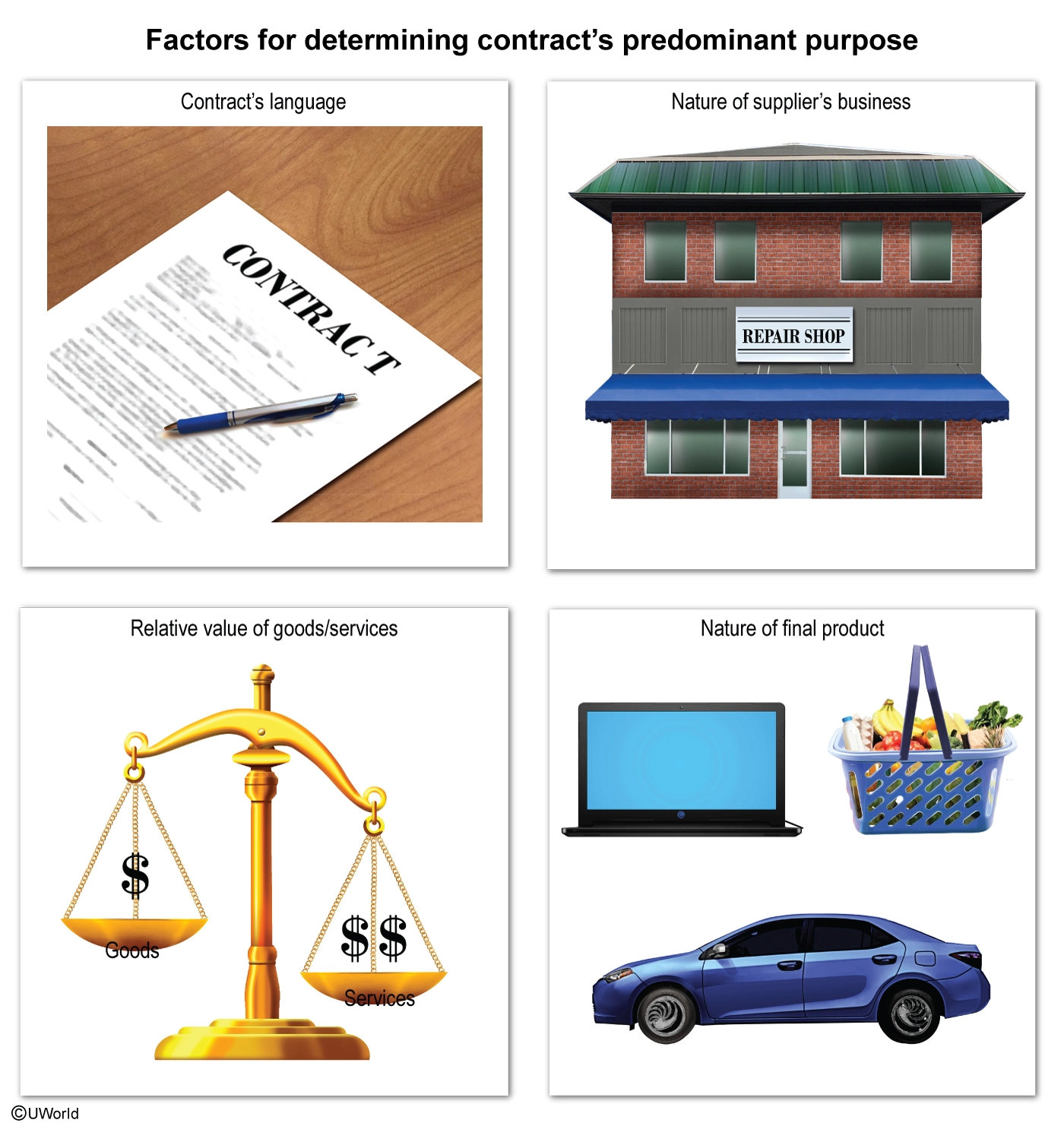
Factors for determining contract's predominant purpose

Contracts for the sale of goods are governed by Article 2 of the Uniform Commercial Code (UCC), while contracts for services are governed by common law. However, some contracts involve the sale of goods and the rendering of services. To determine which law applies to a "mixed" or "hybrid" contract, courts ask whether its predominant purpose was the sale of goods or the rendering of services. The following factors are relevant to this determination:

  • The contract's language
  • The nature of the supplier's business (ie, whether it typically provides goods or services)
  • The relative value of the goods and services
  • The nature of the final product (ie, whether it can be described as a good or service)

Here, the building owner contracted to buy goods (eg, trees, shrubs, sod) and services (ie, designing and installing the landscaping). The owner likely hired the well-known landscaper due to his skill in performing landscaping services, and the $5,000 budget for goods was just one-sixth of the $30,000 contract price. Therefore, the contract primarily calls for services and is subject to the jurisdiction's two-year statute of limitations. And since the owner sued three years after the breach, the owner cannot recover damages from the landscaper.

(Choice A) The predominant-purpose test is unnecessary when a contract is divisible—ie, when the payment for goods can easily be separated from the payment for services. But here, the contract is likely indivisible since it combined the sale of the trees, shrubs, and sod with their installation.

(Choices C & D) The predominant-purpose test focuses on the parties' reason for entering the contract—not for breaching it. Therefore, it is irrelevant that the landscaper's breach was (1) a result of an increase in the price of goods or (2) willful.

Educational objective:
Sale-of-goods contracts are governed by the UCC, while services contracts are governed by common law. When a contract calls for the sale of goods AND the rendering of services, the contract's primary purpose determines whether the UCC or common law applies.

Bluebook Citations :

  • Bonebrake v. Cox, 499 F.2d 951, 960 (8th Cir. 1974) (applying the predominant-purpose test to determine which statute of limitations applies to a mixed contract for goods and services).
  • Princess Cruises, Inc. v. Gen. Elec. Co., 143 F.3d 828, 833 (4th Cir. 1998) (listing factors that courts consider when applying the predominant-purpose test).

A man and a woman dated for several weeks. During that time, the man repeatedly asked the woman to have sex. Each time, the woman responded that she would not have sex with the man unless they were married. One evening, the man promised the woman that they would elope the following weekend if she would agree to have sex. The woman agreed and the couple had sex. The following weekend, the man told the woman that he had no intention of eloping and only made that promise to get the woman's consent. The woman reported the man to the police, who later arrested and charged the man with rape.

Is the man guilty of rape?

  1. No, because fraud in factum did not negate the woman's consent.
  2. No, because fraud in the inducement did not negate the woman's consent.
  3. Yes, because the woman's consent was obtained by fraud in factum.
  4. Yes, because the woman's consent was obtained by fraud in the inducement.
Submit Next Question

Explanation:

Consent to sexual intercourse obtained by fraud
Type of fraud Definition Effect
In factum
  • Fraud pertains to nature of act—eg, doctor convinces patient that sexual act is part of medical exam
  • Victim is unaware that he/she is consenting to sexual intercourse
Negates victim's consent
In inducement
  • Fraud pertains to what victim knows is an act of sexual intercourse—eg, defendant promises marriage in exchange for sex
  • Victim is aware that he/she is consenting to sexual intercourse
Does not negate victim's consent

In most modern jurisdictions, rape is defined as sexual intercourse with another without that person's consent.* This means that rape did not occur if the victim consented to sexual intercourse. However, a victim's consent may be ineffective if it was obtained by fraud. There are two types of fraud:

  • Fraud in factum – when consent is obtained by fraud regarding the nature of the act itself, leaving the victim unaware that he/she consented to sexual intercourse and negating the victim's consent
  • Fraud in the inducement – when consent is obtained by fraud regarding what the victim knows is an act of sexual intercourse, which does not negate the victim's consent

As a result, consent obtained by fraud in factum is not a valid defense to rape, but consent obtained by fraud in the inducement is a valid defense.

Here, the man falsely promised the woman that they would elope if she agreed to have sex with him. Since the woman knew that the act to which she consented was sexual intercourse, her consent was obtained by fraud in the inducement (Choices A & C). This type of fraud did not negate the woman's consent, so the man is not guilty of rape (Choice D).

*At common law, rape was defined as (1) unlawful sexual intercourse (2) with a female who is not the defendant's wife (3) against her will by force or threat of force.

Educational objective:
Fraud in factum occurs when the fraud pertains to the nature of the act itself and negates a rape victim's consent. In contrast, fraud in the inducement occurs when fraud is used to gain consent to what the victim knows is an act of sexual intercourse and does not negate the victim's consent.

A plaintiff sued a defendant for negligence to recover damages that the plaintiff suffered as a result of a crash between the two parties. At trial, the plaintiff's attorney called the plaintiff's wife to testify as to what she witnessed on the day of the crash. On cross-examination of the wife, the defendant's lawyer elicited several responses that tended to show that the plaintiff's actions constituted contributory negligence. The plaintiff's attorney seeks to ask the wife several questions on redirect examination, but the defendant's attorney objected.

What is the strongest argument that the court must allow redirect examination of the wife?

  1. The plaintiff's attorney failed to provide all significant information on direct examination.
  2. The plaintiff's attorney seeks to reiterate the necessary elements of the claim.
  3. The plaintiff's attorney seeks to reply to all matters raised on cross-examination.
  4. The plaintiff's attorney seeks to reply to significant new matters raised on cross-examination.
Submit Next Question

Explanation:

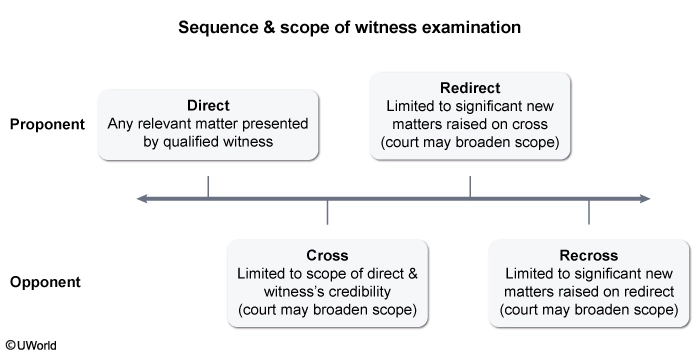
Sequence and scope of witness examination

Federal Rule of Evidence 611 gives trial courts the authority to exercise reasonable control over the mode and order of examining witnesses at trial. This includes the discretion to determine whether—and to what extent—redirect examination of witnesses should be permitted. But when a party raises a significant new matter while cross-examining a witness, the court must allow the opposing party to address that matter through redirect examination.

Therefore, the strongest argument for allowing redirect examination of the plaintiff's wife is that the plaintiff's attorney seeks to reply to significant new matters that were raised on cross-examination.

(Choice A) A party is expected to elicit all significant information during direct examination of a witness. Therefore, a court need not permit redirect examination to allow the party to provide information inadvertently omitted on direct examination.

(Choices B & C) Redirect examination is generally limited to significant new matters raised on cross-examination. Therefore, a party is not entitled to redirect examination to (1) reiterate information like the necessary elements of the claim or (2) reply to all matters addressed in cross-examination.

Educational objective:
When a party raises a significant new matter on cross-examination of a witness, the court must allow redirect examination by the opposing party to address that matter.

Bluebook Citations :

  • Fed. R. Evid. 611 (explaining the mode and order of examining witnesses).

Twenty years ago, a man who owned a 20-acre ranch agreed to sell all of his mineral rights to his neighbor. The man executed a warranty deed conveying the mineral estate to the neighbor, who failed to record the deed.

The following year, a woman moved her mobile home onto an undeveloped five-acre portion of the man's ranch. After the woman had lived on the property for 10 years, a local drilling company began operations on a nearby tract to drill a natural gas well. Believing that the woman owned the property, the drilling company approached the woman about leasing the mineral rights on her property and requested that the woman sign a lease of her mineral rights. The woman signed the lease as requested, and it was promptly and properly recorded. The drilling operations were successful, and the drilling company prepared to distribute profits from royalties. However, a dispute arose between the neighbor and the woman, as both parties claim ownership of the minerals.

The period of time to acquire title by adverse possession in the jurisdiction is 10 years.

In an action to determine title, is the court likely to award title to the mineral estate to the woman?

  1. No, because the woman actually possessed only the surface estate that had previously been severed from the mineral estate.
  2. No, because the woman did not actually possess the mineral estate until she signed the lease of the mineral rights.
  3. Yes, because the neighbor failed to record the warranty deed conveying the mineral estate.
  4. Yes, because the woman adversely possessed both the surface estate and the mineral estate for the statutory period.
Submit Next Question

Explanation:

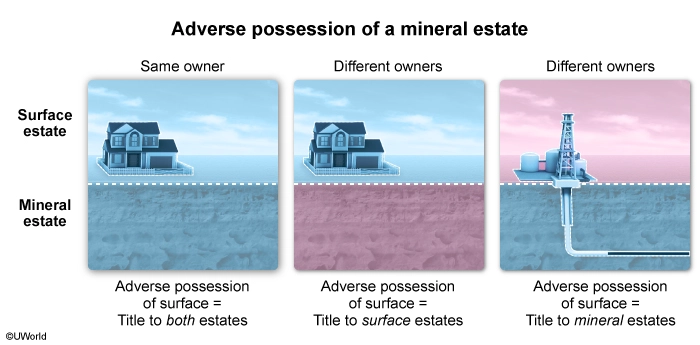
Adverse possession of a mineral state

An adverse possessor can acquire title to land owned by another if his/her possession of the land is:

  • Open and notorious – apparent or visible to a reasonable owner
  • Continuous – uninterrupted for the statutory period
  • Exclusive – not shared with the owner
  • Actual – physical presence on the land and
  • Nonpermissive – hostile and adverse to the owner.

If the surface and mineral estates are owned by the same party, then the adverse possessor will acquire title to both estates—even if only one estate is actually possessed. But if the mineral estate has been severed from the surface estate (ie, the surface and mineral estates are owned by different parties), then the adverse possessor will only acquire title to the estate that is actually possessed. The mineral estate is actually possessed when the adverse possessor mines or drills wells on the land.

Here, the neighbor purchased the mineral estate from the man, thereby severing the mineral estate from the surface estate. And since the woman merely lived on the property for the 10-year statutory period—she did not attempt to mine or drill a well on the mineral estate—she actually possessed only the surface estate during that time (Choice D). This means that the woman did not adversely possess the mineral estate, and the court is not likely to award her title to that estate.

(Choice B) Adverse possession of a mineral estate requires the commencement of drilling or mining operations. Merely signing a lease of the mineral rights is not enough.

(Choice C) A deed need not be recorded to be valid, so the neighbor's failure to record has no impact on whether the woman adversely possessed the mineral estate.

Educational objective:
If a mineral estate has previously been severed from the surface estate (ie, surface and minerals owned by different persons), then an adverse possessor can only acquire title to the mineral estate by actually possessing the minerals (eg, by mining or drilling wells).

A teenager was riding a bicycle when she saw a classmate walking toward her. The teenager rode quickly toward the classmate, knowing that he would think she would run into him on her current trajectory. The teenager was not purposefully trying to harm or touch him. The classmate saw the teenager riding toward him and yelled at her to stop. The teenager swerved at the last moment and avoided hitting him. The classmate had a panic attack because he thought that the teenager would hit him.

Is the classmate likely to succeed if he sues the teenager for assault?

  1. No, because the teenager did not make contact with the classmate.
  2. No, because the teenager did not purposefully try to harm or touch the classmate.
  3. Yes, because the teenager acted with the requisite intent.
  4. Yes, because the teenager's conduct was extreme and outrageous.
Submit

Explanation:

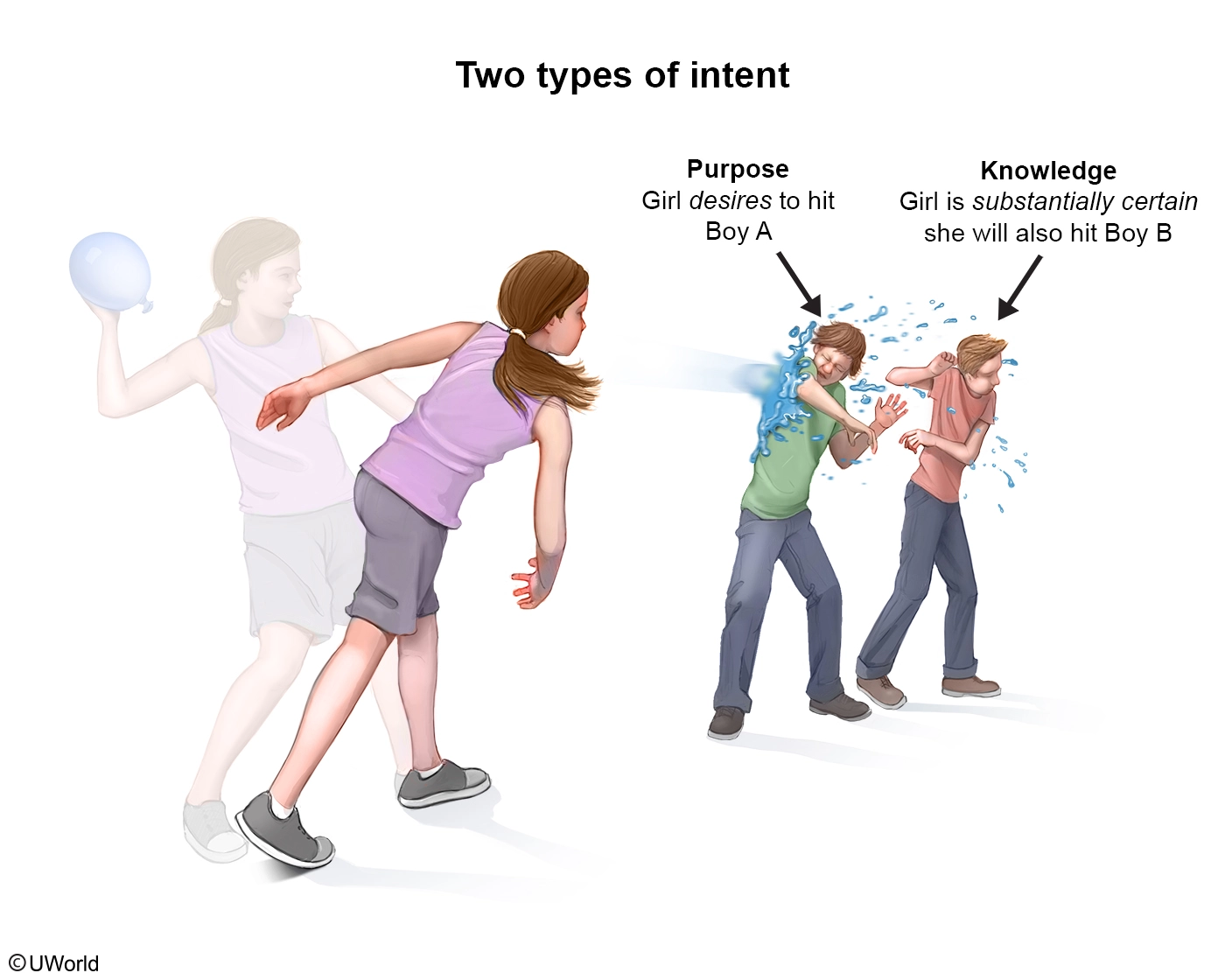
Two types of intent

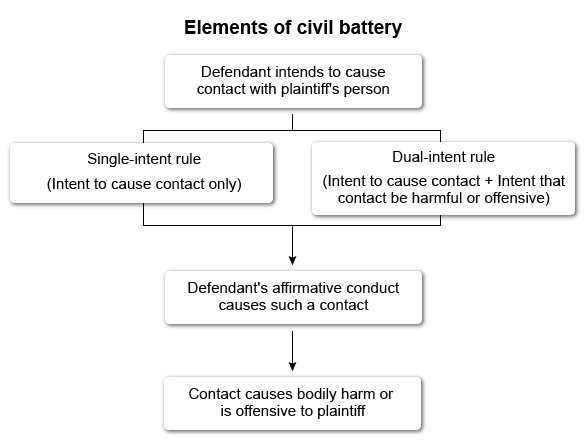
Assault occurs when (1) a defendant intends to cause the plaintiff to anticipate an imminent, and harmful or offensive, contact with the plaintiff's person and (2) the defendant's affirmative conduct causes the plaintiff to anticipate such contact. The intent requirement is met when the defendant acts with either:

  • purpose – the desire to cause anticipation of an imminent harmful or offensive contact or
  • knowledge – the substantial certainty that the plaintiff will suffer such anticipation.

Here, the teenager rode her bicycle directly at her classmate, causing him to think that she would hit him (anticipation of imminent contact). And since the teenager knew with substantial certainty that the classmate would think she would run into him, she acted with the requisite intent. As a result, the classmate is likely to succeed in a suit against the teenager for assault.

(Choice A) Assault merely requires that the plaintiff be placed in anticipation of imminent contact. Actual bodily contact is not required. Therefore, the fact that the teenager did not make contact with the classmate is irrelevant.

(Choice B) The intent to make contact with the plaintiff is a requirement for battery, but assault merely requires the intent to cause the plaintiff to anticipate imminent contact. Therefore, the fact that the teenager did not purposefully try to harm or touch the classmate does not absolve her of liability for assault.

(Choice D) Extreme and outrageous conduct (i.e., conduct that is unacceptable in civilized society) is an element of intentional infliction of emotional distress—not assault, which only requires intentional conduct.

Educational objective:
For assault, intent exists when a defendant acts with the purpose (desire) or knowledge (substantial certainty) that his/her conduct will cause the plaintiff to anticipate an imminent, and harmful or offensive, contact.

Bluebook Citations :
  • Restatement (Third) of Torts: Intentional Torts to Persons § 105 (Am. L. Inst., Tentative Draft No. 1, 2015) (providing the elements for assault).

Take a look at a typical competitor sample question. Their practice questions might parody the exam, but ours consistently meet or exceed exam-level difficulty. Their limited explanations address the correct answer choice but do not go the extra mile to explain the incorrect choices, so you don’t make the same mistakes on exam day.

A mother gave her land to her 2 kids, a son and a daughter, as joint tenants. The son built 2 adjoining homes on the land. He lived in 1 house and rented the other. The daughter lived out of the country and never visited the land. The daughter needed money, so she sold her interest in the land to her ex-boyfriend. Her ex-boyfriend immediately hired a developer to build a 3rd home on the land. Soon after the daughter had sold her interest in the land, she was killed in a motorcycle accident. The ex-boyfriend is now asking the court for a judicial partition of the land. The son contends that upon his sister’s death, he was now the sole owner of the land.

How should the court rule?

  1. For the ex-boyfriend, because he plans to live on the land.
  2. For the ex-boyfriend, because he paid for the son’s interest in the land.
  3. For the son, because he has the right of survivorship.
  4. For the son, because he has the sole position of the land.
Submit

Explanation:

Correct answer: B

Pennsylvania Bar Exam Requirements

Submitting your Pennsylvania Bar Exam application before the first filing deadline can save you significant late fees. Applications typically open Sept. 1 for the February exam and Jan. 3 for the July exam.

Law School Students

To sit for the Pennsylvania Bar Exam, you must have earned a Juris Doctorate (JD) or Bachelor of Laws (LLB) from a law school that was accredited by the American Bar Association (ABA) at the time you enrolled or graduated. Applicants who graduated from a U.S. law school that was not ABA-accredited may still qualify to take the Pennsylvania Bar Exam under Rule 203(ii) if they are licensed to practice law in another U.S. jurisdiction and meet the additional requirements established by the Pennsylvania Board of Law Examiners. The board will evaluate applicants' educational background, professional experience, and standing in other jurisdictions to determine eligibility.

Foreign Lawyers and Students

Foreign-trained lawyers and graduates of foreign law schools may be eligible to sit for the Pennsylvania Bar Exam under Rule 205 - Admission of Foreign Attorneys and Graduates of Foreign Institutions. To qualify, applicants must have completed a law degree from a foreign law school whose curriculum includes instruction in the principles of English Common Law. They must also demonstrate that their education meets the substantial equivalency standards of the Pennsylvania Board of Law Examiners. In addition, applicants must either complete 1 year of study at an ABA-accredited law school, including at least 1 course in U.S. Constitutional Law and 1 in U.S. Civil Procedure, or be a member in good standing of the bar of a U.S. jurisdiction and have been admitted by written examination.

Admission on Motion (Reciprocity)

To be eligible for admission to the Pennsylvania Bar without examination (i.e., Admission by Reciprocity), you must:

  • Be a member in good standing of the bar of a reciprocal U.S. jurisdiction.
  • Have actively practiced law for 5 of the 7 years immediately preceding your application.
  • Hold a JD or LLB from an ABA-accredited law school.
  • Submit a Certificate of Good Standing from each jurisdiction where you are admitted (issued within the past 6 months).
  • Undergo a character and fitness review by the Pennsylvania Board of Law Examiners (processing may take up to 4 months).
  • Have achieved a scaled score of 75 or higher on the Multistate Professional Responsibility Examination (MPRE®).

Scheduling

To apply for the Pennsylvania Bar Exam, you must:

Pennsylvania Bar 2026 Exam Deadlines, Fees, and Cost-Saving Options

Each of Pennsylvania's 3 late filing deadlines triggers higher and higher late fees. If you apply to take the Pennsylvania Bar Exam, we recommend submitting your application early, as it costs nearly 3 times as much to file during the final period.

Exam Dates and Deadlines

The 1st filing deadline for the February 2026 Pennsylvania State Bar Exam is Oct. 30, 2025, with the final deadlines on Nov. 15, Nov. 30, and Dec. 15. Applicants must pay a filing fee of $650.

Filing Periods Feb. 24-25, 2026
First Deadline Oct. 30, 2025
Final Deadline Nov. 15 / Nov. 30 / Dec. 15, 2025

Fees

Pennsylvania Bar Exam Application Fees
Timely Application $750
Late Application $1,075
Final Application $1,400
Other Application Fees
Admission by Bar Examination Score Transfer $650
Application for Admission by Reciprocity $1,325
Supplemental Application for Character and Fitness Determination $325
Miscellaneous Fees
Computer-Based Testing (CBT) Varies (dependent on deadline)
MBE Score Transfer $30
Miscellaneous Certification of Documents/Requests $30
Copy of Completed Application or Data Sheet $30
Corrective Certificate (after results release) $50
Duplicate Bar Examination Results Packet $30

Payment Policies

Certified checks, corporate checks, cashier's checks, and money orders must be made payable to the Pennsylvania Board of Law Examiners. Otherwise, applicants must pay fees via credit card upon online filing. Payments are non-refundable and non-transferable.

Cost-Saving Options

Bar exam costs can quickly add up. Scholarships and grants are available to help reduce the financial burden of pursuing a legal license.

Many Pennsylvania area organizations, including universities, foundations, and law firms, offer law students in the region various scholarships and grants to help with legal education and bar exam costs. For example, The Pennsylvania Bar Foundation annually provides several scholarships and grants to Pennsylvania law students.

Temple University's Beasley School of Law has compiled a list of scholarships and grants: Outside Scholarships Temple Law.

Pennsylvania Bar Exam Scoring and Grading

To be admitted into the Pennsylvania Bar, applicants must pass the UBE with a minimum scaled score of 270 out of 400. Exam weightage is divided between the 3 sections as follows:

  • MBE - 50%
  • MEE - 30%
  • MPT - 20%

The MEE and MPT together make up 50% of your total score, while the MBE accounts for the remaining 50%. This means that strong performance in 1 section can help offset weaker performance in another, as long as the combined scaled score reaches 270 or higher.

Scores are scaled and equated to ensure fairness across different exam administrations. This statistical process adjusts for variations in exam difficulty, so your performance is measured consistently with other test periods.

Pennsylvania Bar Exam Pass Rates

As is typical with bar exams nationwide, the Pennsylvania Bar Exam's repeater pass rate is markedly lower than the first-timer pass rate. This phenomenon is likely because many examinees who failed the first time haven't changed their study habits significantly.

Exam Overall Pass Rate First-Timer Pass Rate Repeater Pass Rate Results Release Date
July 2025 77% 82% 41% Oct. 10, 2025
February 2025 38% 57% 27% April 11, 2025

Below are the annual pass rates for the Pennsylvania Bar Exam since 2017 divided into first-time examinees and repeaters:

Additional Pennsylvania Bar Requirements

You must meet additional requirements to obtain and maintain licensure beyond passing the Pennsylvania Bar Exam. These include passing the Multistate Professional Responsibility Examination (MPRE®) and satisfying the Character and Fitness standards established by the Pennsylvania Board of Law Examiners.

MPRE Requirements

The MPRE is a 2-hour exam consisting of 60 multiple-choice questions that test your knowledge and understanding of the ABA Model Rules of Professional Conduct.

You must achieve a scaled score of 75 or higher on the MPRE to qualify for admission to the Pennsylvania Bar. Your MPRE score must be earned within 4 years before or after the date you file your bar exam application.

You can register for the MPRE through the NCBE. MPRE scores must be transmitted directly from the NCBE to the Pennsylvania Board of Law Examiners. Scores submitted by applicants will not be accepted.

Learn More

Character and Fitness Requirements

After passing the Pennsylvania Bar Exam, all applicants must meet the character and fitness requirements set by the Pennsylvania Board of Law Examiners.

You'll need to complete a detailed Character and Fitness Questionnaire that discloses your educational background, employment history, financial responsibility, criminal record (if any), and other relevant personal conduct. The Board will evaluate your honesty, trustworthiness, diligence, and reliability to determine your fitness to practice law in the Commonwealth of Pennsylvania.

Approval of your Character and Fitness evaluation is required before you can be admitted to the Pennsylvania Bar. The review process can take several months, so applicants are encouraged to submit all documentation promptly.

Pennsylvania Bar Association Contact Information

The Pennsylvania Supreme Court answers calls 9 a.m. to 4 p.m., Monday through Friday, except for state and federal holidays.

Pennsylvania Board of Bar Examiners Contact Information
Medium Info
Phone Number 717-231-3350
Fax Number 717-231-3350
Email [email protected]
Address Pennsylvania Board of Law Examiners
Pennsylvania Judicial Center
601 Commonwealth Ave., Suite 3600
Harrisburg, PA 17120-0901

Frequently Asked Questions

The Pennsylvania Bar Exam lasts 2 days, with the MEE and MPT lasting 3 hours each on day 1, and the MBE lasting 6 hours on day 2.

To take the Pennsylvania Bar Exam, applicants must have completed 24 hours on the campus of a U.S. law school accredited by the ABA.

The Pennsylvania Bar Exam is as challenging as the jurisdictions that use the 3 UBE components.

Pennsylvania does not have a set limit on how many times you can take the bar exam, so if you fail the exam on your first attempt, you should revise your strategy and strive to do better the next time.

The filing deadline for the Pennsylvania February 2026 Bar Exam is Oct. 30, 2025, with subsequent late filing deadlines Nov. 15, Nov. 30, and Dec. 15, 2025. The base application fee is $650, but additional late fees apply as each deadline passes. Applicants are encouraged to submit their applications early through the Pennsylvania Board of Law Examiners’ online portal to avoid late penalties.

The Pennsylvania Bar exam is offered biannually, once in February, and again in July.

No, you cannot practice law in Pennsylvania without a Juris Doctorate. 

It takes approximately 400 hours to study for the Pennsylvania Bar Exam. Most students begin studying 8-10 weeks before the exam. However, beginning sooner can increase retention and decrease burnout, so we recommend starting as early as 4-6 months before the exam.

You must graduate from an ABA-approved law school, pass the UBE and the MPRE, and apply for the state bar. In contrast, you may also transfer your UBE results from another jurisdiction.

To request special accommodations for the Pennsylvania Bar Exam, you must have a disability as defined by the Americans with Disabilities Act and request Nonstandard Testing Accommodation by the filing deadline for the Application to Sit for the Bar Exam.

View More...
Scroll to Top