What Constitutional Law Covers on the Bar Exam
Constitutional Law tests how well you understand the structure of government and the limits placed on it by the U.S. Constitution. On the Multistate Bar Examination (MBE®), questions focus on applying established rules across key areas such as judicial review, separation of powers, federalism, and individual rights.
On the NextGen Uniform Bar Examination™ (NextGen UBE), Constitutional Law tests the same core doctrines but places greater emphasis on applying them in realistic legal scenarios. Instead of relying on rule recognition alone, you will need to analyze fact patterns, identify the relevant constitutional issues, and apply the correct framework. A strong approach requires both doctrinal clarity and the ability to use that knowledge in context.
The sections below break down how Constitutional Law is tested across both formats.
MBE®: Constitutional Law Topic Breakdown
Of the 200 MBE questions, Constitutional Law is 1 of the 7 equally tested subjects, with 25 questions allocated to it. Constitutional Law covers: individual rights, judicial review, separation of powers, and the relationship between federal and state governments. Each area requires a clear understanding of governing principles and the ability to apply them to structured fact patterns, reflecting the central role of constitutional analysis on the exam.
| Constitutional Law Subtopics | % Tested | Number of Questions |
|---|---|---|
| Nature of Judicial Review | 16.7% | 4-5 |
| Separation of Powers | 16.7% | 4-5 |
| Relation of Nation and States in a Federal System | 16.7% | 4-5 |
| Individual Rights | 50% | 12-13 |
| Total scored questions for Constitutional Law | 25 | |
The breakdown above reflects the National Conference of Bar Examiners (NCBE®) published MBE subject matter outline. Constitutional Law is 1 of 7 subjects tested on the MBE alongside Civil Procedure, Contracts, Criminal Law & Procedure, Evidence, Real Property, and Torts.
Nature of Judicial Review
Judicial Review questions on the MBE (4-5 questions) assess the Article III requirement that federal courts handle only genuine “cases and controversies.”
These questions test several foundational principles.
- No Advisory Opinions: Federal courts cannot issue opinions unless they resolve a real, concrete dispute with legal consequences. Hypothetical questions or requests for general guidance are not justiciable.
- Standing: Plaintiffs must demonstrate a direct, specific injury caused by the defendant, which the court has the ability to remedy. Claims based on unenforced statutes or speculative harms do not satisfy this requirement.
- No Mootness: A case must remain relevant throughout the litigation process. For instance, in DeFunis v. Odegaard, the plaintiff’s near-graduation rendered his challenge to an affirmative action policy moot, as the court’s decision could no longer provide meaningful relief.
- Ripeness: Claims must involve an actual or imminent harm, not a hypothetical or uncertain future injury. Courts do not consider challenges to laws or policies unless they have a tangible effect on the plaintiff.
These principles collectively ensure that federal courts remain focused on resolving live, actionable disputes with meaningful consequences, preserving their constitutional role as arbiters of real legal conflicts rather than hypothetical debates. By adhering to these requirements, the judiciary upholds its mandate to deliver timely and impactful decisions within the limits of its jurisdiction.
Separation of Powers
You will see about 4-5 Separation of Powers questions on the MBE exam. One of the most important things to remember is that Congress can only act based on its powers in the U.S. Constitution. All other powers are reserved for the states.
Many questions will ask you about an act by Congress and have you determine whether it is constitutional. You might see an answer choice that justifies a congressional action based on its “general police powers.” This will be an incorrect answer choice. Congress does not have general police powers. Only the states do. An exception to this rule is if there is no state to enact these laws, like in the District of Columbia or on a military base, Indian lands, or federal land.
There are a few other ways the National Conference of Bar Examiners (NCBE®) will try to trick you. For example, remember that Congress does not have the power to act for the general welfare, so any answer choice that says this will be incorrect. Congress only has the power to tax or spend for the general welfare.
Congress also cannot justify a law by referring solely to the Necessary and Proper Clause. This clause allows Congress to do anything necessary and proper to carry out another enumerated power. Thus, the key is that the action must be tied to some existing enumerated power. It is incorrect if the answer choice refers to the Necessary and Proper Clause.
Relation of Nation and States in a Federal System
The MBE dedicates 4-5 questions to the intricate balance of power between the nation and states, emphasizing federal supremacy and the dormant Commerce Clause. These questions explore how federal law preempts state law in 3 situations: when there’s a direct conflict, when state law hinders federal objectives, or when Congress regulates an area so comprehensively that no room remains for state involvement.
Equally tested is the dormant Commerce Clause, which limits states from discriminating against or burdening interstate commerce. Exceptions to this principle include instances where Congress expressly authorizes the discrimination, states act as market participants rather than regulators, or laws address traditional government functions. These questions require a nuanced understanding of federal-state dynamics and the constitutional boundaries that preserve the balance of power in a federal system.
Individual Rights
Individual rights are a key focus in Constitutional Law on the MBE, with 12-13 questions typically covering procedural due process, substantive due process, and the Equal Protection Clause. These questions demand knowledge of the concepts and the ability to apply different levels of scrutiny to various legal scenarios.
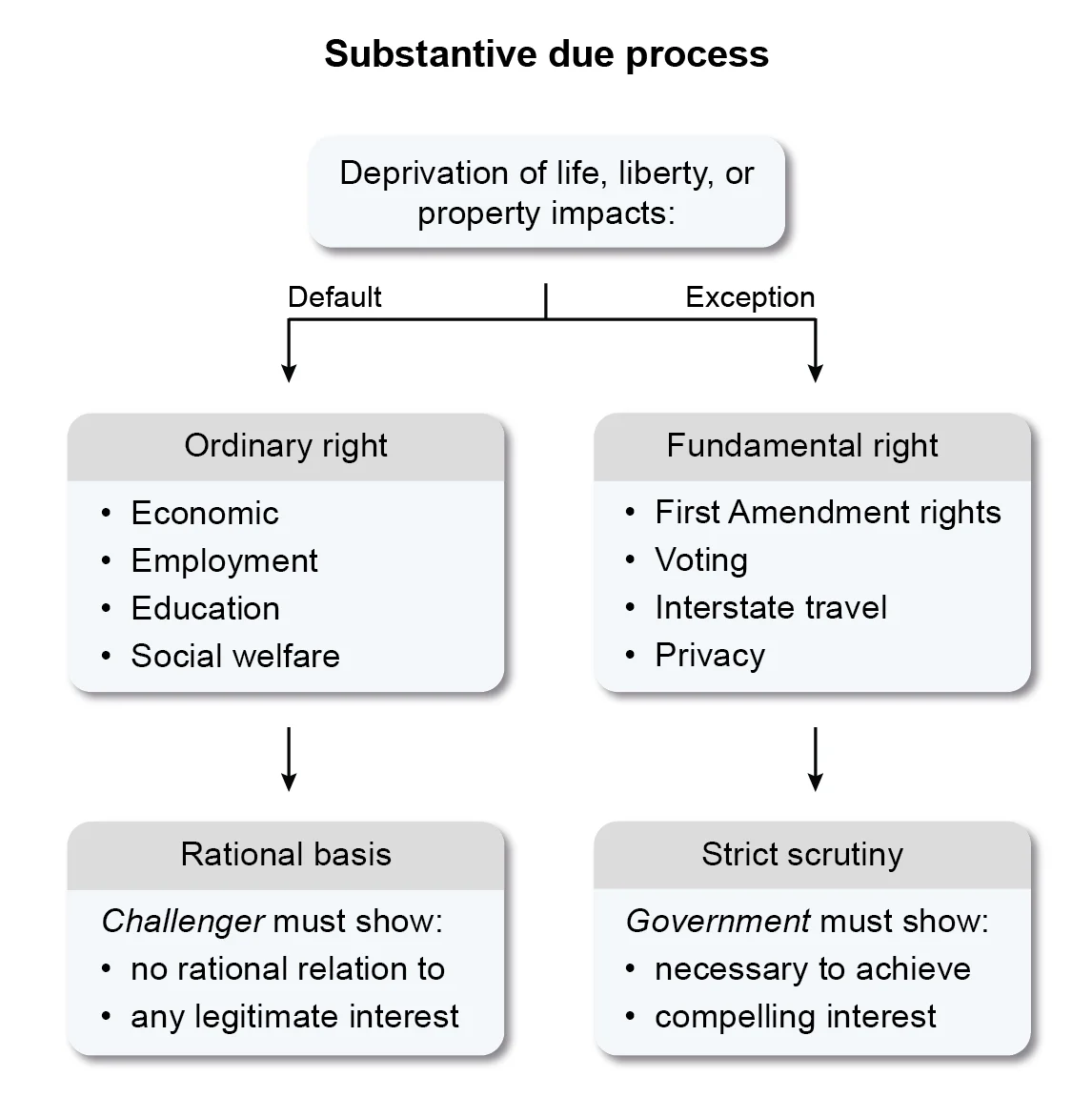
Procedural due process ensures the government cannot deprive a person of life, liberty, or property without notice and a fair opportunity to be heard. Substantive due process addresses laws that restrict everyone’s activities. Laws affecting fundamental rights, such as voting or privacy, are subject to strict scrutiny, requiring the government to prove a compelling interest. For non-fundamental rights, rational basis review applies, where laws are presumed valid unless shown to lack a legitimate purpose, as is often the case with economic regulations.
The Equal Protection Clause addresses scenarios where laws treat individuals or groups differently. The level of scrutiny depends on the classification. Strict scrutiny, the most stringent standard, applies to laws involving race, ethnicity, or alienage and is rarely satisfied. Intermediate scrutiny, applied to classifications based on gender or illegitimacy, requires the government to show an important interest. Laws involving other classifications, such as age, are generally subject to rational basis review, where they are presumed valid unless proven otherwise.
TIP: To perform well in this area, focus on mastering the distinctions between procedural and substantive due process, understanding when strict scrutiny applies, and recognizing the different classifications and their corresponding levels of scrutiny under equal protection. These principles are often at the core of MBE scenarios.
NextGen UBE Constitutional Law Topic Breakdown
Constitutional Law on the NextGen UBE is 1 of 8 Foundational Concepts, and questions move beyond traditional multiple-choice formats to evaluate your ability to analyze facts, identify relevant issues, and apply constitutional principles in context. It is organized into 5 primary areas: federal judicial power, legislative powers, executive powers, the relationship between federal and state governments, and individual rights. Each area requires not only an understanding of the underlying doctrine but also the ability to evaluate how those doctrines operate in practical situations.
- Federal Judicial Power
- Legislative Powers
- Executive Powers
- The Relation of Nation and States in a Federal System
- Individual Rights
Federal Judicial Power
Federal judicial power focuses on the authority of federal courts under Article III, including justiciability doctrines such as standing, ripeness, mootness, and the prohibition on advisory opinions. NCBE questions test whether a federal court can hear a case. This includes evaluating whether the plaintiff has suffered a concrete injury, whether the issue is fit for judicial review, and whether there is an ongoing controversy. Fact patterns often require distinguishing between political questions and issues appropriate for judicial resolution.
Jurisdiction is also central, including federal question jurisdiction and the Supreme Court’s appellate review. You may be required to determine whether a case properly falls within federal judicial power and whether constitutional limits restrict review.
TIP: Identifying threshold justiciability issues and applying the correct doctrine before reaching the merits is the key to mastering this subject.
Legislative Powers
Legislative powers under the NextGen UBE focus on Congress’s authority under Article I, particularly the Commerce Clause, taxing and spending power, the Necessary and Proper Clause, and enforcement powers under the 13th, 14th, and 15th Amendments.
NCBE questions test whether Congress can act in a given scenario. This includes evaluating whether an activity substantially affects interstate commerce, distinguishing between economic and noneconomic conduct, and applying limits on aggregation. Fact patterns also examine conditional spending, especially whether federal funding conditions are coercive or sufficiently related to a federal interest.
The NextGen exam scope also emphasizes Congress’s enforcement powers under the Reconstruction Amendments. You may need to assess whether legislation is congruent and proportional to the constitutional violation being addressed. Administrative agencies are included here as well, particularly whether Congress has properly delegated authority and whether the agency’s action is supported by statute. Strong performance depends on identifying the source of congressional power, selecting the correct test, and applying it precisely to the facts.
Executive Powers
Executive Powers focuses on the President’s authority under Article II, particularly in relation to Congress and administrative agencies. Key areas include commander-in-chief powers, appointment and removal of officials, and control over executive branch functions. NCBE questions test the scope of presidential power in different contexts. This includes determining whether the President is acting with or without congressional authorization, and whether limits imposed by Congress are constitutionally valid. Fact patterns often involve the validity of executive actions affecting domestic administration.
The role of administrative agencies is also emphasized, including the President’s authority over agency officials and the limits on removal. Questions may require you to assess whether agency structure and executive control comply with constitutional requirements. Focus on identifying the source of executive authority, evaluating its relationship with Congress, and applying the appropriate constitutional framework.
The Relation of Nation and States in a Federal System
Federalism focuses on the balance of power between federal and state governments, with emphasis on preemption, the Dormant Commerce Clause, and limits on state authority. NCBE questions commonly test whether federal law overrides state law, either expressly or implicitly. You may be required to determine whether a state law discriminates against or unduly burdens interstate commerce, or whether it regulates in an area reserved to the states.
The scope also includes anti-commandeering principles and intergovernmental immunities. Fact patterns may involve whether Congress improperly requires states to implement federal programs or whether states can regulate or tax federal entities. Strong performance depends on identifying the type of federal-state conflict and applying the correct constitutional limitation.
Individual Rights
Individual Rights focuses on constitutional protections against government action, including equal protection, due process, and First Amendment freedoms. NCBE questions test your ability to identify the right at issue and apply the correct level of scrutiny. This includes classifications based on race, gender, and other characteristics, as well as fundamental rights protected under substantive due process.
The scope also includes procedural due process, requiring analysis of notice and the opportunity to be heard, and the state action requirement. First Amendment questions often involve distinguishing between content-based and content-neutral restrictions and applying the appropriate level of review. Selecting the correct framework, applying the appropriate standard of review, and analyzing how the facts fit within that structure is important.
MBE vs. NextGen UBE Constitutional Law: Key Differences
Constitutional Law is tested on both the MBE and NextGen UBE, but the way it is assessed differs significantly. While both formats rely on the same core doctrines, the MBE emphasizes recognition and application of rules in multiple-choice questions, whereas the NextGen UBE focuses on applying those rules in practical, real-world scenarios. Understanding these differences is critical to preparing effectively. The table below highlights how Constitutional Law testing shifts between the 2 formats.
| Component | MBE | NextGen UBE |
|---|---|---|
| Format | 200 multiple-choice questions (175 scored) testing rule application in isolated fact patterns | Integrated question sets combining multiple-choice, short-answer, and applied tasks |
| Testing Approach | Focus on identifying the correct rule and applying it to a single issue | Emphasis on multi-step analysis, issue spotting, and applying law across layered scenarios |
| Depth of Analysis | Typically tests 1 doctrine per question with clear answer choices | Requires evaluating multiple issues within a single scenario and justifying conclusions |
| Skills Assessed | Legal reasoning, rule recognition, and elimination of incorrect options | Legal analysis, problem-solving, and practical application of constitutional principles |
| Content Scope | Traditional focus on core areas like judicial review, federalism, and individual rights | Expanded scope including administrative agencies, enforcement powers, and real-world legal contexts |
| Constitutional Law Weighting | 25 of the 175 scored questions; 1 of 7 equally weighted MBE subjects | 1 of 8 Foundational Concepts and Principles; NCBE has not published per-concept weighting |
| Preparation Strategy | High-volume practice with multiple-choice questions and rule memorization | Mixed practice combining multiple-choice questions, short-form writing, and applied legal analysis |
A strong preparation strategy accounts for both formats. While mastering black-letter law remains essential, success on the NextGen UBE requires going beyond memorization and developing the ability to apply constitutional principles in realistic legal settings.
How to Study Constitutional Law for the Bar Exam
Constitutional Law rewards precision. The same doctrines show up repeatedly, but the way they are tested shifts between direct rule application and layered analysis. Preparation needs to reflect both, with a clear focus on how rules are triggered, applied, and tested under pressure.
Master the Federal Rules of Constitutional Law
Start with the core frameworks. Equal protection scrutiny, Commerce Clause limits, justiciability doctrines, and First Amendment structures form the backbone of most questions. The goal is not just familiarity, but control. You should be able to identify the governing rule within seconds and move cleanly into analysis. Many errors come from misidentifying the applicable test or skipping a step in the framework. Tight rule recall combined with structured application is what separates correct answers from close misses.
Focus on Highly Tested Topics
Certain areas appear consistently across exams. Judicial review, congressional power, federalism, and individual rights drive a large portion of Constitutional Law questions. Within these areas, specific triggers repeat. State action, suspect classifications, content-based restrictions, and limits on federal authority often signal the path of analysis. Recognizing these patterns early allows you to prioritize the right issue and avoid getting pulled into irrelevant details.
Practice With Explanations, Not Just Correct Answers
Practice is where the subject comes together. Each question should sharpen your understanding of how rules operate in different contexts, not just confirm whether you got it right. The UWorld QBank is built for breaking down the reasoning behind every option, showing how rules apply, where common traps appear, and how similar fact patterns can lead to different outcomes. Over time, this builds pattern recognition and strengthens your ability to eliminate wrong answers with confidence.
Build NextGen Skills with Mixed Practice
NextGen questions require you to work through multiple issues within a single scenario. That shift shows up in how facts are layered and how conclusions are reached. Combine multiple-choice questions with short-form analysis where you identify the issue, select the rule, and apply it clearly. Focus on connecting doctrines across a single fact pattern rather than treating each issue in isolation. This builds the ability to stay organized and accurate when handling more complex question sets.
Constitutional Law Practice Questions and Answers
Think you’re prepared to tackle Constitutional Law on the bar exam? Below are sample questions from UWorld’s Constitutional Law question bank, carefully crafted to mirror the style and complexity of NCBE questions:
A congressional committee investigated the pharmaceutical industry and found that the high cost of prescription drugs purchased and sold in the United States negatively impacted the nation's economy and the health of its citizens. In response, Congress passed a statute that regulates "the retail prices of every purchase or sale of prescription drugs in the United States."
A group of pharmaceutical companies challenged the constitutionality of this statute in federal court.
What is the strongest argument in support of the constitutionality of this statute?
| A. | Congress may enact statutes for the general welfare. | |
| B. | Congress may regulate the prices of all domestic purchases and sales of goods. | |
| C. | The Constitution grants Congress the power to regulate the interstate transportation of prescription drugs. | |
| D. | The purchases and sales of prescription drugs in the United States substantially impact interstate commerce in the aggregate. |
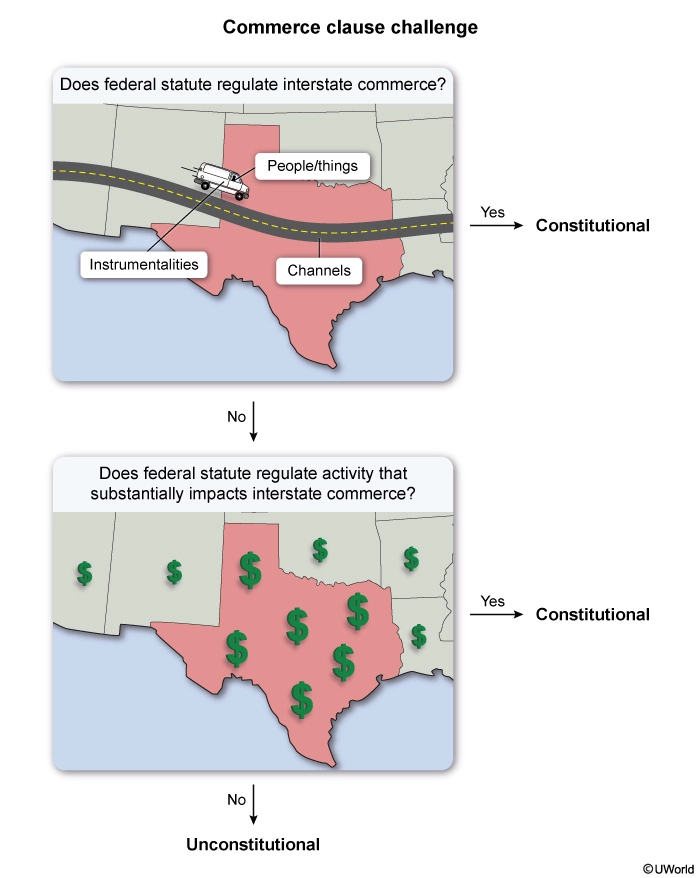
The commerce clause gives Congress broad power to regulate interstate and foreign commerce. This includes:
- the channels of interstate and foreign commerce (eg, roadways)
- the instrumentalities of interstate and foreign commerce (eg, vehicles)
- persons and things moving in interstate or foreign commerce (eg, goods and services) and
- in-state activities that, singly or in the aggregate, substantially impact interstate or foreign commerce.
Since Congress's commerce power is broad, federal statutes are constitutional if there is any rational basis for concluding that the regulated activity substantially affects interstate or foreign commerce. This can be shown through express congressional findings.
Here, the federal statute regulates the retail prices of prescription drugs in the United States. Congress has the authority to regulate such products' interstate transportation, but this statute also regulates in-state purchases and sales (Choice C). Since the congressional committee found that the high cost of prescription drugs negatively impacted the nation's economy, it is rational to conclude that their aggregated in-state purchases and sales substantially impact interstate commerce. Therefore, this is the strongest argument to support this statute.
(Choice A) The taxing and spending clause empowers Congress to tax and spend for the general welfare. But regulating prices is not equivalent to taxing or spending.
(Choice B) Congress cannot regulate the prices of every domestic purchase and sale of goods since it cannot regulate purely in-state sales that do not substantially affect interstate commerce.
Educational objective:
The commerce clause empowers Congress to regulate (1) channels and instrumentalities of, (2) persons and things moving in, and (3) in-state activities that—singly or in the aggregate—substantially affect interstate or foreign commerce.
Bluebook Citations :
- Gonzales v. Raich, 545 U.S. 1, 17 (2005) (explaining Congress's broad authority under the commerce clause).
A federal statute provides funds to private organizations that develop online learning materials for schools. A provision of the statute requires organizations that receive such funds to provide their educational materials to private, religious schools for use in their curriculum on the same terms that the organizations provide to public schools.
A taxpayer brought a suit in federal court to challenge the federal statutory provision as violating the establishment clause of the First Amendment. The taxpayer does not work in the education industry, nor does he have any children.
Does the taxpayer have standing to challenge the provision?
| A. | No, because the private organizations receiving the federal funds are not state actors. | |
| B. | No, because the provision did not cause the taxpayer to suffer a concrete and particularized injury. | |
| C. | Yes, because taxpayers have the right to challenge how Congress spends federal funds. | |
| D. | Yes, because the taxpayer's challenge is based on the establishment clause. |
A federal court will not hear a case unless the plaintiff has standing—i.e., a personal stake in the outcome of the case. To have standing, the plaintiff must assert an injury-in-fact that is concrete and particularized—a generalized grievance shared by many or all citizens is insufficient. Therefore, taxpayers lack standing to challenge the way the government spends tax dollars unless the taxpayer:
- challenges legislation enacted under Congress's or a state's taxing and spending power and
- alleges a violation of a specific constitutional limitation on this power—to date, the only limitation that the U.S. Supreme Court has found is the First Amendment establishment clause.
Here, the taxpayer is challenging a federal statute that provides funds to private organizations to develop online learning materials for schools (exercise of congressional spending power). He is specifically challenging the statutory provision requiring such organizations to provide materials to private, religious schools as a violation of the First Amendment establishment clause (specific constitutional limitation). The taxpayer therefore has standing to challenge this provision.
(Choice A) With the exception of the Thirteenth Amendment, the Constitution applies to government (i.e., state) action. Private action is considered government action only if the state-action doctrine applies. But here, the taxpayer is challenging a federal law, so there is no need to determine whether the private organizations are engaging in state action.
(Choice B) The statutory provision did not cause the taxpayer to suffer a concrete and particularized injury since he does not work in the education industry and does not have children who may be affected by the provision. However, as a taxpayer, he has standing to challenge the provision as violative of the establishment clause.
(Choice C) Taxpayers have the right to challenge how Congress spends federal funds only when the challenge alleges a violation of a specific constitutional limitation on Congress's taxing and spending power (as seen here).
Educational objective:
A plaintiff-taxpayer has standing when his/her suit (1) challenges legislation enacted under Congress's taxing and spending power and (2) alleges a violation of a specific constitutional limitation on that power (i.e., the establishment clause).
Bluebook Citations :
- U.S. Const. art. III, § 2 (defining the case-or-controversy requirement).
- Flast v. Cohen, 392 U.S. 83, 102–04 (1968) (establishing the narrow exception to the rule against taxpayer standing).
A state legislature enacted a statute that allowed executors to claim a tax deduction for the sale of securities that were purchased by an estate after the decedent's death. After the statute was enacted, the state suffered a significant decrease in revenue because the number of estates that claimed the tax deduction was greater than originally projected. To recover this lost revenue, the legislature amended the statute to prevent an estate from claiming the deduction unless the decedent owned the securities prior to death. The amendment was made retroactive so that its effective date was when the statute was initially enacted.
Before the amendment was enacted, an executor sold securities that he had purchased for a decedent's estate after her death. The executor attempted to claim the tax deduction on the estate's tax returns but the state agency that processes tax returns denied his claim even though the estate had purchased the securities before the amendment was enacted. The executor has filed suit against the agency to challenge the constitutionality of the retroactive application of the amendment.
Is the executor's suit likely to succeed?
| A. | No, because the retroactive application of the amendment was necessary to achieve a compelling government interest. | |
| B. | No, because the retroactive application of the amendment was rationally related to a legitimate government interest. | |
| C. | Yes, because the amendment constitutes a bill of attainder. | |
| D. | Yes, because the amendment violates the due process clause of the Fourteenth Amendment. |
The commerce clause gives Congress broad power to regulate interstate and foreign commerce. This includes:
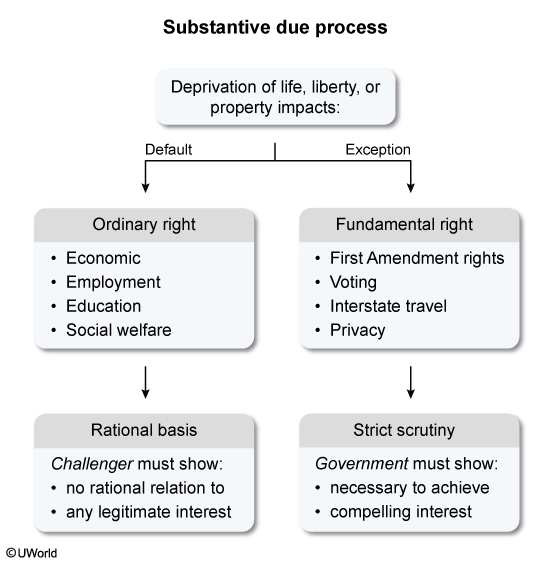
The Fourteenth Amendment substantive due process clause prevents states from depriving persons of life, liberty, or property without adequate justification. Civil laws that retroactively impair an ordinary right—eg, the right to claim a tax deduction—must undergo rational basis scrutiny. Under this test, the law is presumed valid until the challenger shows that the law's retroactive application has no rational relation to any legitimate government interest.
Here, the executor challenged the amendment's retroactive application since it prevented the estate from claiming the tax deduction on its tax returns, which is an ordinary right. But since the state suffered a significant decline in revenue after the statute was enacted, the retroactive application of the amendment was rationally related to the state's legitimate interest in recovering the lost revenue. This means that the amendment does not violate the Fourteenth Amendment due process clause (Choice D). Therefore, the executor's suit is unlikely to succeed.
(Choice A) The retroactive application of a law that affects a fundamental right (eg, voting) is subject to strict scrutiny—ie, the government must prove that the law is necessary to achieve a compelling government interest. But here, the amendment's retroactive application affects an ordinary right and is therefore subject to rational basis scrutiny.
(Choice C) A bill of attainder is a legislative act that punishes a specified person or group without a judicial trial. But since the amendment applies to all persons who purchase securities, it is not a bill of attainder. Additionally, the amendment seeks to increase the state's revenue—not punish individuals.
Educational objective:
Laws that retroactively impair an ordinary right—eg, the right to claim a tax deduction—can be challenged on substantive due process grounds. Such laws are reviewed under rational basis scrutiny and generally are presumed valid.
A county has experienced a surge in tourism, leading to increased demand for short-term rentals and a significant rise in housing costs. In response, the county enacted a new ordinance imposing a tax on companies that operate short-term rental platforms within the county. The revenue from the tax is designed for affordable housing initiatives. The ordinance is scheduled to take effect in 18 months.
You are an attorney working in the county attorney's office. A nonprofit organization that advocates for reducing business regulations has sued the county in the proper federal district court for declaratory relief, alleging that the ordinance violates the Fourteenth Amendment equal protection and due process clauses.
Your supervisor asks you to prepare a memorandum that identifies the grounds on which the suit can be dismissed.
Which of the following grounds should you include in your memorandum?
Select two response options.
- Dormant commerce clause.
- Eleventh Amendment.
- Mootness.
- Ripeness.
- Standing
- Supremacy clause.
Explanation:
Article III restricts federal judicial power to actual cases or controversies—i.e., disputes that are capable of judicial resolution. As a result, federal courts can issue a declaratory judgment on the merits of the suit only if the dispute presents a real and immediate danger to a party's interests.* In order for the court to determine the merits, the plaintiff must establish standing and the suit must be ripe for adjudication. Standing requires the plaintiff to plausibly allege that:
- the plaintiff suffered an actual or imminent harm that is concrete and particularized (injury-in-fact)
- the harm is fairly traceable to the defendant's challenged conduct (causation) and
- a favorable judicial ruling will likely remedy or prevent the alleged harm (redressability).
Here, the nonprofit organization's suit alleges that the county tax on companies that operate short-term rental platforms within the county is unconstitutional. But the organization, which is dedicated to reducing business regulations—not operating short-term rentals—will not be impacted by the tax (no injury-in-fact). And even if it were, the tax will not go into effect for 18 months (not ripe for adjudication). Therefore, in your memorandum on grounds for dismissing the suit, you should include standing and ripeness.
*Otherwise, a declaratory judgment would amount to an impermissible advisory opinion.
(Choice A) The dormant commerce clause concerns state and local laws that discriminate against or unduly burden interstate commerce. Because the nonprofit organization's suit alleges only equal protection and due process violations, the dormant commerce clause is not relevant to the grounds for dismissing the suit.
(Choice B) The Eleventh Amendment generally bars federal courts from adjudicating suits against state governments—not local governments (e.g., counties). Therefore, you should not include this legal topic in your memorandum.
(Choice C) Mootness occurs when further legal proceedings would have no effect—e.g., because the plaintiff's harm has been resolved. Here, further legal proceedings would have an effect because the court could declare the tax unconstitutional, so the claim is not moot.
(Choice F) The supremacy clause governs conflicts between federal and state or local law. Because the nonprofit organization's suit alleges equal protection and due process violations—not federal preemption—and the facts indicate no conflict with federal law, the supremacy clause is not a ground for dismissing the suit.
Educational objective:
Standing requires the plaintiff to plausibly allege that (1) the plaintiff suffered actual or imminent harm that is concrete and particularized, (2) the harm is fairly traceable to the defendant's conduct, and (3) a favorable judicial ruling will likely remedy or prevent the alleged harm.
You represent a nonprofit organization that operates after-school programs for high school students. The organization applied for a state grant available to community groups that provide career training and mentorship services to underserved youth. Although the organization met all eligibility requirements, the state agency that oversees the grant award denied the organization the grant because its programs include optional sessions on religious leadership and spiritual development.
You argue that denying the grant on this basis violated the First Amendment as applied to the states through the Fourteenth Amendment.
Which of the following standards of review will the court most likely apply in determining whether the denial of the grant violated the First Amendment?
Which of the following districts would NOT accomplish the plaintiff's goal?
Select one response option.
- Whether the denial coerced individuals to participate in or refrain from religious activity.
- Whether the denial constituted an endorsement or disapproval of religion.
- Whether the denial was consistent with historical practices and understandings.
- Whether the denial was substantially related to an important government interest.
Explanation:
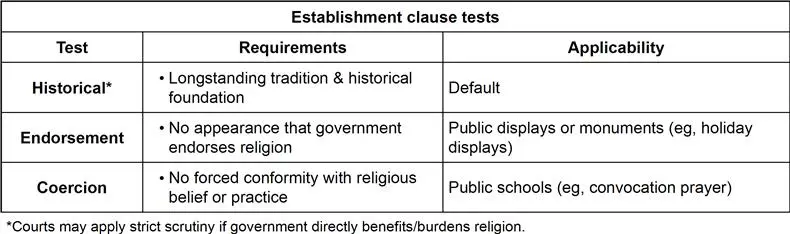
Government conduct that relates to religious affairs can be challenged as violative of the First Amendment establishment clause—applicable to the states through the Fourteenth Amendment. This clause bars the government from expressing a preference for a particular religion (or religion in general) by participating in or aiding religious affairs. To determine whether government conduct offends the establishment clause, a court will typically look at whether the conduct offends historical practices and understandings. If it does, that indicates that the conduct violates the establishment clause.
Here, the state agency denied the grant to the organization even though it was qualified because the organization's programs include optional sessions on religious leadership and spiritual development. Since this denial constitutes government participation in religious affairs, the court will most likely ask whether the denial was consistent with historical practices and understandings in determining whether the denial violated the First Amendment.
(Choice A) The court will consider whether the government conduct constituted coercion when analyzing officially sponsored religious activities in public schools or at public school events (not seen here).
(Choice B) In determining whether public displays or monuments violate the establishment clause, a court will analyze whether they endorse religion. However, this test does not apply to denials of government grants (as seen here).
(Choice D) Whether denying the grant to the organization was substantially related to an important government interest sets forth the test for intermediate scrutiny. This applies to discriminatory actions against a quasi-suspect class. But the organization is not part of a quasi-suspect class, so this standard would not apply here.
Educational objective:
To determine whether government conduct violates the establishment clause, the court will typically look at whether the conduct offends historical practices and understandings.
Integrated Question Set: Task Materials
You are an associate at a general practice law firm. A new client, who is a teacher, seeks your advice about a policy adopted by the Franklin Department of Education. The following is an excerpt from Franklin Department of Education's policy:
Salary is determined by the number of "steps" a teacher has obtained according to Franklin's salary schedule. Each year of experience as a public school teacher in the State of Franklin counts as one step. Each year of qualifying teaching experience in other states is counted as one half step.
End of excerpt
The client previously lived in Olympia and taught there for 22 years. He has accepted a new teaching position at a Franklin public school and is frustrated that he only qualifies for 11 steps on the salary schedule because each year of his experience in Olympia counts as only one half step. He asks you whether the Franklin policy violates his constitutional rights. You review a constitutional law treatise and determine that you might be able to challenge the policy on equal protection grounds.
Now answer Component 1.
The client manages to negotiate additional benefits based on his experience, so he decides against pursuing an action challenging the salary policy. However, several months later, the client contacts you about a new concern. The following is an excerpt from the transcript of your interview with him:
[Client]: I'm having trouble with the principal at my school. I think she hired me because I was the only qualified math teacher available who was willing to work at a public school. She seems to favor younger teachers.
[You]: So, what is your issue?
[Client]: I've always received stellar evaluations in my previous teaching positions. But the principal at this school claims that I'm not a good teacher. She makes me to do countless hours of extra professional development work on my own time. I've asked around, and the only teachers she's asked to do this extra work are over 40.
[You]: What else have you seen at the school to suggest the principal favors younger teachers?
[Client]: Well, she gives them the best classrooms and the best classes. And the only teachers who are required to perform morning and after-school parking lot duty are all over 40.
[You]: Is there anything else?
[Client]: Yes. I was late to work one time. I called to let her know I was stuck in traffic, but she still issued me a formal reprimand. One of the young teachers down the hall is late all the time, and the principal has never punished her.
End of excerpt
Component 1: If you challenge the policy on equal protection grounds, will you likely prevail?
Select one response option.
- No, because heightened scrutiny is only available when a state discriminates against a suspect or quasi-suspect class.
- No, because the policy applies equally to new residents and longtime residents.
- Yes, because the policy benefits longtime residents over new residents.
- Yes, because the policy infringes on the fundamental right to travel.
Explanation:
A state discriminatory action can be challenged under the Fourteenth Amendment equal protection clause. The level of scrutiny a court will apply to evaluate an equal protection challenge depends on the discrimination involved:
- Discrimination against an ordinary class or that impacts a nonfundamental right is typically constitutional under rational basis scrutiny.
- Discrimination against a quasi-suspect class (not seen here) is typically unconstitutional under intermediate scrutiny.
- Discrimination against a suspect class (not seen here) or that substantially impacts a fundamental right is typically unconstitutional under strict scrutiny.
One fundamental right is the right to interstate travel. This includes the right of people who wish to become permanent residents in a new state to be treated equally to native-born or longtime citizens regarding state benefits (e.g., salary). However, this right is not violated if new and longtime residents are treated equally. Instead, rational basis scrutiny will apply.
Here, Franklin's policy treats in-state teaching experience more favorably than out-of-state experience in determining teachers' salaries. But since this determination is not based on the length of a teacher's residency in Franklin, the policy applies equally to new residents and longtime residents and does not infringe on the fundamental right to interstate travel (Choices C and D).* As a result, the policy will likely be constitutional under rational basis scrutiny, making it unlikely that you will prevail if you challenge it on equal protection grounds.
*For example, a longtime or native resident of Franklin who previously commuted to work at a school in another state would be subject to the policy to the same extent as a new resident who taught elsewhere, like your client.
(Choice A) Discrimination against a nonsuspect class triggers strict scrutiny (heightened scrutiny) if a fundamental right (e.g., the right to travel) is substantially impacted.
Educational objective:
Under equal protection, a law that substantially impacts the fundamental right to travel is subject to strict scrutiny. This includes new residents' right to be treated equally to native-born or longtime citizens regarding state benefits. But if new and longtime residents are treated equally, rational basis scrutiny will apply.
Integrated Question Set: Task Materials
You are an associate at a general practice law firm. A new client, who is a teacher, seeks your advice about a policy adopted by the Franklin Department of Education. The following is an excerpt from Franklin Department of Education's policy:
Salary is determined by the number of "steps" a teacher has obtained according to Franklin's salary schedule. Each year of experience as a public school teacher in the State of Franklin counts as one step. Each year of qualifying teaching experience in other states is counted as one half step.
End of excerpt
Now answer Component 2.
The problems with the principal persist, and she eventually notifies your client that his contract will not be renewed for the following year. You determine that your best chance of success is to pursue an age discrimination claim under Franklin law. As you assess the potential evidence for the claim, your client shows you an email he received from a friend who worked for the principal when she was employed at another school. The following is an excerpt from an email your client received from the friend:
Yes, I'm very familiar with her. I worked for her as an assistant principal for five years. She was consistently tougher on older teachers during evaluations. She would nitpick them and put them on professional development plans in hopes that they would leave. If that didn't work, she would refuse to renew their contracts based on bogus evaluations. Meanwhile, her buddies, the younger teachers, would get outstanding ratings even if they were terrible teachers.
Then she would put the money she saved by getting rid of the expensive older teachers toward her pet projects, like buying fancy new furniture for her office and her favorite new teachers' classrooms.
End of excerpt
You want to use the email, or testimony from the client's friend regarding the principal's conduct, as part of the discrimination case. However, you anticipate that the principal will object to the admission of evidence of the principal's prior conduct as impermissible character evidence. You determine that Franklin's rules of evidence are identical to the Federal Rules.
Component 2: If you assert an equal protection claim against the school and principal, what standard of review would apply and why?
The length of the answer should be about one to two sentences.
Answer
Explanation:
Under the Fourteenth Amendment's guarantee of equal protection:
- laws or government actions that categorize or discriminate against a suspect class (e.g., race) or substantially impact a fundamental right (see table above) are subject to strict scrutiny and
- laws or government actions that categorize or discriminate against a quasi-suspect class (e.g., gender) are subject to intermediate scrutiny.
In comparison, a law or government action that discriminates against a nonsuspect class (e.g., age group) or impacts an ordinary right (e.g., employment) is subject to mere rational basis review. Under this deferential standard, the challenger has the burden to show that the state action is not rationally related to a legitimate state interest.
Here, your client alleges that the school principal's actions (which constitute government action) discriminate against him based on his age. However, age is not a nonsuspect classification. And even if the principal's actions impact his right to employment, this is an ordinary right. Therefore, if you assert an equal protection claim against the school and principal, the rational basis standard of review will apply.
Educational objective:
Under the equal protection clause, laws or government actions that discriminate against a nonsuspect class (e.g., age group) and impact an ordinary right (e.g., employment) are subject to mere rational basis review.
Integrated Question Set: Task Materials
You are an associate at a general practice law firm. A new client, who is a teacher, seeks your advice about a policy adopted by the Franklin Department of Education. The following is an excerpt from Franklin Department of Education's policy:
Salary is determined by the number of "steps" a teacher has obtained according to Franklin's salary schedule. Each year of experience as a public school teacher in the State of Franklin counts as one step. Each year of qualifying teaching experience in other states is counted as one half step.
End of excerpt
The client previously lived in Olympia and taught there for 22 years. He has accepted a new teaching position at a Franklin public school and is frustrated that he only qualifies for 11 steps on the salary schedule because each year of his experience in Olympia counts as only one half step. He asks you whether the Franklin policy violates his constitutional rights. You review a constitutional law treatise and determine that you might be able to challenge the policy on equal protection grounds.
Now answer Component 3.
The client asks whether the friend's information should be introduced at trial through the email or by calling his friend as a witness to testify about his observations and experiences concerning the principal.
You want to use the email, or testimony from the client's friend regarding the principal's conduct, as part of the discrimination case. However, you anticipate that the principal will object to the admission of evidence of the principal's prior conduct as impermissible character evidence. You determine that Franklin's rules of evidence are identical to the Federal Rules.
Component 3: What would be your best response to the principal's objection?
The length of the answer should be about one sentence.
The client also asks whether Creator 1 will likely be liable if the contract with the parts manufacturer is binding on the partnership.
Answer
FRE 404(b) (which is identical to the Franklin evidentiary rules) governs the admissibility of evidence of specific acts (i.e., other crimes, wrongs, or actions). Under this rule, evidence of a specific act:
- is not admissible to prove a person's character to show that the person acted consistently with that character on a particular occasion (i.e., to show the person's propensity to act a certain way) but
- is admissible for other purposes, such as to prove motive, intent, absence of mistake, identity, or common plan (MIMIC).*
Here, you want to admit evidence of the principal's prior discriminatory conduct through the friend's email or testimony. Such evidence is inadmissible as character evidence to prove the principal's discriminatory propensity. But you can argue that it is admissible for another purpose, such as to establish the principal's (1) intent to discriminate based on age or (2) motive for hiring and retaining younger teachers (i.e., to save money to spend elsewhere). Therefore, this would be your best response to the principal's objection.
*Such evidence may be offered for any relevant noncharacter purpose; the MIMIC acronym reflects the most common noncharacter purposes.
Educational objective:
Under Federal Rule of Evidence 404(b), evidence of specific acts (i.e., other crimes, wrongs, or actions) is not admissible to prove a person's character to show that the person acted consistently with that character on a particular occasion. But such evidence is admissible for other purposes (e.g., to show motive or intent).
Integrated Question Set: Task Materials
You are an associate at a general practice law firm. A new client, who is a teacher, seeks your advice about a policy adopted by the Franklin Department of Education. The following is an excerpt from Franklin Department of Education's policy:
Salary is determined by the number of "steps" a teacher has obtained according to Franklin's salary schedule. Each year of experience as a public school teacher in the State of Franklin counts as one step. Each year of qualifying teaching experience in other states is counted as one half step.
End of excerpt
The client previously lived in Olympia and taught there for 22 years. He has accepted a new teaching position at a Franklin public school and is frustrated that he only qualifies for 11 steps on the salary schedule because each year of his experience in Olympia counts as only one half step. He asks you whether the Franklin policy violates his constitutional rights. You review a constitutional law treatise and determine that you might be able to challenge the policy on equal protection grounds.
Now answer Component 4.
You resolve the age discrimination concerns through mediation, and your client remains employed with the school district. The client then learns that his former partner became pregnant just before they broke up and he moved to Franklin and that she recently gave birth to a baby girl. The client and the former partner decide to work together to raise their daughter and agree that the daughter will primarily live with the client. The client and the former partner were never married.
The client immediately requests to add his daughter to his school district's health insurance policy, which states "Coverage under the Franklin State Health Plan is available to all full-time employees and their children." A human resources administrator contacts the client and tells him that his request was denied because he was not married to the former partner when his daughter was born. The administrator explains that the client might be able to eventually add his daughter to the policy but that he would need to complete a lengthy special approval process first.
You are preparing to discuss the matter with the school district's attorney and intend to raise the argument that the policy will likely be subject to heightened scrutiny if challenged.
Question
- The email, because it is a recorded recollection.
- The email, because it is a self-authenticating document.
- The testimony of the friend, because the best evidence rule applies.
- The testimony of the friend, because the email is inadmissible hearsay.
Explanation:
Hearsay is a statement that the declarant made at a time other than while testifying at the current trial or hearing (i.e., an out-of-court statement) that is offered to prove the truth of the matter asserted in that statement. Hearsay evidence is generally inadmissible unless it falls within an exception or exclusion (see flowchart above) or is offered for a purpose other than proving the truth of the matter asserted.
Here, the friend sent your client an email explaining his past experiences with the principal. You want to use these out-of-court statements to prove the truth of the matter asserted therein—that the principal acted in the discriminatory manner described. But no hearsay exception or exclusion applies to allow admission of the statements in the email. And since the email is inadmissible hearsay, you should advise the client that the testimony of the friend is the best evidence to present.
(Choice A) The recorded recollection hearsay exception applies when a witness cannot remember an event well enough to testify about it fully and accurately even after consulting a record made or adopted by the witness (not seen here).
(Choice B) All tangible evidence, including documentary evidence (e.g., an email) must be authenticated. A self-authenticating document is a written document that does not require extrinsic evidence of authenticity to be admitted. But a personal email from a friend is not self-authenticating.
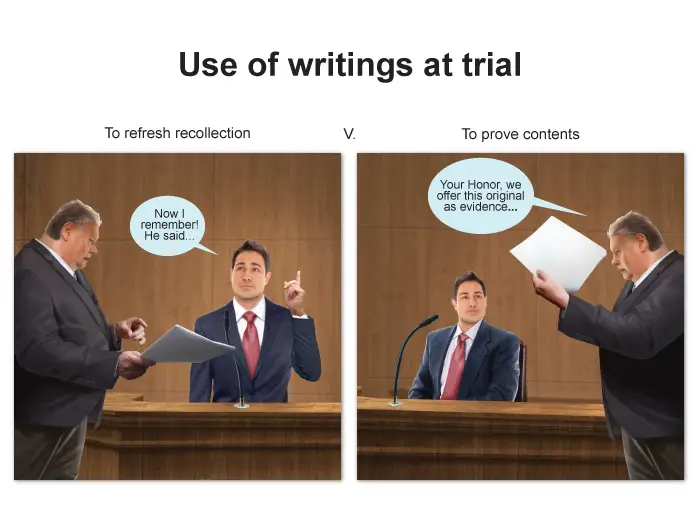
(Choice C) The best evidence rule requires that an original document or a reliable duplicate be produced to prove the contents of a writing, recording, or photograph (not seen here).
Educational objective:
Hearsay is a declarant's out-of-court statement offered at trial to prove the truth of the matter asserted therein. Hearsay is inadmissible unless it falls within an exemption or exception or is offered for a purpose other than to prove the truth of the matter asserted.
Integrated Question Set: Task Materials
You are an associate at a general practice law firm. A new client, who is a teacher, seeks your advice about a policy adopted by the Franklin Department of Education. The following is an excerpt from Franklin Department of Education's policy:
Salary is determined by the number of "steps" a teacher has obtained according to Franklin's salary schedule. Each year of experience as a public school teacher in the State of Franklin counts as one step. Each year of qualifying teaching experience in other states is counted as one half step.
End of excerpt
The client previously lived in Olympia and taught there for 22 years. He has accepted a new teaching position at a Franklin public school and is frustrated that he only qualifies for 11 steps on the salary schedule because each year of his experience in Olympia counts as only one half step. He asks you whether the Franklin policy violates his constitutional rights. You review a constitutional law treatise and determine that you might be able to challenge the policy on equal protection grounds.
Now answer Component 5.
You convince the school district to add your client's daughter to the insurance policy. The client now seeks your help with a problem involving his apartment. He has been renting an apartment in a four-unit building since he arrived in Franklin, and now his daughter lives there with him. The landlord has informed the client that he and his daughter will be required to move out because, although adults of all ages are welcome, no children are allowed to live in the building.
Question
Component 5: What are two factors that favor your position?
The length of the answer should be about one sentence.
Answer
Explanation:
Laws that discriminate against a suspect or quasi-suspect class are subject to heightened scrutiny. Classifications based on someone's status as a nonmarital child (i.e., legitimacy) are quasi-suspect and subject to intermediate scrutiny. Under this heightened standard, the state must show that its action is substantially related to an important state interest. But to trigger heightened scrutiny, there must be discriminatory intent on the government's part, which can be shown:
- facially – when the language of the law creates distinctions between classes of people
- as applied – when the law is applied in a discriminatory fashion or
- through a motive – when a law that is neutral on its face and in its application results in a disparate impact and there is proof of discriminatory motive or intent.
Here, the client's daughter was denied health insurance without additional approval because she is a nonmarital child. Because classifications based on status as a nonmarital child are quasi-suspect, the denial will be subject to intermediate scrutiny if discriminatory intent can be shown. And though the text of the policy is neutral, it is applied in a discriminatory fashion because it imposes extra requirements for nonmarital children. Therefore, these two factors favor your position that the policy will likely be subject to heightened scrutiny if challenged.
Educational objective:
Under an equal protection analysis, status as a nonmarital child is a quasi-suspect classification, and discrimination on this basis is subject to intermediate scrutiny if discriminatory intent can be shown (e.g., if the law or action is discriminatory as applied).
Integrated Question Set: Task Materials
You are an associate at a general practice law firm. A new client, who is a teacher, seeks your advice about a policy adopted by the Franklin Department of Education. The following is an excerpt from Franklin Department of Education's policy:
Salary is determined by the number of "steps" a teacher has obtained according to Franklin's salary schedule. Each year of experience as a public school teacher in the State of Franklin counts as one step. Each year of qualifying teaching experience in other states is counted as one half step.
End of excerpt
The client previously lived in Olympia and taught there for 22 years. He has accepted a new teaching position at a Franklin public school and is frustrated that he only qualifies for 11 steps on the salary schedule because each year of his experience in Olympia counts as only one half step. He asks you whether the Franklin policy violates his constitutional rights. You review a constitutional law treatise and determine that you might be able to challenge the policy on equal protection grounds.
Now answer Component 6.
Question
Component 6: Identify one fact you must investigate to determine whether the client and his daughter are protected by the Fair Housing Act.
The length of the answer should be about one sentence or phrase.
Answer
Submit
Explanation:
The federal Fair Housing Act (FHA) prohibits discrimination based on race, color, religion, national origin, sex, disability, and familial status (except in senior housing). The FHA applies to the sale, rental, and financing of homes and in other housing-related transactions. However, some buildings are exempted from the FHA, including:
- owner-occupied buildings with no more than four living units (including the owner's unit)
- single-family housing sold or rented without the use of a broker and
- housing operated by religious organizations and private clubs that limit occupancy to members.
Here, the landlord is attempting to evict the client and his daughter based on her living with him in the apartment (familial status). The building contains four units. If the owner occupies one of the units, then he is excepted from adhering to the FHA. Therefore, one fact you must investigate to determine whether the client and his daughter are protected by the FHA is whether the owner lives in one of the units.
Educational objective:
The Fair Housing Act prohibits discrimination in the sale, rental, and financing of homes and in other housing-related transactions. However, owner-occupied buildings with no more than four units are exempt.
Frequently Asked Questions
How heavily is Constitutional Law tested on the MBE?
Constitutional Law accounts for 25 questions on the MBE, making it 1 of the core tested subjects. These questions focus on applying established doctrines across areas such as judicial review, federalism, and individual rights. Consistent performance in this subject can have a meaningful impact on your overall score.
How is Constitutional Law tested on the NextGen UBE?
On the NextGen UBE, Constitutional Law is tested through integrated question sets that require applying legal principles in realistic scenarios. Instead of isolated multiple-choice questions, you may encounter fact patterns involving multiple issues that require structured analysis and clear reasoning.
Is Constitutional Law harder on the NextGen UBE than the MBE?
The difficulty comes from the format rather than the substance. The underlying rules remain the same, but the NextGen UBE requires applying them across more complex and layered fact patterns. This demands stronger issue-spotting and analytical skills compared to traditional multiple-choice questions.
Read About Other Bar Exam Subjects
Master jurisdiction, motions, and trial rules with clear breakdowns and practice that mirrors how questions actually appear.
Learn how contracts are formed, enforced, and breached through real exam scenarios and high-yield rule application.
Understand crimes, defenses, and constitutional protections with fact patterns that reflect real testing scenarios.
Cut through complex rules on admissibility, relevance, and hearsay with practical examples and exam-focused explanations.
Tackle ownership, transfers, and land use with structured explanations and patterns that show up repeatedly on the exam.
Break down liability, negligence, and defenses with clear frameworks and questions designed to sharpen legal reasoning.
References
- National Conference of Bar Examiners. (2025). NextGen UBE content scope.
- National Conference of Bar Examiners. (2023). MBE subject matter outline.
https://www.ncbex.org/sites/default/files/2023-01/MBE_Subject_Matter_Outline.pdf
- National Conference of Bar Examiners. (n.d.). Multistate Bar Examination (MBE).