Torts Outline: MBEĀ® and NextGen UBE | Key Concepts to Know & How To Study for the Bar Exam

Torts is a core bar exam subject that focuses on civil liability for harm caused to others. To succeed on torts questions, you must identify the type of tort, apply the required elements, evaluate defenses, and determine the appropriate damages. Torts questions on the MBE test your ability to apply tort principles to detailed fact patterns, while those on the NextGen UBE require you to analyze liability across integrated scenarios involving multiple issues and legal doctrines.
Two law students studying Torts MBE questions for the bar exam on laptops.

What Torts Covers on the Bar Exam

Torts questions require you to determine whether a defendant is liable for causing harm, whether any defenses limit or preclude liability, and what legal consequences follow. Depending on the claim, you may need to analyze intentional conduct, negligence principles (including duty and breach), strict liability, causation, defenses, and damages.

The subject includes intentional torts, negligence, strict liability, and products liability, along with related doctrines such as nuisance, defamation, privacy, and misrepresentation.

  • On the Multistate Bar Examination (MBEĀ®), Torts is tested through multiple-choice questions that emphasize applying these rules to structured fact patterns.
  • On the NextGen Uniform Bar ExaminationTM (NextGen UBE), Torts appears in integrated, practice-based scenarios that require you to analyze multiple legal issues, evaluate factual materials, and reach well-reasoned conclusions.

MBE®: Torts Topic Breakdown

To prepare for Torts on the MBE, it’s essential to understand how this section is organized. The National Conference of Bar Examiners (NCBEĀ®) has divided Torts into 4 subtopics:

Torts Subtopics % Tested Number of Questions
Negligence 50.0% 12-13
Intentional Torts 16.7% 4-5
Strict Liability and Product Liability 16.7% 4-5
Other Torts 16.7% 4-5
Total scored questions for Torts 25

The most highly tested subtopic is negligence, which comprises 50% of the Torts questions (12–13 questions). The remaining 50% are equally divided among the other subtopics, with 4–5 questions each for intentional torts, strict liability and products liability, and other torts.

The breakdown above reflects the NCBE-published MBE subject matter outline. Torts is 1 of 7 subjects tested on the MBE alongside Criminal Law & Procedure, Constitutional Law, Contracts, Evidence, Real Property, and Civil Procedure.

Negligence

Negligence constitutes 50% (12–13 questions) of Torts and accounts for 1/14th of your overall score on the MBE. Additionally, it is tested on most state exams, including the Multistate Essay Examination (MEEĀ®).

To establish negligence, you must prove 4 main elements with evidence: duty, breach, causation, and harm. A negligence claim requires proof of duty, breach, causation, and damages. If the plaintiff cannot establish any one of these elements, the negligence claim fails. For example, if someone slips and falls on a two-by-four left negligently on the sidewalk but no harm occurs, there is no valid negligence claim, because negligence requires actual damages.

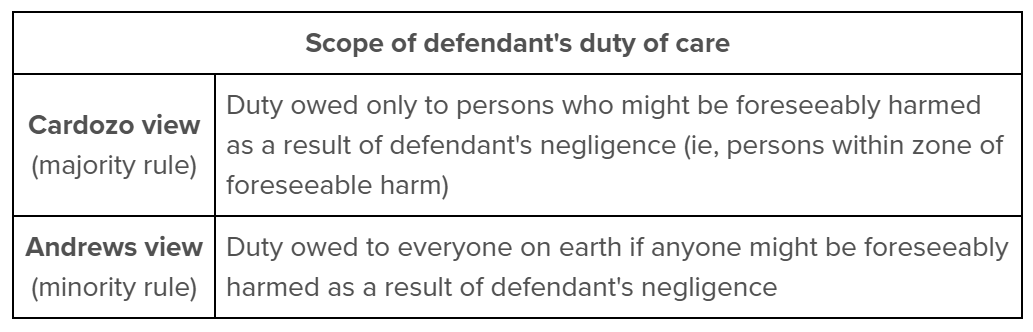
Duty is often a tricky topic for test-takers. You must first determine whether the defendant owed the plaintiff a duty of care and whether the defendant breached the applicable standard of care. The expected duty of care varies depending on whether the defendant is a child, mentally impaired individual, or professional. For example, if the defendant is a child, the rule states that the defendant owes a duty of care to a child of similar age, intelligence, and experience acting under similar circumstances, unless they are engaged in an adult activity (e.g., shooting a gun or driving).

Although there is generally no duty to affirmatively act, certain special relationships, such as physician-patient, common carrier-passenger, business owner-invitee, employer-employee, and parent-child or guardian-minor, may create an affirmative duty to take reasonable steps to protect or assist another from foreseeable harm. In some situations, one party may be held liable for another person's torts through vicarious liability. The most commonly tested example is an employer's liability for torts committed by an employee acting within the scope of employment.

Property owners may be liable for any injuries that occur on their property if they breach the duty of care owed to the injured entrant. The level of duty owed depends on the type of owner and the classification of the visitor to the premises (invitee, licensee, or trespasser). The highest degree of duty and care is owed to invitees, such as customers, who are invited onto the premises for business activities. Under the law, property owners must exercise reasonable care to keep the premises reasonably safe and to warn of or remedy dangerous conditions as required by the applicable standard of care. They generally must warn of or make safe unreasonably dangerous conditions they know or should know about (depending on entrant classification). Conversely, there is little duty owed to an undiscovered adult trespasser.

Proving Negligence

To establish causation, the plaintiff must prove actual causation (cause in fact). First, use the but-for test to determine if the breach directly caused the harm. Ask yourself, "But for the defendant's conduct, would the harm have occurred?"

  • If the answer is no, the defendant's conduct was an actual cause of the harm.
  • If the answer is yes, the defendant's conduct was not an actual cause.

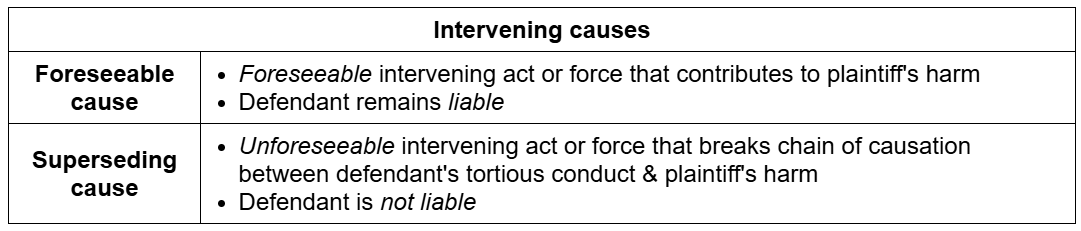
Second, determine whether the harm was a reasonably foreseeable consequence of the breach and whether any superseding intervening event broke the chain of causation.

When proof of fault or negligence is lacking, 2 legal doctrines may assist the plaintiff in seeking damages:

  • Negligence per se applies when the defendant violates a statute designed to protect a class of persons that includes the plaintiff from the type of harm that occurred.
  • Res ipsa loquitur permits a factfinder to infer negligence when the nature of the accident ordinarily would not occur absent negligence.

Compensatory and Additional Damages

Once negligence has been proven, the injured party may recover compensatory damages designed to compensate for the losses caused by the defendant's conduct. Generally, these damages cover medical costs, property damage, and lost wages. However, it is also possible to recover additional compensation for intangible losses, such as emotional distress, loss of consortium (typically asserted by a spouse and, in some jurisdictions, close family members), or punitive damages when the defendant acted with malice or conscious disregard for the safety of others. Furthermore, the defendant may be held responsible for a plaintiff's injuries even if they stem from a preexisting condition, according to the eggshell skull or thin skull rule.

When multiple defendants are responsible for the plaintiff's injuries, the allocation of damages depends on the jurisdiction's liability rules. Some jurisdictions apply joint and several liability, while others apply several or proportionate liability. In jurisdictions with joint and several liability, the plaintiff can recover damages from either or both defendants, regardless of their degree of fault. By contrast, in jurisdictions with pure several liability, each defendant is liable only for that defendant's proportionate share of the plaintiff's damages.

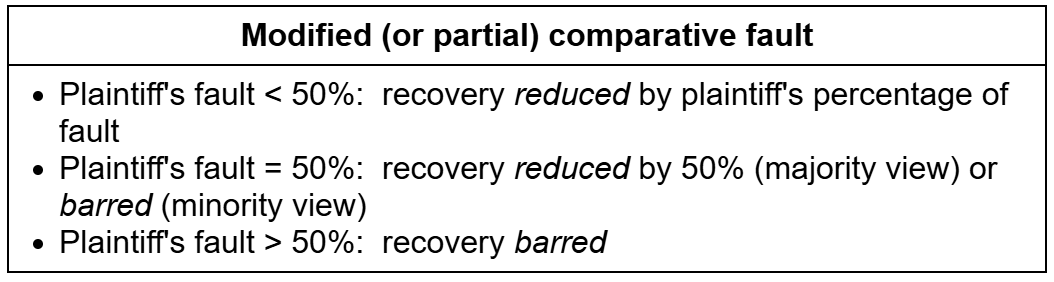
Conversely, certain defenses can be applied to reduce or limit a defendant's liability for damages, such as contributory negligence, which attributes fault to the plaintiff. For instance, if a plaintiff is hit by a car while jaywalking, he is considered partly responsible for his injuries. Most states follow the rule of pure comparative negligence, which states that the recoverable damages will be reduced by the percentage of the plaintiff's fault. Some states instead apply a modified comparative-negligence rule, which bars recovery once the plaintiff reaches a specified percentage of fault (typically 50% or 51%, depending on the jurisdiction). In contrast, a few states do not allow plaintiffs to recover damages if they are found to be even slightly negligent (1% or more).

Another important defense is assumption of the risk. Assumption of the risk may be express, when a liability waiver is signed, for example, or implied, when a plaintiff voluntarily encounters a known and appreciated risk. This defense is commonly applied to claims arising from adventure or extreme sports and other risky activities.

Intentional Torts

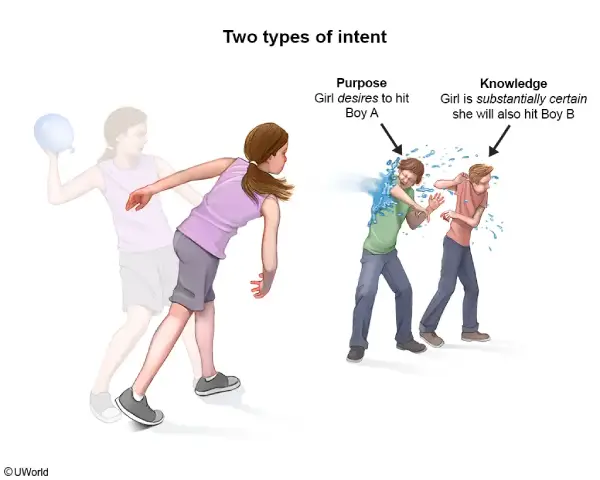
Expect approximately 4–5 questions on intentional torts. To hold a defendant liable for an intentional tort, such as battery, assault, false imprisonment, intentional infliction of emotional distress, trespass to land, trespass to chattels, and conversion, you must show that the defendant acted intentionally with the purpose of bringing about the prohibited contact, confinement, invasion, interference, or other legally recognized result, rather than merely acting negligently. Intent can be proved by demonstrating that the defendant:

  • acted with the purpose of causing the result or
  • knew the result was substantially certain to occur.

There are several viable defenses that a defendant can employ to escape liability in an intentional tort case. Common examples include self-defense, the defense of property, and the defense of others. In these cases, the defendant must prove that he reasonably believed that threatened harm was imminent and that the force he used in response was reasonably necessary and proportionate under the circumstances. Another common defense is the assertion of a special privilege or consent to act, such as parental discipline of a child or explicit or implied consent through willing participation.

Strict Liability and Products Liability

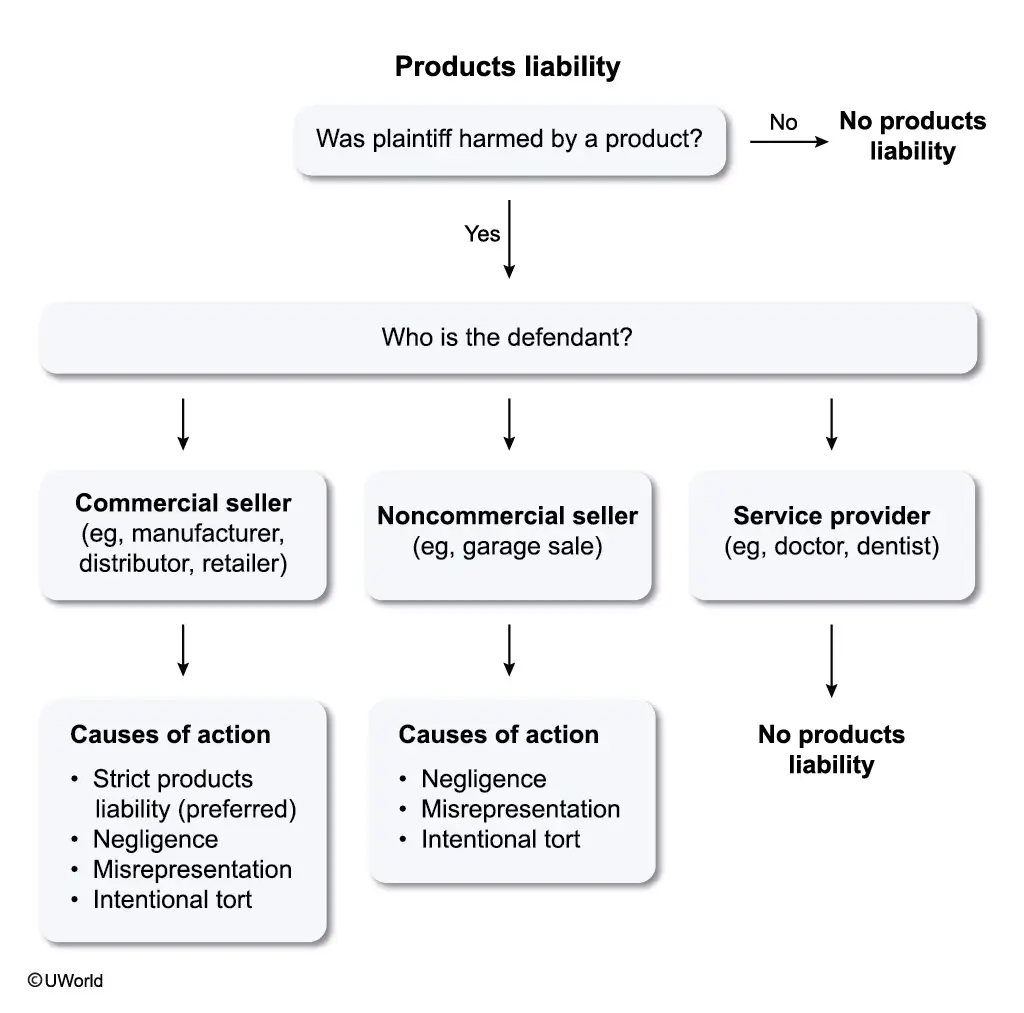
You should also expect about 4–5 tort questions on strict liability and products liability on the MBE. Strict liability allows a plaintiff to collect damages without proving negligence. Because negligence is not required, the focus is generally on whether the defendant engaged in an activity or provided a product that gives rise to strict liability, rather than on whether the defendant exercised reasonable care. Instead of proving negligence, the plaintiff must establish the elements of the applicable strict liability claim, along with causation and damages. Common strict liability claims include injuries arising from abnormally dangerous activities and wild animals and strict products liability. Although owners of ordinary domesticated animals are generally not subject to strict liability, an owner may be strictly liable if the animal is known to have dangerous propensities abnormal to its class.

Other Torts

Additionally, there will be 4–5 Torts questions based on other torts. The most commonly tested issues in this subtopic include defamation, privacy torts (such as intrusion, appropriation, false light, and disclosure), and nuisance. The most nuanced type of these torts is defamation, which depends on whether the plaintiff is a private or public figure and the nature of the statement involved.

For example, if the plaintiff is a nonpublic figure and the issue is of public concern, the following elements must be established:

  1. A defamatory statement concerning the plaintiff
  2. Publication to a third party
  3. The required level of fault (generally negligence for a private plaintiff)
  4. Any additional constitutional requirements, including falsity where applicable
  5. Recoverable damages

However, if the plaintiff is a public official or public figure, the plaintiff generally must prove actual malice: that the defendant knew the statement was false or acted with reckless disregard for its truth.

NextGen UBE Torts Topic Breakdown

On the NextGen UBE, Torts is 1 of 8 Foundational Concepts and Principles tested across multiple-choice questions, integrated question sets, and performance tasks. The NCBE has not published a fixed weighting per Foundational Concept. Within Torts, the 8 subcategories are:

Intentional Torts

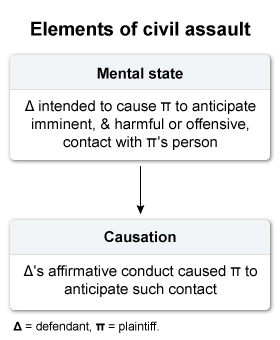
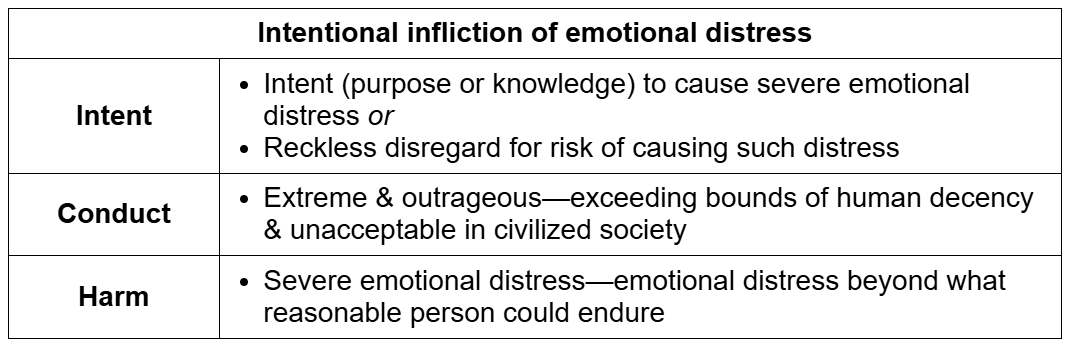
Intentional torts require you to determine whether the defendant acted with the purpose of bringing about the prohibited contact, confinement, interference, or other legally recognized result or with substantial certainty that such a result would occur. You must analyze harms to the person, including battery, assault, false imprisonment, and intentional infliction of emotional distress, along with property torts such as trespass to land, trespass to chattels, and conversion. Questions often require distinguishing between closely related torts, particularly where intent or the nature of the interference is unclear.

You must also evaluate whether the defendant's conduct satisfies all required elements, including harmful or offensive contact, reasonable apprehension of imminent harmful or offensive contact, confinement, or severe emotional distress. Scenarios frequently test transferred intent and whether intent toward one person or to commit one tort can satisfy the requirements for another.

Defenses play a central role in limiting or eliminating liability. You must analyze consent, including its scope, capacity, and possible revocation, as well as self-defense, defense of others, and defense of property, focusing on proportionality and reasonable force. Additional doctrines such as necessity, shopkeeper's privilege, and law-enforcement privileges are commonly tested, particularly in scenarios involving detention, property protection, or mistaken belief.

Negligence

Negligence focuses on whether the defendant failed to exercise reasonable care under the circumstances. You must determine whether a duty exists, which includes understanding competing approaches to duty such as foreseeability-based limitations and broader duty frameworks and applying the appropriate standard of care. Questions frequently test variations in the standard for professionals, children, possessors of land, and other defendants subject to specialized standards of care.

You must also analyze whether the defendant breached the applicable standard by failing to act as a reasonably prudent person would under similar circumstances. This includes evaluating risk, burden, and likelihood of harm, as well as applying doctrines such as negligence per se when a statute defines the standard of care.

Causation is a heavily tested component and requires careful analysis. You must distinguish between actual cause, typically using a but-for test, and proximate cause, which limits liability to harms that are sufficiently foreseeable. Questions often involve intervening and superseding causes, requiring you to determine whether later events break the chain of causation.

You are also required to assess liability for the acts of others, such as employer liability under respondeat superior, as well as duties arising from special relationships. Defenses such as comparative negligence and assumption of risk are frequently tested and may reduce or bar recovery depending on how fault is allocated.

Common-Law Strict Liability

Strict liability applies when liability is imposed without proof of fault for certain categories of conduct. You must determine whether an activity qualifies as abnormally dangerous by evaluating factors such as the degree of risk, likelihood of serious harm, inability to eliminate risk through reasonable care, and whether the activity is uncommon in the area.

A critical issue is whether the harm resulted from the type of risk that makes the activity abnormally dangerous. Even if an activity qualifies, liability will only attach if the injury arises from that specific risk, making this a frequent point of distinction in exam questions.

You must also determine whether the plaintiff's injury falls within the scope of the risks that make the activity abnormally dangerous and whether the applicable requirements for recovery are satisfied. Assumption of risk is generally a defense to strict liability. By contrast, ordinary contributory negligence is generally not a defense, and the effect of comparative fault depends on the jurisdiction and the type of strict liability claim.

Products Liability

Products liability focuses primarily on strict products liability for defective products placed into the stream of commerce. You must determine whether the product was defective and unreasonably dangerous at the time it left the seller's or manufacturer's control and whether the defect caused the plaintiff's injury.

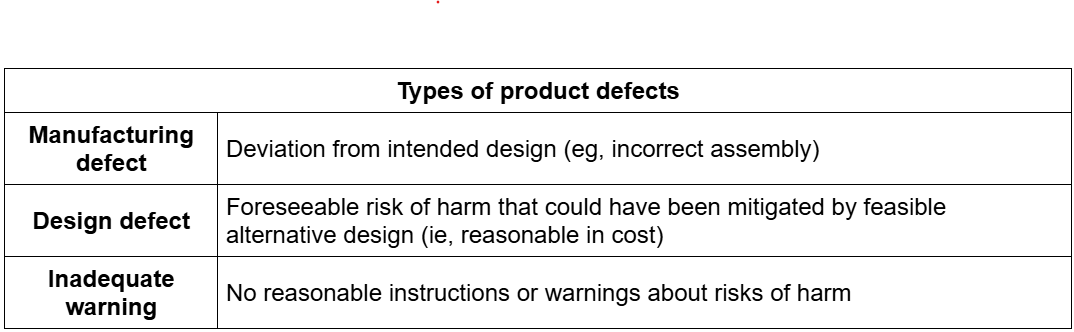
You must distinguish between manufacturing defects, where the product deviates from its intended design, design defects, where the product's design is unreasonable and dangerous, and failure-to-warn claims, where adequate warnings or instructions were not provided. Questions often test whether particular sellers fall within the chain of distribution or qualify for any applicable defenses or exceptions.

You are also required to identify proper parties. Plaintiffs may include foreseeable users and bystanders, while defendants typically include all commercial sellers in the distribution chain. Questions frequently test whether sellers can avoid liability or whether liability extends broadly across multiple parties.

Defenses are a key component of analysis. You must evaluate product misuse, alteration, assumption of risk, and comparative fault, as well as whether the plaintiff used the product in a foreseeable way. Some questions may also involve overlapping theories, requiring you to distinguish strict liability from negligence-based claims or warranty principles.

Nuisance and Defenses

Nuisance involves interference with the use and enjoyment of land, requiring you to distinguish between private nuisance, which affects specific individuals, and public nuisance, which affects the community at large. You must determine whether the interference is substantial and unreasonable, often requiring a fact-specific analysis of the nature, duration, and extent of the harm.

Questions frequently require balancing the utility of the defendant's conduct against the gravity of the harm. You must evaluate factors such as locality, whether the activity is appropriate for the area, and whether the interference would substantially affect an ordinarily reasonable person rather than only an unusually sensitive plaintiff. These distinctions are critical in determining whether liability should be imposed.

You must also analyze available remedies and defenses. This includes determining whether damages or injunctive relief is appropriate, as well as whether defenses such as coming to the nuisance or statutory compliance apply and whether equitable considerations affect the availability of injunctive relief.

Misrepresentation and Defenses

Misrepresentation involves false statements that induce justifiable reliance and cause legally compensable harm, most commonly economic loss. You must distinguish between fraudulent misrepresentation, which requires knowledge of falsity or reckless disregard for the truth, and negligent misrepresentation, which arises from a failure to exercise reasonable care in providing information.

You are required to apply elements such as material misstatement, intent or negligence, justifiable reliance, causation, and damages. Questions often test whether a statement constitutes fact versus opinion and whether the plaintiff's reliance was reasonable under the circumstances.

You must also evaluate limitations on liability and available defenses. This includes determining whether disclaimers affect reliance, whether the plaintiff's reliance remained justifiable in light of the available information, and whether the misrepresentation directly caused the claimed loss.

Defamation and Privacy

Defamation requires proof of a false statement of fact, publication to a third party, the applicable level of fault, and any required showing of damages. You must distinguish between statements of fact and opinion, determine whether the statement is defamatory, and apply the appropriate fault standard, depending on the plaintiff's status and, in some cases, whether the statement involves a matter of public concern.

Questions frequently test constitutional limitations, especially in cases involving public officials or matters of public concern. You must also evaluate defenses such as truth, privilege, and consent and determine whether the plaintiff must prove actual damages or whether damages may be presumed.

Privacy torts include intrusion upon seclusion, public disclosure of private facts, appropriation of name or likeness, and false light. You must analyze whether the conduct satisfies the elements of each claim and whether defenses or constitutional protections limit recovery, particularly in cases involving public interest or consent.

Damages

Damages questions focus on determining the appropriate remedy once liability is established. You must evaluate compensatory damages, including both economic losses and noneconomic harms such as pain and suffering, as well as punitive and nominal damages where appropriate.

You are also required to analyze how damages are allocated among parties. This includes determining whether joint and several liability, several liability, contribution, or indemnity applies, as well as how fault is apportioned under the applicable comparative-fault system.

Additional issues include the eggshell-skull (thin-skull) rule, which allows full recovery even for unusually severe injuries, and the duty to mitigate damages. Questions may also test the collateral-source rule and other doctrines affecting the calculation of damages.

MBE vs. NextGen UBE Torts: Key Differences

Torts is tested on both the MBE and the NextGen UBE, but the difference lies in how legal knowledge is applied. The MBE emphasizes speed, precision, and rule recognition through multiple-choice questions. The NextGen UBE, by contrast, focuses on applying those legal principles in realistic, practice-oriented scenarios.

Understanding this shift is critical. Success on the MBE depends on quickly and accurately applying the governing legal rule, while success on the NextGen UBE depends on integrating legal principles with factual analysis, evaluating multiple issues, and clearly explaining your reasoning.

Component MBE NextGen UBE
Format Multiple-choice questions with 4 answer choices Task-based assessments, including short-answer and applied analysis
Issue Scope Typically tests a single issue or narrow legal concept Tests multiple issues within a single, integrated fact pattern
Governing Law Focus on blackletter law and clearly defined rules Focus on applying legal principles in realistic, and sometimes ambiguous, factual contexts
Depth of Analysis Apply legal rules to select the best answer Analyze facts in depth, explain reasoning, and reach supported conclusions
Fact Complexity Short, controlled fact patterns with limited variables Longer, more detailed scenarios with layered and competing facts
Skills Tested Rule application, issue spotting, and answer elimination Legal reasoning, integrated analysis, factual evaluation, and written communication

The primary difference is not the subject matter but how that knowledge is applied. The MBE emphasizes efficient identification and application of legal rules, while the NextGen UBE places greater emphasis on integrated legal analysis, factual evaluation, and practical reasoning. To prepare effectively, you need both. Strong doctrinal knowledge is essential for the MBE, but without the ability to apply that knowledge in complex scenarios, performance on the NextGen UBE will suffer.

How to Study Torts for the Bar Exam

Studying Torts effectively requires more than memorizing legal rules and definitions. You need to understand how doctrines are tested on the MBE and how they are applied in the NextGen UBE. This means building a strong foundation in core areas like negligence, intentional torts, strict liability, products liability, causation, defenses, and damages while also learning how to apply those rules in different formats.

Your preparation should reflect both exam styles. The MBE rewards speed and accuracy on multiple-choice questions, while the NextGen UBE requires structured thinking, deeper analysis, and clear application of law to facts. A balanced study approach ensures you are prepared to recognize legal issues quickly and apply legal principles effectively.

Master Torts Elements and Defenses

The first step in mastering Torts is learning the elements of each claim, the available defenses, and how they interact. You should be able to quickly identify the required elements for negligence, intentional torts, strict liability, and products liability along with defenses such as comparative fault, assumption of risk, consent, and other privileges.

However, memorization alone is not enough. You must connect each element to how it appears in fact patterns. For example, duty and breach often hinge on subtle factual distinctions, while defenses like comparative negligence can significantly alter outcomes even when liability is clear.

To build this skill, focus on applying rules as you study them. Instead of reviewing rules in isolation, practice identifying where each element is satisfied or challenged within a fact pattern. This approach strengthens both MBE accuracy and NextGen analytical ability.

Focus on Highly Tested Topics

Negligence is the most heavily tested area, accounting for approximately half of Torts questions on the MBE. This includes duty, breach, causation, damages, and defenses such as comparative fault and assumption of risk. That said, you cannot ignore other areas. Intentional torts, strict liability, and products liability are consistently tested and often include nuanced rules and exceptions. These topics also appear in combination with negligence in more complex fact patterns, particularly on the NextGen UBE.

A strong study plan focuses heavily on negligence while maintaining coverage across all major topics. This ensures you are prepared for both high-frequency questions and integrated fact patterns that require you to apply multiple tort doctrines within a single scenario.

Practice with Explanations, Not Just Correct Answers

Practice is only effective if you understand why an answer is correct or incorrect. When reviewing Torts practice questions, examine why each answer choice is correct or incorrect rather than focusing only on the correct answer. This is especially important for topics like causation, duty, and products liability, where small factual differences can change the outcome.

The goal is to identify patterns in how questions are tested. For example, proximate causation often turns on foreseeability, while duty questions may hinge on relationships or policy considerations. Understanding these patterns improves both speed and accuracy over time.

Reviewing explanations through UWorld's QBank also helps you avoid repeating mistakes. Instead of moving quickly through large volumes of questions, focus on extracting insights from each one. This approach builds deeper understanding and leads to more consistent performance.

Build NextGen Skills with Mixed Practice

To prepare effectively for the NextGen UBE, you should supplement multiple-choice practice with exercises that require written legal analysis. This means incorporating exercises that require you to analyze facts, identify legal issues, evaluate liability, and explain your reasoning in a structured way. Even short written responses can significantly improve your ability to apply the law.

You should regularly practice breaking down fact patterns, identifying relevant issues, and organizing your analysis. This includes evaluating theories of liability, assessing defenses, and determining the appropriate remedies based on the facts presented.

The most effective approach is to combine MBE-style questions with applied practice. This allows you to reinforce doctrinal knowledge while developing the analytical and communication skills required for NextGen success. Over time, this integrated method helps you move from simply recognizing the law to confidently using it.

Torts Practice Questions and Answers

Think you're prepared to tackle Torts on the bar exam? Below are sample questions from UWorld's Torts question bank, carefully crafted to mirror the style and complexity of NCBE questions:

A teenager was riding a bicycle when she saw a classmate walking toward her. The teenager rode quickly toward the classmate, knowing that he would think she would run into him on her current trajectory. The teenager was not purposefully trying to harm or touch him. The classmate saw the teenager riding toward him and yelled at her to stop. The teenager swerved at the last moment and avoided hitting him. The classmate had a panic attack because he thought that the teenager would hit him.

Is the classmate likely to succeed if he sues the teenager for assault?

No, because the teenager did not make contact with the classmate.
No, because the teenager did not purposefully try to harm or touch the classmate.
Yes, because the teenager acted with the requisite intent.
Yes, because the teenager's conduct was extreme and outrageous.
Submit Next Question

A mother went to a retail toy store to purchase a birthday gift for her eight-year-old daughter.  Without inspecting it, a toy-store employee sold an electric toy oven to the mother.  The toy oven could bake small batches of real food using heat generated from light bulbs located in the interior of the oven.  The instructions that came with the toy oven clearly stated that adult supervision was required when operating the oven, so the mother helped the daughter use the oven to bake brownies.  While the brownies were baking, a six-year-old boy who lived next door came over to play with the daughter.  When the brownies were done baking, the mother allowed the boy to open the oven and remove them.  As he was doing so, a broken light bulb inside of the oven suddenly caught on fire, causing second-degree burns on the boy's hands.

The boy's father subsequently filed a negligence action against the manufacturer of the toy oven.  At trial, it was established that had the manufacturer or the toy store exercised reasonable care in the inspection of the toy oven, the broken light bulb would have been discovered.

Who is likely to prevail?

A. The boy's father, because the manufacturer breached its duty of reasonable care toward the boy.
B. The boy's father, because the manufacturer is strictly liable for the toy oven's defect.
C. The manufacturer, because it was not reasonably foreseeable that the boy would be injured by the daughter's defective toy oven.
D. The manufacturer, because the toy store's negligent failure to inspect the toy oven before selling it to the mother is a superseding cause of the boy's injuries.
Submit Next Question

A pregnant woman, whose due date for the delivery of her viable fetus was less than a month away, was walking in a parking lot and looking at her cell phone.  She was hit by a car driven by a police officer, who had just received word of an emergency and carelessly failed to see the woman.  Several days later, the woman gave birth to a child who suffered neurological damage as a result of the accident.

The woman, on behalf of her child, brought a negligence suit against the police officer for damages associated with the physical injuries suffered by the child.  The woman and the police officer were found to be equally at fault for the accident.

The jurisdiction has adopted a modified comparative fault statute that bars a plaintiff from recovery against a defendant whose fault is less than or equal to that of the plaintiff.

In the child's suit against the police officer, will the child be likely to recover for her injuries?

A. No, because the child was in utero at the time of the accident.
B. No, because the firefighters' rule applies to police officers.
C. Yes, because the child was viable at the time of the accident.
D. Yes, because the woman was not at greater fault than the police officer.
Submit
Select a Question sample.

Select a Question sample.

A retail corporation employed a purchasing manager to order inventory for its stores. The manager's authority was limited to contracts worth $25,000 or less. A supplier knew the manager was acting on behalf of the corporation but did not know of the limitation on the manager's authority.

Without obtaining approval, the manager entered into a $100,000 contract with the supplier. The corporation promptly informed the supplier that the manager lacked authority and refused to perform the contract. The supplier suffered losses and is considering legal action against the manager.

Which topic is most relevant to determining whether the supplier may recover damages from the manager?

Select one response option.

  1. Actual authority.
  2. Apparent authority.
  3. Ratification.
  4. Warranty of authority.
Submit Next Question

Explanation:

Agent's warranty of authority

A principal is liable on a contract entered into by an agent on the principal's behalf if the agent has the power to bind the principal to the contract. An agent has the power to do so when:

  • the agent has actual authority (express or implied)
  • the agent has apparent authority or
  • the principal ratifies the agent's unauthorized act.

An agent acting on behalf of a disclosed principal—i.e., one whose existence and identity are known to the third party—is generally not personally liable on contracts entered into on the principal's behalf. However, an agent who purports to act for a disclosed principal gives an implied warranty of authority to the third party. If the principal is not bound because the agent lacked authority, the agent is personally liable to the third party for breach of that warranty.

Here, the supplier knew the manager was acting on behalf of the corporation (disclosed principal). However, the manager lacked actual authority to enter the $100,000 contract because his authority was limited to $25,000 (Choice A). The corporation promptly disavowed the contract, so the supplier is considering legal action against the manager personally. Because an agent's warranty of authority governs an agent's personal liability to a third party in this situation, this topic is most relevant to whether the supplier may recover damages from the manager.

(Choice B) Apparent authority concerns whether the principal is bound to the third party because the principal's manifestations caused the third party to reasonably believe that the agent had authority. Although apparent authority may determine whether the corporation is liable on the contract, the question asks about the supplier's ability to recover from the manager personally, so the more relevant topic is warranty of authority.

(Choice C) Ratification occurs when a principal affirms an unauthorized act after it occurs. Here, the corporation refused to perform the contract, so ratification did not occur.

Educational objective:
An agent who purports to act for a disclosed principal gives an implied warranty of authority to the third party. If the principal is not bound because the agent lacked authority, the agent is personally liable to the third party for breach of that warranty.

Bluebook Citations :
  • Restatement (Third) of Agency § 6.10 (implied warranty of authority).

Your client owns and operates a small petting zoo and suffers from a neurological condition that occasionally causes vivid hallucinations. During one episode, the client saw a visitor approaching while wearing a large, feathered costume. Because of the hallucination, the client believed that the visitor was a large predatory bird that was about to attack her.

Acting quickly, the client swung a wooden stick and struck the visitor, causing injury. The visitor has sued the client for battery.

The jurisdiction follows the single-intent rule for battery.

Which of the following is your strongest argument that the client is not liable for battery?

Select one response option.

  1. The client believed she was striking a dangerous animal rather than the visitor.
  2. The client did not intend to cause serious injury to the visitor.
  3. The client lacked the capacity to understand that her conduct was wrongful.
  4. The client used only nondeadly force.
Submit

Explanation:

Effect of mental deficiency on intent

A defendant is liable to the plaintiff for battery if:

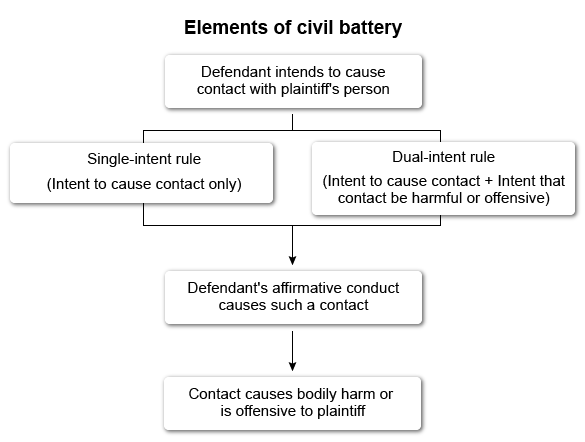
  • the defendant intends to cause a contact with the plaintiff's person
  • the defendant's affirmative conduct causes such a contact and
  • the contact causes bodily harm or is offensive to the plaintiff.

An act is intentional if the defendant acts with the purpose of causing the consequences of the act or knows that the consequences are substantially certain to result. In most jurisdictions, a mentally impaired person is not excluded from liability for intentional acts if that person could form the requisite mental state.

Here, the client struck the visitor, causing harmful contact. However, because of her hallucination, the client believed she was striking a dangerous animal rather than the visitor. Because this negates the intent to cause contact with the plaintiff's person, a required element of battery is lacking. Therefore, this is the strongest argument that the client is not liable for battery.

(Choice B) Under the single-intent rule, a defendant may be liable for any intentional contact that is harmful or offensive—regardless of whether the defendant intended it to be harmful or offensive. Therefore, lack of intent to cause serious injury does not defeat liability.

(Choice C) A mentally impaired person may be liable for battery if the person is capable of forming the intent to strike another—even if the person is incapable of comprehending the wrongfulness of the act. Accordingly, this argument does not support a defense to the battery claim.

(Choice D) Battery requires proof of harmful or offensive (not deadly) contact with the plaintiff. Therefore, the client's use of nondeadly force does not negate this element of battery.

Educational objective:
A mentally impaired person is not excluded from liability for an intentional act so long as the person was able to form the requisite mental state (e.g., battery requires the intent to cause contact with the plaintiff's person).

Bluebook Citations :
  • Restatement (Third) of Torts: Liability for Physical and Emotional Harm § 1 (Am. L. Inst., Tentative Draft No. 6, 2021) (explaining that mentally impaired individuals are not excluded from liability for intentional torts).
  • NCBE Content Scope Outline Torts I.A.2. Battery (Starred)
  • Foundational Skill B8: Identify which claims to recommend bringing, which remedies to recommend seeking, which evidence to present, which arguments or defenses to raise, or how to respond to arguments or defenses, based on the relevant legal rules and standards and consistent with a client's objectives, interests, and constraints.

Integrated Question Set: Task Materials

Your law firm supervisor has asked you to assist a client. The client is an auto dealership that sells motor vehicles to the public. The dealership recently contracted with an electric car manufacturer that failed to perform under the contract. Your supervisor has interviewed the owner of the auto dealership, who will be your client contact.

The following is an excerpt of the notes from the client interview:

  • The client entered into a contract with a manufacturer for the purchase of 100 state-of-the-art electric cars of a type available only from that manufacturer.
  • The manufacturer identified the cars under the contract, and delivery was promised for September 1 so the dealership could sell the cars at an advertised sales event on September 1. The date of this sales event was written into the contract.
  • The client advertised a major sales event to take place on September 1, the purpose of which was to sell the electric cars.
  • The manufacturer failed to deliver the cars on September 1 as promised. It did not notify the client in advance that it would not be delivering the cars.
  • The client canceled the sales event on the day of the event after being unable to find an alternative source for this car or a similar one.
  • When the client contacted the manufacturer about its failure to deliver the cars, the manufacturer did not respond until September 7.
  • The manufacturer admitted that it had not shipped any cars to the dealership. The cars are now ready for sale, but the manufacturer does not want to ship them to the dealership because it has found a new buyer who is willing to pay significantly more for the cars.

End of excerpt

The contract does not address damages. You have determined that the contract is enforceable and that it is governed by the Franklin Commercial Code.

You consider what potential remedies are available to the client if it pursues a breach of contract claim against the manufacturer for failing to deliver the cars.

You locate the following provisions of the Franklin Commercial Code:

§ 102-11 Buyer's Incidental and Consequential Damages

. . .

(2) Consequential damages resulting from the seller's breach include

(a) any loss resulting from general or particular requirements and needs of which the seller at the time of contracting had reason to know and which could not reasonably be prevented by cover or otherwise;

. . .

§ 102-12 Remedies for Breach of Contract; Specific Performance or Replevin

(1) Specific performance may be ordered if the goods are unique or in other proper circumstances.

(2) . . .

(3) The buyer has a right of replevin for goods identified to the contract if the buyer is unable to effect cover for such goods or the circumstances reasonably indicate that such effort will be unavailing.

End of excerpts

Now answer Component 1.

Notwithstanding any other available remedies, the client decides to sue the manufacturer for damages.

Discovery reveals that the manufacturer is a corporation with only two shareholders and that there are no shareholder agreements. You also determine that the manufacturer was established as a corporation only three years ago and that the two shareholders provided the initial investment to start the manufacturer. The initial investment was an appropriate amount for this type of manufacturing venture. Both shareholders serve on the manufacturer's nine-person board of directors. The board of directors has met once in three years. The two shareholders are the only two shareholders of two other small corporations. The manufacturer has its own bank account from which it pays the salaries of its employees, the property taxes of a property that the shareholders personally own but hope to use to expand the manufacturer's business at some point, and the lease and insurance for the manufacturing plant.

You consider whether you should pursue an argument that the two shareholders should be held personally liable for the manufacturer's possible liability for breach of contract.

Component 1: Given § 102-11 and § 102-12, identify two specific facts that support the client's position that it is entitled to consequential damages from the manufacturer for its lost profits.

Provide one answer in each answer field. The length of each answer should be about one sentence.

Answer

Submit Next Question

Explanation:

Under the Uniform Commercial Code (UCC) (consistent with the Franklin Commercial Code (FCC)), consequential damages from the seller's breach include losses resulting from general or particular requirements and needs (1) of which the seller had reason to know at the time of contracting and (2) which could not reasonably be prevented by cover or otherwise.

Here, when the manufacturer failed to meet the requirement of delivering the cars in time for the September 1 sales event, the client had to cancel the event. The manufacturer knew at the time of contracting that the client was holding the sales event on September 1 because the sales event was included in the contract. The client could not have reasonably prevented the loss, because it could not find another source (i.e., cover) for the cars. Therefore, these facts support the client's position that it is entitled to consequential damages from the manufacturer.

Educational objective:
Under the Uniform Commercial Code, consequential damages are losses resulting from general or particular requirements and needs of which the seller had reason to know at the time of contracting and which could not be reasonably prevented by cover or otherwise.

Integrated Question Set: Task Materials

Your law firm supervisor has asked you to assist a client. The client is an auto dealership that sells motor vehicles to the public. The dealership recently contracted with an electric car manufacturer that failed to perform under the contract. Your supervisor has interviewed the owner of the auto dealership, who will be your client contact.

The following is an excerpt of the notes from the client interview:

  • The client entered into a contract with a manufacturer for the purchase of 100 state-of-the-art electric cars of a type available only from that manufacturer.
  • The manufacturer identified the cars under the contract, and delivery was promised for September 1 so the dealership could sell the cars at an advertised sales event on September 1. The date of this sales event was written into the contract.
  • The client advertised a major sales event to take place on September 1, the purpose of which was to sell the electric cars.
  • The manufacturer failed to deliver the cars on September 1 as promised. It did not notify the client in advance that it would not be delivering the cars.
  • The client canceled the sales event on the day of the event after being unable to find an alternative source for this car or a similar one.
  • When the client contacted the manufacturer about its failure to deliver the cars, the manufacturer did not respond until September 7.
  • The manufacturer admitted that it had not shipped any cars to the dealership. The cars are now ready for sale, but the manufacturer does not want to ship them to the dealership because it has found a new buyer who is willing to pay significantly more for the cars.

End of excerpt

The contract does not address damages. You have determined that the contract is enforceable and that it is governed by the Franklin Commercial Code.

You consider what potential remedies are available to the client if it pursues a breach of contract claim against the manufacturer for failing to deliver the cars.

You locate the following provisions of the Franklin Commercial Code:

§ 102-11 Buyer's Incidental and Consequential Damages

. . .

(2) Consequential damages resulting from the seller's breach include

(a) any loss resulting from general or particular requirements and needs of which the seller at the time of contracting had reason to know and which could not reasonably be prevented by cover or otherwise;

. . .

§ 102-12 Remedies for Breach of Contract; Specific Performance or Replevin

(1) Specific performance may be ordered if the goods are unique or in other proper circumstances.

(2) . . .

(3) The buyer has a right of replevin for goods identified to the contract if the buyer is unable to effect cover for such goods or the circumstances reasonably indicate that such effort will be unavailing.

End of excerpts

Now answer Component 2.

Notwithstanding any other available remedies, the client decides to sue the manufacturer for damages.

Discovery reveals that the manufacturer is a corporation with only two shareholders and that there are no shareholder agreements. You also determine that the manufacturer was established as a corporation only three years ago and that the two shareholders provided the initial investment to start the manufacturer. The initial investment was an appropriate amount for this type of manufacturing venture. Both shareholders serve on the manufacturer's nine-person board of directors. The board of directors has met once in three years. The two shareholders are the only two shareholders of two other small corporations. The manufacturer has its own bank account from which it pays the salaries of its employees, the property taxes of a property that the shareholders personally own but hope to use to expand the manufacturer's business at some point, and the lease and insurance for the manufacturing plant.

You consider whether you should pursue an argument that the two shareholders should be held personally liable for the manufacturer's possible liability for breach of contract.

Component 2: Given § 102-11 and § 102-12, identify one claim the client may have that it is entitled to a nonmonetary remedy, and explain how the facts now known support the claim.

Provide your answer in the answer field. The length of your answer should be about two to three sentences.

Answer

Submit Next Question

Explanation:

Buyer's right to obtain goods from seller

Under the Uniform Commercial Code (UCC) (which is consistent with the FCC), a buyer may demand specific performance for unique goods. In addition, specific performance may be had in other proper circumstances, and an inability to cover is strong evidence of such circumstances.

Here, the state-of-the-art electric cars are only available from the manufacturer (i.e., unique goods). Accordingly, the client was unable to cover. Therefore, this fact supports a claim for specific performance.

Alternatively, a buyer can obtain identified, undelivered goods from the seller through a claim for replevin if:

  • the buyer is unable to cover or
  • the circumstances reasonably indicate that reasonable effort to obtain cover will be unavailing.

Here, the manufacturer identified the cars under the contract but did not deliver them, and the client was unable to cover by finding substitute vehicles. Therefore, these facts support a claim for replevin.

Educational objective:
Under the Uniform Commercial Code, a buyer may demand specific performance when the goods are unique or when proper circumstances exist. The buyer has a right of replevin to obtain identified, undelivered goods from the seller if the buyer is unable to cover.

Integrated Question Set: Task Materials

Your law firm supervisor has asked you to assist a client. The client is an auto dealership that sells motor vehicles to the public. The dealership recently contracted with an electric car manufacturer that failed to perform under the contract. Your supervisor has interviewed the owner of the auto dealership, who will be your client contact.

The following is an excerpt of the notes from the client interview:

  • The client entered into a contract with a manufacturer for the purchase of 100 state-of-the-art electric cars of a type available only from that manufacturer.
  • The manufacturer identified the cars under the contract, and delivery was promised for September 1 so the dealership could sell the cars at an advertised sales event on September 1. The date of this sales event was written into the contract.
  • The client advertised a major sales event to take place on September 1, the purpose of which was to sell the electric cars.
  • The manufacturer failed to deliver the cars on September 1 as promised. It did not notify the client in advance that it would not be delivering the cars.
  • The client canceled the sales event on the day of the event after being unable to find an alternative source for this car or a similar one.
  • When the client contacted the manufacturer about its failure to deliver the cars, the manufacturer did not respond until September 7.
  • The manufacturer admitted that it had not shipped any cars to the dealership. The cars are now ready for sale, but the manufacturer does not want to ship them to the dealership because it has found a new buyer who is willing to pay significantly more for the cars.

End of excerpt

The contract does not address damages. You have determined that the contract is enforceable and that it is governed by the Franklin Commercial Code.

You consider what potential remedies are available to the client if it pursues a breach of contract claim against the manufacturer for failing to deliver the cars.

You locate the following provisions of the Franklin Commercial Code:

§ 102-11 Buyer's Incidental and Consequential Damages

. . .

(2) Consequential damages resulting from the seller's breach include

(a) any loss resulting from general or particular requirements and needs of which the seller at the time of contracting had reason to know and which could not reasonably be prevented by cover or otherwise;

. . .

§ 102-12 Remedies for Breach of Contract; Specific Performance or Replevin

(1) Specific performance may be ordered if the goods are unique or in other proper circumstances.

(2) . . .

(3) The buyer has a right of replevin for goods identified to the contract if the buyer is unable to effect cover for such goods or the circumstances reasonably indicate that such effort will be unavailing.

End of excerpts

Now answer Component 3.

As discovery progresses, you begin to suspect that the manufacturer may claim commercial impracticability as a defense to any liability for failing to perform under the contract. You learn that a supplier of critical parts to the cars failed to deliver the parts to the manufacturer. As a result, the manufacturer had to locate a new supplier, who charged a significantly higher price. You review the contract and note that no particular supplier is named in the contract.

You research the issue and locate the following provision of the Franklin Commercial Code:

§ 32-355 Defenses; Impracticability

(a) Except so far as a seller may have assumed a greater obligation, delay in delivery or nondelivery in whole or in part by a seller is not a breach of the seller's duty under a contract for sale if performance as agreed has been made impracticable by the occurrence of a contingency the nonoccurrence of which was a basic assumption on which the contract was made and the seller notifies the buyer seasonably that there will be delay or nondelivery.

(b) When a particular source of supply is exclusive under the agreement and fails, the present section applies.

End of statute

Component 3: Which of the following facts best support the position that the two shareholders of the manufacturer should be personally liable for any damage award against the manufacturer?

Select two response options.

  1. The manufacturer pays for the property taxes of a property that the shareholders personally own but hope to use to expand the manufacturer at some point.
  2. The manufacturer was established only three years ago.
  3. The manufacturer's board of directors has met once in three years.
  4. The two shareholders are the only two shareholders of two other small corporations.
  5. The two shareholders provided the initial investment to start the manufacturer.
  6. The two shareholders serve on the manufacturer's board of directors.
Submit Next Question

Explanation:

Piercing the veil of limited liability

Shareholders, as investors in a corporation, are subject to limited liability for corporate conduct—they are generally only at risk to the extent of their investment. However, courts may pierce the corporate veil and allow for individual shareholder liability under certain circumstances. In deciding whether to pierce the veil, courts look to factors such as:

  • undercapitalization of the corporation at the time of formation

  • disregard of corporate formalities

  • intermingling of corporate and personal assets

  • use of corporate assets for personal purposes

  • self-dealing with the corporation and

  • whether the corporation is being used as a "façade" for a dominant shareholder's personal dealings (i.e., whether it is an "alter ego" of the shareholder).

Here, the manufacturer pays for the property taxes of a property that the shareholders personally own. This fact supports piercing the veil because it evidences an intermingling of corporate and personal assets and the use of corporate assets for personal purposes. Additionally, the fact that the manufacturer's board of directors has met only once in three years evidences a disregard of corporate formalities. Therefore, these facts best support the position that the two shareholders of the manufacturer should be personally liable for any damage award against the manufacturer.

(Choice B) The date a corporation was established is not a factor courts consider in deciding whether to pierce the corporate veil.

(Choice D) The fact that the shareholders are the only two shareholders of two other small corporations does not by itself suggest a basis for piercing the veil.

(Choice E) Absent evidence that the shareholders intentionally undercapitalized the corporation at the time of formation, the fact that the two shareholders provided the initial investment is not a basis for piercing the corporate veil.

(Choice F) The fact that the shareholders are two of the nine directors on the board of directors of the manufacturer does not, without more, establish that they are the sole decision-makers of the corporation.

Educational objective:
Shareholders, as investors in a corporation, are subject to limited liability for corporate conduct—they are generally only at risk to the extent of their investment. However, courts may pierce the corporate veil and allow for individual shareholder liability under certain circumstances.

Integrated Question Set: Task Materials

Your law firm supervisor has asked you to assist a client. The client is an auto dealership that sells motor vehicles to the public. The dealership recently contracted with an electric car manufacturer that failed to perform under the contract. Your supervisor has interviewed the owner of the auto dealership, who will be your client contact.

The following is an excerpt of the notes from the client interview:

  • The client entered into a contract with a manufacturer for the purchase of 100 state-of-the-art electric cars of a type available only from that manufacturer.
  • The manufacturer identified the cars under the contract, and delivery was promised for September 1 so the dealership could sell the cars at an advertised sales event on September 1. The date of this sales event was written into the contract.
  • The client advertised a major sales event to take place on September 1, the purpose of which was to sell the electric cars.
  • The manufacturer failed to deliver the cars on September 1 as promised. It did not notify the client in advance that it would not be delivering the cars.
  • The client canceled the sales event on the day of the event after being unable to find an alternative source for this car or a similar one.
  • When the client contacted the manufacturer about its failure to deliver the cars, the manufacturer did not respond until September 7.
  • The manufacturer admitted that it had not shipped any cars to the dealership. The cars are now ready for sale, but the manufacturer does not want to ship them to the dealership because it has found a new buyer who is willing to pay significantly more for the cars.

End of excerpt

The contract does not address damages. You have determined that the contract is enforceable and that it is governed by the Franklin Commercial Code.

You consider what potential remedies are available to the client if it pursues a breach of contract claim against the manufacturer for failing to deliver the cars.

You locate the following provisions of the Franklin Commercial Code:

§ 102-11 Buyer's Incidental and Consequential Damages

. . .

(2) Consequential damages resulting from the seller's breach include

(a) any loss resulting from general or particular requirements and needs of which the seller at the time of contracting had reason to know and which could not reasonably be prevented by cover or otherwise;

. . .

§ 102-12 Remedies for Breach of Contract; Specific Performance or Replevin

(1) Specific performance may be ordered if the goods are unique or in other proper circumstances.

(2) . . .

(3) The buyer has a right of replevin for goods identified to the contract if the buyer is unable to effect cover for such goods or the circumstances reasonably indicate that such effort will be unavailing.

End of excerpts

Now answer Component 4.

While the suit against the manufacturer is ongoing, the owner of the auto dealership calls you with an additional concern. He is upset about a news article on a popular local news website about the canceled electric car sales event. The owner fears that the dealership's sales have decreased as a result and that its reputation has been damaged. You read the article and determine that some statements in it are untrue. The owner is irritated that he was not offered an opportunity to share why the sales event was canceled.

The owner asks you to reach out to the news website to negotiate a resolution.

Component 4: List two specific arguments that support the client's position that the manufacturer does not have a defense of commercial impracticability under § 32-355.

Provide one answer in each answer field. The length of each answer should be about one sentence.

Answer

Submit Next Question

Explanation:

impracticability defense

A party's duty to perform can be discharged by impracticability. Under Franklin Commercial Code (FCC) § 32-355, impracticability is available as a defense to failure to deliver goods under a contract if:

  • performance has become impracticable because of the occurrence of a contingency
  • the nonoccurrence of the contingency was a basic assumption on which the contract was made and
  • the seller seasonably notifies the buyer that there will be nondelivery.

This impracticability defense applies when a particular supply source is exclusive under the agreement and fails.

Here, the manufacturer may raise impracticability as a defense based on the failure of a supplier to deliver critical parts. But the client can argue that this defense should fail because the manufacturer cannot meet the requirements of FCC § 32-355, as (1) there is no indication that the performance of the supplier that failed was a basic assumption of the client's contract with the manufacturer, (2) the manufacturer did not provide seasonable notice, and (3) the contract did not make the supplier the exclusive source of the parts under the agreement.

Educational objective:
A party's duty to perform under a contract can be discharged if performance has become impracticable.

Integrated Question Set: Task Materials

Your law firm supervisor has asked you to assist a client. The client is an auto dealership that sells motor vehicles to the public. The dealership recently contracted with an electric car manufacturer that failed to perform under the contract. Your supervisor has interviewed the owner of the auto dealership, who will be your client contact.

The following is an excerpt of the notes from the client interview:

  • The client entered into a contract with a manufacturer for the purchase of 100 state-of-the-art electric cars of a type available only from that manufacturer.
  • The manufacturer identified the cars under the contract, and delivery was promised for September 1 so the dealership could sell the cars at an advertised sales event on September 1. The date of this sales event was written into the contract.
  • The client advertised a major sales event to take place on September 1, the purpose of which was to sell the electric cars.
  • The manufacturer failed to deliver the cars on September 1 as promised. It did not notify the client in advance that it would not be delivering the cars.
  • The client canceled the sales event on the day of the event after being unable to find an alternative source for this car or a similar one.
  • When the client contacted the manufacturer about its failure to deliver the cars, the manufacturer did not respond until September 7.
  • The manufacturer admitted that it had not shipped any cars to the dealership. The cars are now ready for sale, but the manufacturer does not want to ship them to the dealership because it has found a new buyer who is willing to pay significantly more for the cars.

End of excerpt

The contract does not address damages. You have determined that the contract is enforceable and that it is governed by the Franklin Commercial Code.

You consider what potential remedies are available to the client if it pursues a breach of contract claim against the manufacturer for failing to deliver the cars.

You locate the following provisions of the Franklin Commercial Code:

§ 102-11 Buyer's Incidental and Consequential Damages

. . .

(2) Consequential damages resulting from the seller's breach include

(a) any loss resulting from general or particular requirements and needs of which the seller at the time of contracting had reason to know and which could not reasonably be prevented by cover or otherwise;

. . .

§ 102-12 Remedies for Breach of Contract; Specific Performance or Replevin

(1) Specific performance may be ordered if the goods are unique or in other proper circumstances.

(2) . . .

(3) The buyer has a right of replevin for goods identified to the contract if the buyer is unable to effect cover for such goods or the circumstances reasonably indicate that such effort will be unavailing.

End of excerpts

Now answer Component 5.

The client and the news website reach a negotiated resolution. Shortly after, the dealership owner emails you about another issue. The following is an excerpt from the email:

To: [You]

From: [Dealership owner]

Subject: Employee's Social Media Post

We just hired a new employee to service and repair cars. She had been employed for only two weeks when she accessed one of the dealership's social media accounts without permission and posted that the electric car manufacturer had taken the dealership's money even though the manufacturer knew that it would never deliver the cars the dealership ordered. The post was taken down as soon as we discovered it, which was about 24 hours after she posted it. We reprimanded the employee after the incident. What happens if the manufacturer sues the dealership for the employee's actions?

End of excerpt

Component 5: Identify two potential terms of an agreement that could lead to a negotiated resolution of the dispute with the news website, taking into consideration the client's known objectives, interests, and constraints.

Provide one answer in each answer field. The length of each answer should be about one sentence.

Answer


Submit Next Question

Explanation:

In formulating possible settlement terms, an attorney must consider the parties' primary objectives and any collective or congruent concerns or objectives that motivate the parties. The attorney must determine what each party is willing to concede (i.e., mere preferences rather than primary goals). The attorney may also consider the relationship history between the parties and whether the parties have an interest in preserving or creating a public image or reputation that may be impacted differently by a public trial or private settlement.

Here, the dealership's owner is concerned that the dealership's sales have decreased as a result of the article and that its reputation has been damaged. The owner is particularly upset that he was not given the opportunity to explain why the sales event was canceled. In addition, you have determined that some of the statements in the article are false, and the news website may have an interest in avoiding defamation litigation.

Accordingly, the agreement should seek a resolution that will allow the dealership to restore its reputation and potentially end the decrease in sales. Two ways of doing this are providing the client with an opportunity to explain why the event was canceled and publishing a new, factually accurate article. Any proposed terms can be contingent on the client agreeing not to take legal action against the news website, which would help meet the news website's likely objective of avoiding litigation.

Educational objective:
In formulating possible settlement terms, an attorney must consider the parties' primary objectives and any collective or congruent concerns or objectives that motivate the parties.

Integrated Question Set: Task Materials

Your law firm supervisor has asked you to assist a client. The client is an auto dealership that sells motor vehicles to the public. The dealership recently contracted with an electric car manufacturer that failed to perform under the contract. Your supervisor has interviewed the owner of the auto dealership, who will be your client contact.

The following is an excerpt of the notes from the client interview:

  • The client entered into a contract with a manufacturer for the purchase of 100 state-of-the-art electric cars of a type available only from that manufacturer.
  • The manufacturer identified the cars under the contract, and delivery was promised for September 1 so the dealership could sell the cars at an advertised sales event on September 1. The date of this sales event was written into the contract.
  • The client advertised a major sales event to take place on September 1, the purpose of which was to sell the electric cars.
  • The manufacturer failed to deliver the cars on September 1 as promised. It did not notify the client in advance that it would not be delivering the cars.
  • The client canceled the sales event on the day of the event after being unable to find an alternative source for this car or a similar one.
  • When the client contacted the manufacturer about its failure to deliver the cars, the manufacturer did not respond until September 7.
  • The manufacturer admitted that it had not shipped any cars to the dealership. The cars are now ready for sale, but the manufacturer does not want to ship them to the dealership because it has found a new buyer who is willing to pay significantly more for the cars.

End of excerpt

The contract does not address damages. You have determined that the contract is enforceable and that it is governed by the Franklin Commercial Code.

You consider what potential remedies are available to the client if it pursues a breach of contract claim against the manufacturer for failing to deliver the cars.

You locate the following provisions of the Franklin Commercial Code:

§ 102-11 Buyer's Incidental and Consequential Damages

. . .

(2) Consequential damages resulting from the seller's breach include

(a) any loss resulting from general or particular requirements and needs of which the seller at the time of contracting had reason to know and which could not reasonably be prevented by cover or otherwise;

. . .

§ 102-12 Remedies for Breach of Contract; Specific Performance or Replevin

(1) Specific performance may be ordered if the goods are unique or in other proper circumstances.

(2) . . .

(3) The buyer has a right of replevin for goods identified to the contract if the buyer is unable to effect cover for such goods or the circumstances reasonably indicate that such effort will be unavailing.

End of excerpts

Now answer Component 6.

Component 6: Assuming that the employee's post was defamatory, which of the following provides the best defense to a possible claim by the manufacturer that the dealership is vicariously liable for the tortious action of the employee?

Select one response option.

  1. The employee had only been employed by the dealership for two weeks when the incident occurred.
  2. The employee was reprimanded for her actions.
  3. The employee's job was to service and repair cars at the dealership.
  4. The post was taken down as soon as the dealership discovered it, which was about 24 hours after it was posted.
Submit

Explanation:

Establishing principal's tort liability under respondeat superior

Vicarious liability is a form of strict liability in which one person is liable for the tortious actions of another. An employer is vicariously liable for an employee's tortious conduct when:

  • an employer-employee relationship exists and

  • the employee's tortious conduct occurs within the scope of employment—i.e., while the employee is performing assigned work.

Here, the employee was hired to service and repair cars—not to make social media posts. Therefore, the client's best defense to vicarious liability is that the employee's tortious conduct did not occur within the scope of her employment.

(Choices A, B, and D) The duration of the employee's employment, the fact that she was reprimanded, and the fact that the post was taken down quickly would not prevent vicarious liability.

Educational objective:
An employer may be held vicariously liable for its employees' tortious conduct when there is an employer-employee relationship and the tortious conduct occurs within the scope of employment.

Frequently Asked Questions

Torts is 1 of 7 MBE subjects and typically accounts for around 25 questions on the exam. Within Torts, negligence is the most heavily tested topic, making up approximately half of those questions. This means a strong grasp of duty, breach, causation, damages, and defenses is essential to score well.

Negligence is the highest priority because it accounts for approximately half of the Torts questions on the MBE and provides the foundation for many integrated fact patterns. You should also focus on intentional torts, strict liability, and products liability, as these areas are consistently tested. Defenses and damages are also important because they often determine the final outcome in both MBE and NextGen questions.

The NextGen UBE tests Torts through a variety of practical, scenario-based formats, including multiple-choice questions, integrated question sets, and performance tasks. You may be required to analyze a fact pattern, evaluate liability, apply defenses, and determine damages in a structured response. These formats place greater emphasis on legal reasoning, factual analysis, and application of legal principles than traditional standalone multiple-choice questions.

Memorization is necessary but not sufficient. You must know the elements of each tort and the relevant defenses, but success depends on your ability to apply those rules to facts. Both the MBE and NextGen UBE test your ability to apply legal principles to facts, not merely recall blackletter law.

Effective practice involves more than selecting the correct answer. You should review explanations for every question, understand why incorrect choices are wrong, and identify patterns in how issues are tested. This approach improves both accuracy on the MBE and analytical skills for the NextGen UBE.

Causation is challenging because it requires both actual cause and proximate cause, and questions often turn on subtle distinctions. Proximate cause, in particular, focuses on foreseeability and often requires determining whether an intervening event rises to the level of a superseding cause that breaks the chain of liability. These nuances make it one of the most tested and commonly missed areas.

Read About Other Bar Exam Subjects

Civil Procedure

Master jurisdiction, motions, and trial rules with clear breakdowns and practice that mirrors how questions actually appear. 

Contracts

Learn how contracts are formed, enforced, and breached through real exam scenarios and high-yield rule application. 

Constitutional Law 

How far does the Commerce Clause reach? Master MBE and NextGen UBE constitutional law: judicial review, federalism, and individual rights.

Criminal Law & Procedure

Understand crimes, defenses, and constitutional protections with fact patterns that reflect real testing scenarios.

Evidence

Cut through complex rules on admissibility, relevance, and hearsay with practical examples and exam-focused explanations. 

Real Property

Tackle ownership, transfers, and land use with structured explanations and patterns that show up repeatedly on the exam. 

References

  1. National Conference of Bar Examiners. (n.d.). MBE. Retrieved from

    https://www.ncbex.org/exams/mbe

  2. National Conference of Bar Examiners. (n.d.). Preparing for the MBE. Retrieved from

    https://www.ncbex.org/exams/mbe/preparing-mbe

  3. National Conference of Bar Examiners. (2025). NextGen UBE content scope.

    https://www.ncbex.org/sites/default/files/2025-07/NCBE%20NextGen%20UBE%20Content%20Scope-Aug%202025.pdf

  4. National Conference of Bar Examiners. (2023). MBE subject matter outline. Retrieved from

    https://www.ncbex.org/sites/default/files/2023-01/MBE_Subject_Matter_Outline.pdf

View More...
Scroll to Top

Ready to Enroll?

Go to UWorld Checkout
Please select a state to continue.