What Contracts Covers on the Bar Exam
Contracts questions focus on how agreements are formed, interpreted, performed, and enforced. On the Multistate Bar Examination (MBE®), testing centers on applying common law and Uniform Commercial Code (UCC) principles to identify the correct outcome within a single issue. The NextGen Uniform Bar ExaminationTM (Next Gen UBE) builds on the same rules but requires working through multiple issues within a single fact pattern, especially around breach and remedies.
MBE® Contracts Topic Breakdown
To prepare for the Contracts section of the bar exam, it's important to know how it's organized, which MBE topics are covered, and how they are weighted. The National Conference of Bar Examiners (NCBE®) has based the majority of the questions on common law, while the remaining 25% focus on Articles 1 and 2 of the UCC. When approaching any contract question on the MBE, determine whether to apply common law or the UCC, which is for the sale of goods.1,2
Questions are divided into 6 categories, with some topics tested more heavily than others. For example, 50% of the questions will fall under either Formation of Contracts or Performance, Breach, and Discharge, with each having 6-7 questions. The remaining 50% of the questions will deal with the other 4 categories: Defenses to Enforceability, Contract Content and Meaning, Remedies, and Third-Party Rights, each with 3-4 questions.4
| Contracts Subtopics | % Tested | Number of Questions |
|---|---|---|
| Formation of Contracts | 25% | 6-7 |
| Performance, Breach, and Discharge | 25% | 6-7 |
| Defenses to Enforceability | 12.5% | 3-4 |
| Contract Content and Meaning | 12.5% | 3-4 |
| Remedies | 12.5% | 3-4 |
| Third-Party Rights | 12.5% | 3-4 |
| Total scored questions for Civil Procedure | 25 | |
The breakdown above reflects the National Conference of Bar Examiners (NCBE®) published MBE subject matter outline. Contracts is 1 of 7 subjects tested on the MBE alongside Civil Procedure, Constitutional Law, Criminal Law & Procedure, Evidence, Real Property, and Torts.
Formation of Contracts
About 6-7 questions on the MBE will be on the formation of contracts. Under common law, an acceptance must be the "mirror image" of the offer, or it will be considered rejected. The UCC follows the "battle of the forms" doctrine, under which an acceptance containing different terms is still enforceable.
It's important to determine exactly when a contract was formed. Often, the NCBE will present a series of interactions between 2 parties, and it is up to you to order and classify them correctly (i.e., offer, acceptance, consideration) to determine whether there was mutual consent and, as a result, a valid contract.
Performance, Breach, and Discharge
Another 6-7 questions on the MBE will address performance, breach, and discharge of contracts. Under common law, you must decide whether there was a breach or whether the performance was substantial enough for the other party to be obligated to perform their duty. Under the UCC, the seller must provide a perfect tender of goods for 1-shot deals, or the buyer can reject them (although the seller usually has time to correct the mistake). Other topics within this category include instalment contracts, express conditions, warranties, impossibility/impracticability, and frustration of purpose.
Defenses to Enforceability
You will find 3-4 questions on defenses to enforceability on the MBE Contracts subcategory. In some cases, such as when at least 1 party is a minor or incapacitated, there is a mutual misunderstanding, or there was deliberate fraud, it is easy to spot when a contract is not enforceable. Other times, the scenario is less obvious, so you should consider whether it falls within the Statute of Frauds.
The Statute of Frauds covers the common law contracts for the sale of land, marriage, agreements involving goods worth more than $500, and contracts lasting 1 year or more. Additionally, it covers UCC contract issues regarding the merchant exception and the maximum quantity of goods to be received. These instances require that the contract be in writing, contain the material terms, and be signed by the "party to be charged."
Contract Content and Meaning
There will be 3-4 questions about contract content and meaning on the MBE. In these cases, you should decide whether the parol evidence rule applies to the scenario. For instance, if a party tries to add terms from the preliminary and/or oral negotiations to the final agreement, it is only allowed if there is partial integration of the contract. So watch out for that merger clause that says, "This is the full and final agreement." Also, note that parol evidence does not apply to additions such as formation defenses, interpretations, conditions precedent, clerical errors, or later modifications.
Remedies
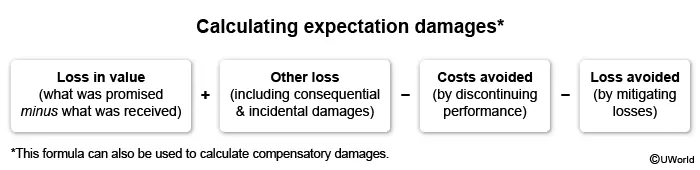
You can expect 3-4 questions about contract remedies, but you most likely know them better as damages. Generally speaking, the nonbreaching party will at least be entitled to expectation damages equal to the value of their position had there not been a breach.5
Therefore, the general formula to calculate damages is as follows: the loss of value of the breaching party's performance + incidental costs + consequential costs - any expenses saved as a result of the breach.6
It's essential to familiarize yourself with all the types of breaches and damages available to a party, such as reliance, restitution, rescission, specific performance, reformation, or remedial rights. When it comes to UCC contracts, which have various damage formulas, the key is to ensure that the non-breaching party has the value it bargained for.
Third-Party Rights
There will be 3-4 questions regarding third-party rights on the MBE. Generally, this means deciding whether a third party has the right to sue on a contract and against whom. The key is correctly identifying the type of situation (i.e., beneficiary, delegation, or assignment).
For example, a common assignment situation would be where Person A owes money to Person B, but Person B assigns the right to receive the money to Person C. In that situation, if Person C does not receive the money, the question may ask whether they can sue and, if so, against whom. Another common scenario is hiring a subcontractor whereby Person A hires Person B to perform a service, but then Person B delegates it to Person C, who doesn't perform. In this case, it's important to remember that delegation is generally permissible even without consent, writing, or consideration when determining whether Person A can sue and, if so, against whom.7
NextGen UBE Contracts Topic Breakdown
The NextGen UBE tests Contracts through integrated, real-world scenarios that require applying multiple rules within a single fact pattern. Instead of isolating one issue, questions often combine formation, performance, breach, and remedies, requiring a structured and complete analysis.
You are expected to evaluate how agreements are formed, identify breakdowns in mutual assent, determine whether obligations were discharged, and analyze the consequences of breach. This includes working through layered facts involving offer and acceptance, consideration, defenses to enforcement, and damages.
| Identification of Governing Law | Performance |
| Formation of Contracts | Breach and Discharge |
| Defenses to Enforceability | Remedies |
| Contract Content and Meaning | Third-Party Rights and Obligations |
Identification of Governing Law
These questions require you to determine whether common law, UCC Article 2, or a hybrid approach governs the transaction. You must evaluate the subject matter of the contract and decide which body of law applies to each issue. In hybrid transactions, you may need to apply different rules to different aspects of the agreement. Identifying the correct governing law is essential, as it shapes how formation, performance, and remedies are analyzed.
Formation of Contracts
Formation questions require you to determine whether a valid agreement exists based on mutual assent and consideration. You must analyze offers, acceptance, and whether the parties intended to be bound, including issues involving definiteness and timing. Scenarios may also test promissory estoppel, restitution, contract modifications, and UCC-specific formation rules such as additional terms and conduct-based agreements.
Defenses to Enforceability
These questions test whether a contract is unenforceable due to legal defenses. You must evaluate issues such as incapacity, duress, mistake, fraud, illegality, and unconscionability. You may also need to analyze whether the Statute of Frauds applies, whether its requirements are satisfied, and how electronic transactions affect enforceability.
Contract Content and Meaning
These questions require you to interpret contract terms and resolve disputes over meaning. You must determine whether the language is ambiguous and apply rules of interpretation to identify intent. Scenarios may involve the parol evidence rule, as well as the use of course of dealing, course of performance, and trade usage to explain or supplement terms. You may also need to address omitted or implied terms.
Performance
Performance questions focus on whether contractual obligations have been properly carried out. You must analyze conditions, the duty of good faith and fair dealing, and UCC-specific performance rules. You may also need to evaluate warranties, disclaimers, tender of delivery, rejection, cure, and risk of loss to determine whether performance was adequate or defective.
Breach and Discharge
These questions require you to determine whether a breach has occurred and whether obligations are discharged. You must distinguish between material and partial breaches and assess their legal consequences. Scenarios may also involve anticipatory repudiation, as well as doctrines such as impossibility, impracticability, frustration of purpose, and force majeure.
Remedies
Remedies questions focus on determining the appropriate relief following a breach. You must evaluate expectation damages, reliance, restitution, and the role of liquidated damages. You are also required to apply limitations such as foreseeability and mitigation, and determine when equitable remedies such as specific performance or reformation are appropriate, including under UCC provisions.
Third-Party Rights and Obligations
These questions test how contracts affect third parties. You must determine whether a third-party beneficiary has enforceable rights and when those rights vest. You may also need to analyze assignments and delegations, including how rights and duties are transferred and what defenses can be asserted against third parties under both common law and UCC principles.
MBE vs. NextGen UBE Contracts: Key Differences
While the legal principles tested in Contracts remain consistent, the way they are applied differs between the MBE and the NextGen UBE. Understanding these differences is essential to adjusting your approach and avoiding common mistakes.
| Component | MBE | NextGen UBE |
|---|---|---|
| Format | Standalone multiple-choice questions focused on a single primary issue | Integrated scenarios combining multiple contract issues within 1 fact pattern |
| Issue Scope | Typically tests 1 concept, with limited overlap | Requires analysis of formation, performance, breach, and remedies together |
| Governing Law | Clearly identifiable in most questions | May require applying different rules within the same scenario |
| Depth of Analysis | Focuses on selecting the correct rule and outcome | Requires structured reasoning and evaluation of competing arguments |
| Fact Complexity | More controlled and direct fact patterns | More detailed and layered factual scenarios |
| Skills Tested | Rule recognition and application | Issue-spotting, legal reasoning, and outcome justification |
| Contracts Procedure Weighting | 25 of the 175 scored questions; 1 of 7 equally weighted MBE subjects | 1 of 8 Foundational Concepts and Principles; NCBE has not published per-concept weighting |
Adapting to these differences requires more than memorizing rules. You need to recognize how issues connect, apply the correct framework, and work through each layer of the problem to arrive at a legally sound conclusion.
How to Study Contracts for the Bar Exam
Studying Contracts effectively requires combining rule mastery with consistent application. While the MBE tests your ability to recognize and apply rules in controlled scenarios, the NextGen UBE requires working through layered fact patterns that combine multiple issues. A strong study approach focuses on understanding how rules operate across different contexts and how outcomes are reached.
Master Common Law and UCC Article 2 Rules
You need to know when common law applies and when UCC Article 2 governs, as this distinction affects nearly every contract question. Focus on how formation, modification, performance, and remedies differ under each system. Many questions turn on subtle differences, such as how acceptance is treated or whether consideration is required. Being able to quickly identify the governing law and apply the correct framework is essential for accuracy.
Focus on Highly Tested Topics
Formation, performance, breach, discharge, and remedies make up the core of Contracts testing. These areas appear frequently and often form the foundation for more complex questions. Prioritizing these topics ensures you are prepared for both straightforward MBE questions and multi-issue NextGen scenarios that build on the same concepts.
Practice with Explanations, Not Just Correct Answers
Practice is only effective if you understand why an answer is correct. Reviewing explanations helps you identify gaps in reasoning, clarify rule application, and avoid repeating the same mistakes. UWorld's MBE QBank includes detailed answer explanations for every Contracts question, so you pay close attention to why incorrect options are wrong, as this improves your ability to eliminate traps and refine your decision-making under timed conditions.
Build NextGen Skills With Mixed Practice
To prepare for the NextGen UBE, you need to go beyond multiple-choice questions. Incorporate short written analysis, contract interpretation exercises, and applied scenarios into your practice. Working through mixed formats helps you connect issues, structure your analysis, and develop the ability to handle more complex, integrated fact patterns.
Contracts Practice Questions and Answers
Think you're prepared to tackle Contracts on the bar exam? Below are sample questions from UWorld's Contract question bank, carefully crafted to mirror the style and complexity of NCBE questions:
The owner of a new office building contracted with a well-known landscaper to design and install landscaping around the building for $30,000. The agreement was memorialized in writing, was signed by both parties, and called for a budget of $5,000 for trees, shrubs, sod, and materials. The contract required the landscaper to complete the work within six months. Due to an unexpected increase in the price of trees and shrubs, the landscaper abandoned the project and never completed any of the work.
Three years after the landscaper's deadline, the building owner sued the landscaper for breach of contract. In the jurisdiction, the statute of limitations for breach of a services contract is two years after the breach, and the statute of limitations for breach of a sale-of-goods contract is four years.
Can the owner recover damages from the landscaper?
| A. | No, because the contract is divisible with respect to the services and goods, and the landscaper's breach is therefore subject to the two-year statute of limitations. | |
| B. | No, because the contract primarily calls for services, and the landscaper's breach is therefore subject to the two-year statute of limitations. | |
| C. | Yes, because the landscaper's breach was a result of an increase in the price of goods, and his breach is therefore subject to the four-year statute of limitations. | |
| D. | Yes, because the landscaper's breach was willful, and he is therefore estopped from denying that his breach is subject to the four-year statute of limitations. |
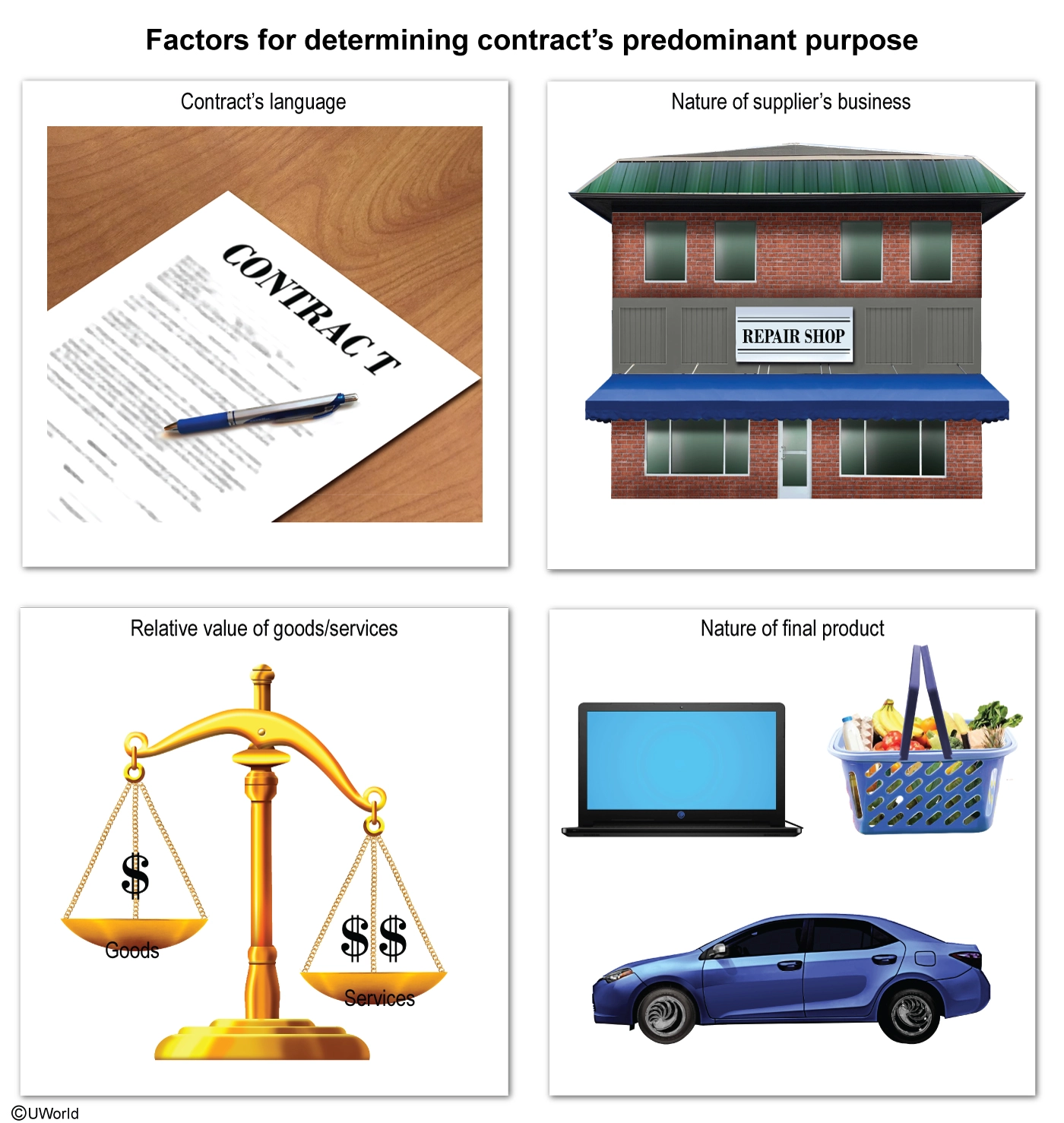
Contracts for the sale of goods are governed by Article 2 of the Uniform Commercial Code (UCC), while contracts for services are governed by common law. However, some contracts involve the sale of goods and the rendering of services. To determine which law applies to a "mixed" or "hybrid" contract, courts ask whether its predominant purpose was the sale of goods or the rendering of services. The following factors are relevant to this determination:
- The contract's language
- The nature of the supplier's business (ie, whether it typically provides goods or services)
- The relative value of the goods and services
- The nature of the final product (ie, whether it can be described as a good or service)
Here, the building owner contracted to buy goods (eg, trees, shrubs, sod) and services (ie, designing and installing the landscaping). The owner likely hired the well-known landscaper due to his skill in performing landscaping services, and the $5,000 budget for goods was just one-sixth of the $30,000 contract price. Therefore, the contract primarily calls for services and is subject to the jurisdiction's two-year statute of limitations. And since the owner sued three years after the breach, the owner cannot recover damages from the landscaper.
(Choice A) The predominant-purpose test is unnecessary when a contract is divisible—ie, when the payment for goods can easily be separated from the payment for services. But here, the contract is likely indivisible since it combined the sale of the trees, shrubs, and sod with their installation.
(Choices C & D) The predominant-purpose test focuses on the parties' reason for entering the contract—not for breaching it. Therefore, it is irrelevant that the landscaper's breach was (1) a result of an increase in the price of goods or (2) willful.
Educational objective:
Sale-of-goods contracts are governed by the UCC, while services contracts are governed by common law. When a contract calls for the sale of goods AND the rendering of services, the contract's primary purpose determines whether the UCC or common law applies.
- Bonebrake v. Cox, 499 F.2d 951, 960 (8th Cir. 1974) (applying the predominant-purpose test to determine which statute of limitations applies to a mixed contract for goods and services).
- Princess Cruises, Inc. v. Gen. Elec. Co., 143 F.3d 828, 833 (4th Cir. 1998) (listing factors that courts consider when applying the predominant-purpose test).
The owner of a gun store had been doing business with a hunter for many years. The hunter entered the gun store and spoke to the owner about purchasing a new hunting rifle on credit. The hunter disclosed that he intended to use the rifle on a turkey-hunting trip that weekend even though it was two weeks before turkey-hunting season began. The hunter left with the rifle after signing a written agreement to pay for the rifle in 12 monthly installments.
The rifle functioned well on the hunter's trip, during which a friend advised the hunter that he could avoid paying for the rifle because the contract was illegal. The hunter took the friend's advice and never paid any installments.
If the store owner sues for breach of contract, will he be likely to prevail?
| A. | No, because the store owner failed to disaffirm the contract's illegal purpose before giving the hunter possession of the rifle. | |
| B. | No, because the store owner knew that the hunter intended to use the rifle for an illegal purpose. | |
| C. | Yes, because a contract to sell a rifle is not, in and of itself, illegal. | |
| D. | Yes, because the store owner substantially performed and did not sell the rifle in order to further the hunter's illegal purpose. |
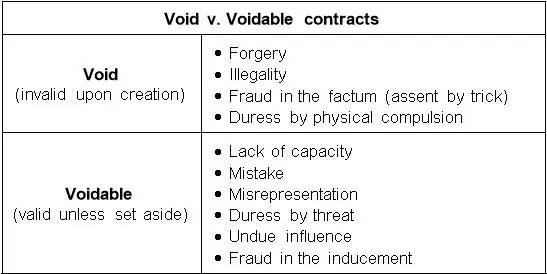
An illegal contract arises when one or both parties' purpose, formation, or performance is against the law. These contracts are usually void, and there is no recovery for breach. However, an exception arises if one party lacked an illegal purpose and substantially performed under the contract. That party may recover expectation damages for breach—even if he/she knew of the other party's illegal purpose.* This is true unless:
- the performing party took action to further the other party's illegal purpose or
- the illegal purpose involves grave social harm (eg, threat to human life).
Here, the contract was illegal because the hunter's purpose was to use the rifle to hunt outside the mandated turkey-hunting season. However, the store owner substantially performed by giving the hunter the rifle and had no illegal purpose of his own. And though the store owner knew of the hunter's illegal purpose, the store owner took no action to further it (Choice B). Additionally, hunting two weeks out of season does not involve grave social harm. Therefore, the store owner will likely prevail in a breach-of-contract suit.
*If the performing party was unaware of the other party's illegal purpose, then no further analysis is necessary.
(Choice A) The store owner did not need to disaffirm the contract's illegal purpose—eg, by telling the hunter not to use the rifle on the upcoming hunting trip. It is enough that the store owner did not act to further the hunter's illegal purpose and there was no threat of grave social harm.
(Choice C) A contract to sell a rifle is not, in and of itself, illegal (absent statutory restrictions—not seen here). But the contract is still illegal because the hunter intended to use the rifle for an illegal purpose.
Educational objective:
Illegal contracts are usually void and there is no recovery for breach. However, a party who substantially performed and lacked an illegal purpose may recover—even if he/she knew of the other party's illegal purpose—unless (1) the performing party took action to further that illegal purpose or (2) the purpose involves grave social harm.
- Restatement (Second) of Contracts § 182 (Am. Law Inst. 1981) (explaining the effect of performance under a contract when the other party's purpose is illegal).
A woman encountered her coworker and the coworker's friend at a local coffee shop. The woman, who knew that the coworker needed a new laptop for his personal use, had planned to offer her extra laptop to the coworker. The woman went to the counter to place her coffee order and, with her back to the table where the coworker and his friend sat, said, "By the way, I know you are looking for a new laptop. I will sell you my laptop for $100." The friend immediately replied, "I accept your offer!"
Has a contract been formed between the friend and the woman?
| A. | No, because the friend was mistaken as to the terms of the contract. | |
| B. | No, because the friend was not the party with whom the woman intended to contract. | |
| C. | Yes, because the friend reasonably believed that he had the power to accept the woman's offer. | |
| D. | Yes, because the woman's objective intent was to contract with whoever overheard the offer. |
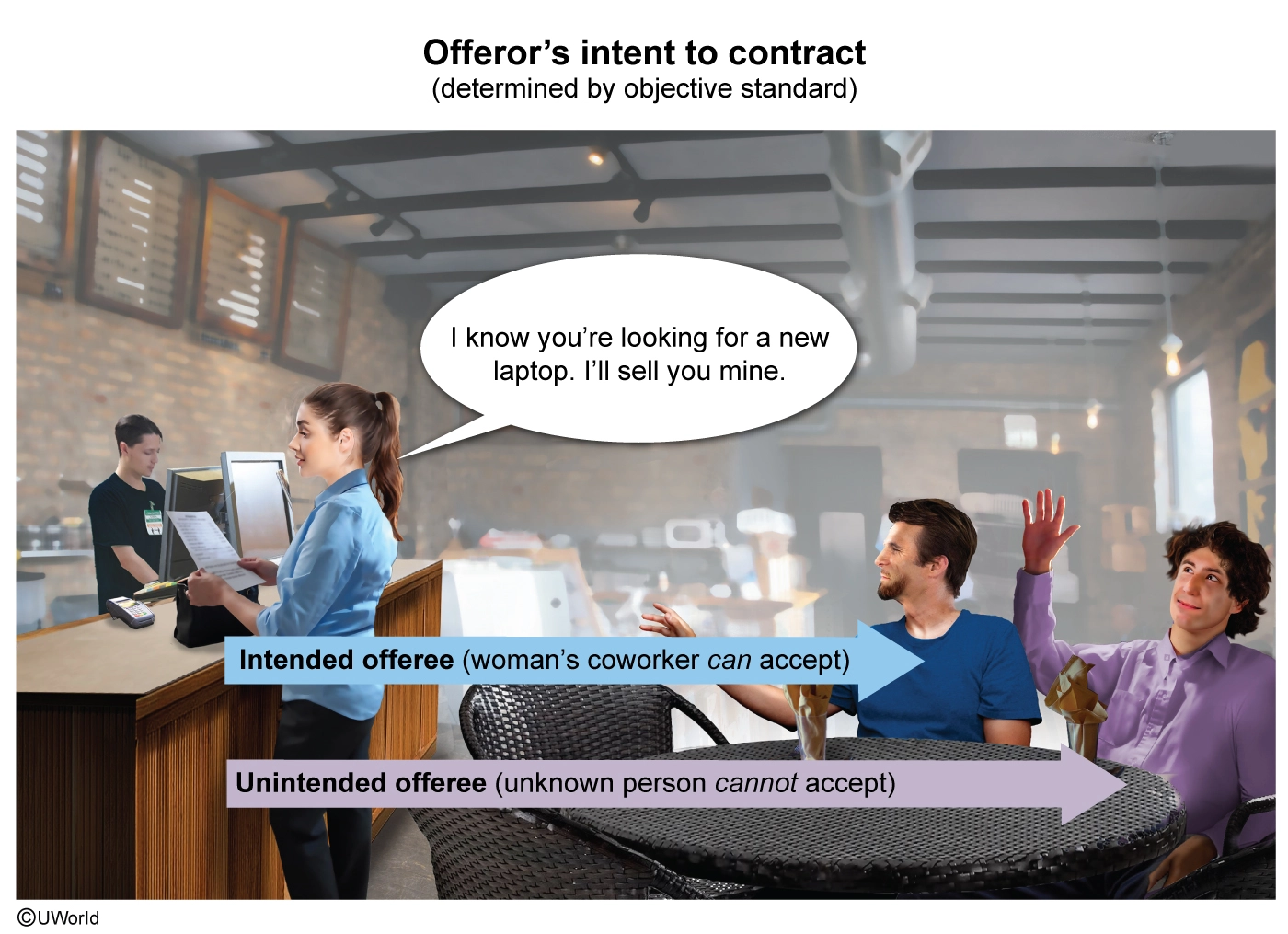
The offeror is master of the offer. This means, among other things, that the power to accept an offer belongs only to the person (or class of persons) with whom the offeror intended to contract. In contract law, intent is measured by an objective standard, not by the subjective intent or belief of a party. Therefore, whether the offeror intended to contract with someone is judged by outward objective facts, as they would be interpreted by a reasonable person.
Here, the woman knew that her coworker needed a new laptop. Her statement—"I know you are looking for a new laptop"—demonstrated her objective intent to contract with the coworker (Choice D). Although the friend overheard the woman's offer to sell her laptop, he could not reasonably believe that he had the power to accept it. This is especially true since there is no indication that the two had ever met (Choice C). Therefore, no contract was formed because the friend was not the party with whom the woman intended to contract.
(Choice A) A mistake as to a basic assumption upon which a contract was made renders the contract voidable—not void. If a contract is voidable, then it is considered valid until set aside. But here, no contract was ever formed because the offer was not accepted by the intended offeree, so this defense is inapplicable.

Educational objective:
The power of acceptance belongs only to the person(s) with whom the offeror intended to contract. Such intent is judged by outward objective facts, as interpreted by a reasonable person.
- Restatement (Second) of Contracts § 29 (Am. Law Inst. 1981) (to whom an offer is addressed).
Your client, a pest control company, properly treated a residence for termites for an agreed upon fee. The client also entered into an agreement with the homeowner obligating the client to repair any damage to the residence caused by termites for four years in exchange for an additional annual fee. The day after the homeowner paid the final annual fee, at the beginning of the fourth year of the agreement, he discovered a termite infestation in the home while changing a light bulb. However, the homeowner did not notify the client of the infestation until the final month of the agreement. The client refused to repair the termite damage.
The homeowner then hired a contractor to repair the termite damage at a cost of $25,000. Had the homeowner notified the client when he first discovered the termite infestation, the cost to repair the damage to the residence would have been $3,000. The homeowner sued the client for breach of their annual repair agreement. The client asks you the amount of damages that it should expect the court to award.
Which of the following amounts most likely reflects the damages that the court would award to the homeowner?
Select one response options.
- $25,000, because this was the cost to repair the termite damage to the residence that occurred within the four-year term of the contract.
- $3,000, because the client was entitled to damages of $22,000 due to the homeowner's breach of his duty to mitigate damages.
- $3,000, because the homeowner failed to timely notify the client of the termite infestation.
- Nothing, because the homeowner waived any rights in law against the client by hiring the contractor..
Explanation:
The primary goal of contract damages is to place the nonbreaching party in the same position as if the contract had been fully performed (i.e., expectation damages). Parties to a contract have a duty to mitigate (i.e., avoid or minimize) damages to the extent reasonably possible, although in doing so they are not required to take any steps that involve undue risk, expense, or inconvenience. Damages that a nonbreaching party could have reasonably mitigated are not recoverable from the breaching party.
Here, the client contracted to repair termite damage to the homeowner's residence for a four-year term. The client breached this contract by refusing to repair termite damage that the homeowner reported during the fourth year. The homeowner incurred $25,000 to repair the termite damage by hiring a replacement contractor (Choice A). However, had the homeowner notified the client about the damage as soon as he discovered it, the cost to repair would have been only $3,000. And because the homeowner failed to mitigate the damage, the court will likely award the homeowner $3,000.
(Choice B) A party does not become liable to another party by breaching its duty to mitigate damages. Failure to mitigate only reduces the damages that the party can recover for breach of contract. This means that the client is not entitled to damages of $22,000 from the homeowner due to the homeowner's failure to mitigate.
(Choice D) The client's refusal to perform in accordance with its contractual obligation to repair the termite damage constituted a breach of contract. The homeowner did not give up the right to seek or obtain damages from the client for its breach by hiring another contractor to perform the repairs in the client's place.
Educational objective:
Parties to a contract have a duty to mitigate damages to the extent reasonably possible. Damages that a nonbreaching party could have reasonably mitigated are not recoverable from the breaching party.
- Restatement (Second) of Contracts § 350 (Am. L. Inst. 1981) (discussing reasonable efforts to mitigate and avoidable losses).
You represent a homeowner who has a home business that produces a large amount of trash. Your client was concerned because his local municipal sanitation service was not collecting all the trash he left out on collection days. As a result, trash had accumulated on your client's property. A couple of months ago, the client spoke with a supervisor at the sanitation service and promised to give her tickets to a specific upcoming sporting event if she ensured that his trash would be properly collected each week. Because the supervisor suspected that your client might not honor the agreement, she insisted it be put into writing. For several weeks after the client signed the agreement, the sanitation service collected all the trash from the client's property. However, the upcoming sporting event was canceled. The client informed the supervisor that the tickets he promised were no longer available but that he could offer substitute tickets to a different event. The supervisor refused the offer and threatened to sue. The client has asked you whether he faces contractual liability in a potential suit by the supervisor.
Which of the following search terms would be the most likely to produce resources that will answer the client's question?
Select two response option.
- Duress.
- Impossibility.
- Misunderstanding.
- Preexisting duty rule.
- Unconscionability.
- Undue influence.
Explanation:
When there is a valid offer and acceptance that creates an agreement, the agreement is a legally enforceable contract if there is consideration. Under the preexisting duty rule, a promise to perform a preexisting legal duty does not qualify as consideration because the promisor is already bound to perform.
Here, the client entered a written agreement with the sanitation supervisor to ensure trash pickup in exchange for tickets to a sporting event. If the supervisor already had a duty to provide this service, the agreement may not be binding, and the client may not be liable. Therefore, research on the preexisting duty rule would help answer the client's question regarding his contractual liability.
Additionally, under the doctrine of impossibility, nonperformance of a contractual obligation may be excused when an unforeseen event occurs that makes performance impossible.* Here, the cancellation of the sporting event made it impossible for the client to give the supervisor the promised tickets. Therefore, research on impossibility would also help answer the client's question.
*Under the modern view, adopted by the Restatement, the standard is impracticability rather than objective impossibility.
(Choice A) Duress is an improper threat that deprives a party of meaningful choice. It can be a defense to a claim of breach, but there are no facts signaling duress here.
(Choice C) A misunderstanding occurs when both parties believe they are agreeing to the same material terms but actually agree to different terms (not seen here).
(Choice E) Unconscionability may bar enforcement when a contract is so unfair that no reasonable person would have agreed to it. Here, there is no indication that the terms of the agreement were unfair.
(Choice F) Undue influence is the unfair persuasion of a party to assent to a contract. A party to a contract who is a victim of undue influence can void the contract, but there are no facts signaling undue influence here.
Educational objective:
A promise to perform a preexisting legal duty generally does not qualify as consideration. The impossibility doctrine excuses nonperformance when an unforeseen event occurs that makes performance of a contractual obligation impossible.
- Restatement (Second) of Contracts § 73 (providing that performance of a clear legal duty is not consideration).
- Restatement (Second) of Contracts § 261 (providing elements of impracticability).
Integrated Question Set: Task Materials
You are an associate at a law firm helping your supervisor with a case for a new client, a social media influencer who streams online games. The client entered into a brand ambassador agreement with a company on January 1 and is now in a dispute with the company over payment. The following is an excerpt from that agreement:
Term. This Agreement shall begin on January 1 and continue until December 31.
Scope of Work. [Client] shall promote [company's] services through social media posts and appear at all events hosted by [company]. [Client] shall post promotional content, along with an affiliate link, on [client's] social media platforms at least five times per month, beginning January 1.
Compensation. [Client] shall receive a one-time payment of $50,000 plus a monthly commission of 10% of all subscription sales generated through [client's] affiliate links.
Duties. [Client] shall disclose the relationship with [company] in all promotional posts. [Client] shall refrain from engaging in behavior that violates community standards of good conduct and is likely to cause harm to [company's] business, reputation, or other interests.
Termination. Either party may terminate this Agreement with 30 days' written notice to the other party. [Company] reserves the right to terminate this Agreement at any time if [client] breaches this Agreement.
Entire Agreement. This Agreement constitutes the entire understanding between the parties and supersedes all prior agreements or understandings.
Modification. This Agreement may only be modified in a writing signed by both parties. Any oral modifications or agreements shall be void and unenforceable.
End of excerpt
On September 1, your client met with the company's chief marketing officer (CMO) after the company posted record profits because of the client's promotional efforts. The CMO orally agreed to pay the client an additional $50,000 at the end of the month and to increase his commission to 20% of all subscription sales generated through affiliate links, effective immediately. However, the client had to increase the number of promotional posts to 10 posts per month for the remainder of the contract.
On September 30, the client did not receive the additional $50,000 as agreed. Additionally, the client only received a 10% commission for the month. The next day, you spoke with the company's attorney. The attorney claimed that the agreement between the CMO and the client to modify the contract was unenforceable because (1) it was not in writing as required by the contract and (2) it was not supported by consideration, as the client already had a duty to post promotional content.
Now answer Component 1.
The company's attorney further stated that the company terminated its CMO on September 15 after determining that she was misappropriating funds. Prior to her termination, the CMO frequently entered contracts with brand ambassadors on the company's behalf. However, the attorney stated that the CMO was aware that she had no power to modify existing contracts on the company's behalf without prior board approval. As a result, the company disclaimed any liability related to the alleged modification of the contract.
Component 1: Identify two arguments you should raise in response to the attorney's claim that the agreement to modify the contract was unenforceable.
Provide one answer in each answer field. The length of each answer should be about one sentence.
Answer
Explanation:
At common law, a written contract can be modified by a subsequent oral agreement unless the modified contract falls within the statute of frauds. This is true even when the written contract contains a "no oral modification" (NOM) clause. Under the statute of frauds, most states require that the following categories of contracts be evidenced by a writing:
- a contract made upon consideration of marriage (not seen here)
- a contract to answer for another's debt or duty (not seen here)
- a contract that cannot be performed within one year of its making
- a contract for the sale of goods for $500 or more (not seen here)
- a contract for the sale of an interest in real property (not seen here)
A contract falls within the one-year provision of the statute of frauds only if its terms make it impossible for any party to fully perform within one year of its making.
Here, the company's attorney claimed that the modification was unenforceable because it was not in writing. But because the client entered the contract on January 1 and the contract's terms require full performance by December 31, the statute of frauds will not apply. As a result, the modification need not be in writing, regardless of the NOM clause, because the modified contract falls outside the statute of frauds.
The attorney further claimed that the modification was unenforceable because it was not supported by consideration. At common law, contract modifications must be supported by new consideration to be enforceable. This requirement is only met if both parties alter their duties.
Here, the client had a duty to make five promotional posts a month, but the contract modification increased this to 10 posts a month in exchange for additional compensation. Therefore, the consideration requirement was met, and this is another argument against the attorney's claim.
Educational objective:
At common law, a written contract may be modified by a later oral agreement unless the modification falls within the statute of frauds. Common law requires contract modifications to be supported by new consideration, which requires both parties to alter their duties.
Integrated Question Set: Task Materials
You are an associate at a law firm helping your supervisor with a case for a new client, a social media influencer who streams online games. The client entered into a brand ambassador agreement with a company on January 1 and is now in a dispute with the company over payment. The following is an excerpt from that agreement:
Term. This Agreement shall begin on January 1 and continue until December 31.
Scope of Work. [Client] shall promote [company's] services through social media posts and appear at all events hosted by [company]. [Client] shall post promotional content, along with an affiliate link, on [client's] social media platforms at least five times per month, beginning January 1.
Compensation. [Client] shall receive a one-time payment of $50,000 plus a monthly commission of 10% of all subscription sales generated through [client's] affiliate links.
Duties. [Client] shall disclose the relationship with [company] in all promotional posts. [Client] shall refrain from engaging in behavior that violates community standards of good conduct and is likely to cause harm to [company's] business, reputation, or other interests.
Termination. Either party may terminate this Agreement with 30 days' written notice to the other party. [Company] reserves the right to terminate this Agreement at any time if [client] breaches this Agreement.
Entire Agreement. This Agreement constitutes the entire understanding between the parties and supersedes all prior agreements or understandings.
Modification. This Agreement may only be modified in a writing signed by both parties. Any oral modifications or agreements shall be void and unenforceable.
End of excerpt
On September 1, your client met with the company's chief marketing officer (CMO) after the company posted record profits because of the client's promotional efforts. The CMO orally agreed to pay the client an additional $50,000 at the end of the month and to increase his commission to 20% of all subscription sales generated through affiliate links, effective immediately. However, the client had to increase the number of promotional posts to 10 posts per month for the remainder of the contract.
On September 30, the client did not receive the additional $50,000 as agreed. Additionally, the client only received a 10% commission for the month. The next day, you spoke with the company's attorney. The attorney claimed that the agreement between the CMO and the client to modify the contract was unenforceable because (1) it was not in writing as required by the contract and (2) it was not supported by consideration, as the client already had a duty to post promotional content.
Now answer Component 2.
In light of the company's refusal to honor the terms of the modified contract, your supervisor asks you to draft a complaint on behalf of your client for breach of contract. The client has stated that he would like to recover the additional sales commissions owed for the month of September. The client also wants to recover the projected sales commissions that he would receive through December 31.
Component 2: Which of the following legal principles is most likely to determine whether the company is liable for breach of the modified contract?
Select one response option.
- Apparent authority.
- Implied actual authority.
- Vicarious liability.
- Warranty of authority.
Explanation:
An agent is a representative (e.g., employee) who acts on behalf of a principal (e.g., employer). A contract that the agent enters into on the principal's behalf is enforceable against the principal if the agent has one of three forms of authority to bind the principal to the contract:
-
express actual authority – authority created by a principal's express manifestation of intent (not seen here)
-
implied actual authority – authority to take actions the agent reasonably believes are necessary, usual, and proper to achieve the principal's goals
-
apparent authority – authority arising from a principal's conduct that causes a third party to reasonably believe the agent has authority to act on the principal's behalf
Here, the CMO agreed to modify your client's contract on the company's behalf. Because the CMO knew that she did not have the authority to modify contracts on the company's behalf, she had no express or actual authority to modify the client's contract. Therefore, the legal principle of apparent authority is likely to determine whether the company is liable for breach of the modified contract.
(Choice B) The company's attorney stated that the CMO was aware that she had no authority to modify existing contracts without prior board approval. Therefore, implied actual authority will not apply.
(Choice C) A principal may be vicariously liable for a tort committed by an agent acting within the scope of employment. But here, the client is asserting a contractual claim.
(Choice D) An agent claiming to contract with a third party on a principal's behalf creates an implied warranty of authority. If the agent lacks authority to bind the principal to the contract, the agent is liable to the third party for breach, but the contract is still unenforceable against the principal.
Educational objective:
An agent may bind the principal to a contract when the agent has actual or apparent authority. An agent has apparent authority when the principal's actions cause a third party to reasonably believe in the agent's authority to act.
Integrated Question Set: Task Materials
You are an associate at a law firm helping your supervisor with a case for a new client, a social media influencer who streams online games. The client entered into a brand ambassador agreement with a company on January 1 and is now in a dispute with the company over payment. The following is an excerpt from that agreement:
Term. This Agreement shall begin on January 1 and continue until December 31.
Scope of Work. [Client] shall promote [company's] services through social media posts and appear at all events hosted by [company]. [Client] shall post promotional content, along with an affiliate link, on [client's] social media platforms at least five times per month, beginning January 1.
Compensation. [Client] shall receive a one-time payment of $50,000 plus a monthly commission of 10% of all subscription sales generated through [client's] affiliate links.
Duties. [Client] shall disclose the relationship with [company] in all promotional posts. [Client] shall refrain from engaging in behavior that violates community standards of good conduct and is likely to cause harm to [company's] business, reputation, or other interests.
Termination. Either party may terminate this Agreement with 30 days' written notice to the other party. [Company] reserves the right to terminate this Agreement at any time if [client] breaches this Agreement.
Entire Agreement. This Agreement constitutes the entire understanding between the parties and supersedes all prior agreements or understandings.
Modification. This Agreement may only be modified in a writing signed by both parties. Any oral modifications or agreements shall be void and unenforceable.
End of excerpt
On September 1, your client met with the company's chief marketing officer (CMO) after the company posted record profits because of the client's promotional efforts. The CMO orally agreed to pay the client an additional $50,000 at the end of the month and to increase his commission to 20% of all subscription sales generated through affiliate links, effective immediately. However, the client had to increase the number of promotional posts to 10 posts per month for the remainder of the contract.
On September 30, the client did not receive the additional $50,000 as agreed. Additionally, the client only received a 10% commission for the month. The next day, you spoke with the company's attorney. The attorney claimed that the agreement between the CMO and the client to modify the contract was unenforceable because (1) it was not in writing as required by the contract and (2) it was not supported by consideration, as the client already had a duty to post promotional content.
Now answer Component 3.
You finish drafting the complaint and file a breach-of-contract action against the company. In its answer and affirmative defenses to the complaint, the company asserts that its performance has been excused for breach of contract. The company's answer and affirmative defenses read in relevant part as follows:
Component 3: If the client succeeds on his breach-of-contract claim, which of the following damages is the court most likely to award?
Select one response option.
First Affirmative Defense
[Company's] performance under the contract is excused because of [client's] September 21 violation of the "Duties" clause. That clause provides that [client] shall refrain from engaging in behavior that violates community standards of good conduct and is likely to cause harm to [company's] business, reputation, or other interests.
On September 21, [client] violated community standards of good conduct as interpreted under Franklin law by appearing on a podcast in which the host discussed binge drinking, medicinal use of marijuana, and sexual conduct.
Second Affirmative Defense
[Company's] performance under the contract is excused because of [client's] violation of the "Scope of Work" clause, which requires [client] to appear at all events hosted by [company].
On September 25, [client] failed to appear at [company's] promotional event hosted at a music festival in Columbia, thereby violating the "Scope of Work" clause.
End of excerpt
Your supervisor asks you to research whether the company's first affirmative defense is sufficient to warrant nonperformance under the contract.
Component 3: If the client succeeds on his breach-of-contract claim, which of the following damages is the court most likely to award?
Select one response option.
- Only the additional sales commissions owed for the month of September.
- Only the projected sales commissions that the client would receive through December 31.
- Both the additional sales commissions owed for the month of September and the projected sales commissions that the client would receive through December 31.
- Neither the additional sales commissions owed for the month of September nor the projected sales commissions that the client would receive through December 31.
After a contract is breached, the nonbreaching party may seek compensatory damages. These damages primarily aim to put the nonbreaching party in the same position as if the contract had been performed. Compensatory damages typically include all of the following (minus mitigable damages):
- expectation damages – the difference between the value of performance without the breach (what was promised) and the value of performance with the breach (what was received)
- consequential damages – losses that arose from the nonbreaching party's special circumstances that were reasonably foreseeable to the breaching party when the contract was made (not seen here)
- incidental damages – reimbursement for commercially reasonable expenses that the nonbreaching party incurred as a result of the breach (not seen here)
But if expectation damages cannot be calculated with reasonable certainty, the plaintiff may instead seek reliance damages. Reliance damages allow the nonbreaching party to recover for any expenses incurred in reasonable reliance that the contract would be performed.
Here, the client wants to recover sales commissions for September through December. Awarding the client the September sales commissions would give the client the benefit that he was entitled to receive under the modified contract (i.e., expectation damages). And because the month is over, these can be calculated with reasonable certainty. So, the court is likely to award damages for sales commissions owed for the month of September (Choices B and D).
But because the client cannot predict his future sales, any sales commissions that may be earned from now to December 31 are too speculative to award as expectation damages. Without evidence that the client incurred expenses in reasonable reliance on these projected commissions, the court is unlikely to award damages for commissions through December 31 (Choice C).
Therefore, court is likely to award damages for only the additional sales commissions owed for the month of September.
Educational objective:
Expectation damages (i.e., benefit-of-the-bargain damages) must be calculated with reasonable certainty. If they are too speculative, the plaintiff may instead seek reliance damages.
Integrated Question Set: Task Materials
You are an associate at a law firm helping your supervisor with a case for a new client, a social media influencer who streams online games. The client entered into a brand ambassador agreement with a company on January 1 and is now in a dispute with the company over payment. The following is an excerpt from that agreement:
Term. This Agreement shall begin on January 1 and continue until December 31.
Scope of Work. [Client] shall promote [company's] services through social media posts and appear at all events hosted by [company]. [Client] shall post promotional content, along with an affiliate link, on [client's] social media platforms at least five times per month, beginning January 1.
Compensation. [Client] shall receive a one-time payment of $50,000 plus a monthly commission of 10% of all subscription sales generated through [client's] affiliate links.
Duties. [Client] shall disclose the relationship with [company] in all promotional posts. [Client] shall refrain from engaging in behavior that violates community standards of good conduct and is likely to cause harm to [company's] business, reputation, or other interests.
Termination. Either party may terminate this Agreement with 30 days' written notice to the other party. [Company] reserves the right to terminate this Agreement at any time if [client] breaches this Agreement.
Entire Agreement. This Agreement constitutes the entire understanding between the parties and supersedes all prior agreements or understandings.
Modification. This Agreement may only be modified in a writing signed by both parties. Any oral modifications or agreements shall be void and unenforceable.
End of excerpt
On September 1, your client met with the company's chief marketing officer (CMO) after the company posted record profits because of the client's promotional efforts. The CMO orally agreed to pay the client an additional $50,000 at the end of the month and to increase his commission to 20% of all subscription sales generated through affiliate links, effective immediately. However, the client had to increase the number of promotional posts to 10 posts per month for the remainder of the contract.
On September 30, the client did not receive the additional $50,000 as agreed. Additionally, the client only received a 10% commission for the month. The next day, you spoke with the company's attorney. The attorney claimed that the agreement between the CMO and the client to modify the contract was unenforceable because (1) it was not in writing as required by the contract and (2) it was not supported by consideration, as the client already had a duty to post promotional content.
Now answer Component 4.
You turn your attention to the company's second affirmative defense, concerning your client's failure to attend the September 25 promotional event in Columbia. You find a copy of the transcript of the client interview that your supervisor conducted two days after the client was served with the answer by the company. The following is an excerpt from that transcript:
[Supervisor]: [Company] claims that you breached the contract on two occasions, correct?
[Client]: There's no way I breached the contract. Even though I went on the podcast, I never talked about alcohol, drugs, or sex. Plus, [company] had said it was a good idea for me to appear on other platforms to promote the business.
[Supervisor]: What about the September 25 promotional event?
[Client]: That was out of my hands. [Company] scheduled my flight to Columbia for 5:00 a.m. on September 25. I was scheduled to appear at the event at 11:00 a.m. that same day. But the pilots at the airport grounded all of the planes as part of a labor strike. No one knew that the pilots were about to go on strike!
[Supervisor]: Were there any other modes of transportation there?
[Client]: I thought about renting a car and driving to Columbia. But by the time I would have arrived, the event would have ended. Honestly, I want to avoid trial, but I feel like my hands are tied. I love being a brand ambassador for [company] and want to continue working with them. I've brought them a lot of business, and all I want is the lump sum I was promised. And 20% commission is only fair.
End of excerpt
Your supervisor wants to assert an impracticability defense with respect to the company's second affirmative defense.
Component 4: Identify one legal research question that must be answered concerning the company's first affirmative defense.
The length of the answer should be about one sentence.
Answer
Explanation:
Under common law, which governs contracts for services, a material breach allows the nonbreaching party to withhold its performance. A breach is material when the nonbreaching party does not receive the substantial benefit of its bargain. But a party who substantially performs contractual obligations (i.e., commits a minor breach) can still recover on the contract even though that party has not rendered full performance.
Here, the company's first affirmative defense states that its performance was excused because the client breached the contract's "Duties" clause, which provides that the client must refrain from behavior that violates community standards of good conduct. The pleading asserts that your client's appearance on a podcast discussing binge drinking, medicinal marijuana use, and sexual conduct violated these standards as interpreted by Franklin law.
However, there remains a question of whether a breach of this clause would constitute a material or minor breach of the contract. Answering this question would determine whether the company was required to perform despite the client's breach. Therefore, this is one legal research question that must be answered.
Additionally, neither the contract nor a cited Franklin law define "conduct that violates community standards of good conduct." Therefore, another legal research question that must be answered is how Franklin courts determine whether conduct violates community standards of good conduct.*
*While a student may determine that the company must also establish that the conduct likely caused harm to its business, reputation, or other interests, this is a factual determination—not a legal research question.
Educational objective:
Under common law, which governs contracts for services, a material breach allows the nonbreaching party to withhold its performance. But a party who substantially performs contractual obligations (i.e., commits a minor breach) can still recover on the contract.
Integrated Question Set: Task Materials
You are an associate at a law firm helping your supervisor with a case for a new client, a social media influencer who streams online games. The client entered into a brand ambassador agreement with a company on January 1 and is now in a dispute with the company over payment. The following is an excerpt from that agreement:
Term. This Agreement shall begin on January 1 and continue until December 31.
Scope of Work. [Client] shall promote [company's] services through social media posts and appear at all events hosted by [company]. [Client] shall post promotional content, along with an affiliate link, on [client's] social media platforms at least five times per month, beginning January 1.
Compensation. [Client] shall receive a one-time payment of $50,000 plus a monthly commission of 10% of all subscription sales generated through [client's] affiliate links.
Duties. [Client] shall disclose the relationship with [company] in all promotional posts. [Client] shall refrain from engaging in behavior that violates community standards of good conduct and is likely to cause harm to [company's] business, reputation, or other interests.
Termination. Either party may terminate this Agreement with 30 days' written notice to the other party. [Company] reserves the right to terminate this Agreement at any time if [client] breaches this Agreement.
Entire Agreement. This Agreement constitutes the entire understanding between the parties and supersedes all prior agreements or understandings.
Modification. This Agreement may only be modified in a writing signed by both parties. Any oral modifications or agreements shall be void and unenforceable.
End of excerpt
On September 1, your client met with the company's chief marketing officer (CMO) after the company posted record profits because of the client's promotional efforts. The CMO orally agreed to pay the client an additional $50,000 at the end of the month and to increase his commission to 20% of all subscription sales generated through affiliate links, effective immediately. However, the client had to increase the number of promotional posts to 10 posts per month for the remainder of the contract.
On September 30, the client did not receive the additional $50,000 as agreed. Additionally, the client only received a 10% commission for the month. The next day, you spoke with the company's attorney. The attorney claimed that the agreement between the CMO and the client to modify the contract was unenforceable because (1) it was not in writing as required by the contract and (2) it was not supported by consideration, as the client already had a duty to post promotional content.
Now answer Component 5.
Your supervisor asks you to prepare a motion for summary judgment in this matter. Before you draft the motion, the company's attorney calls your office to discuss a possible settlement. The attorney tells you that it wants to avoid the potential bad press of severing its ambassador deal with the client. Accordingly, the company proposes the following:
- The company will pay the client the additional $50,000; however, the client must agree to extend the brand ambassador deal for an additional six months.
- The client will receive an additional $1,000 bonus every month if more than 10,000 new subscribers sign up through the client's affiliate links.
- The client will receive a commission of 15% of all subscription sales generated through the client's affiliate links.
Your supervisor asks you to review the settlement offer and prepare to discuss its benefits and drawbacks with the client.
Question
Component 5: Identify two facts that are likely to be relevant in demonstrating that the pilot strike made the client's performance impracticable.
Provide one answer in each answer field. The length of each answer should be about one sentence or phrase.
Answer
Explanation:
Relevant facts are any facts that make a particular outcome on a material issue more or less probable. To determine whether a fact is relevant, you must first identify the required elements or factors in a matter.
Here, your supervisor wants to assert an impracticability defense with respect to the company's second affirmative defense. Parties to a contract have an absolute duty to perform unless that duty is discharged. Performance can be discharged by impracticability if:
- an unanticipated or extraordinary event made a party's performance impracticable
- the contract was formed under the basic assumption that the event would not occur and
- the party seeking discharge of performance is not at fault.
Here, the issue is whether an unanticipated or extraordinary event (i.e., the pilot strike) made the client's performance (i.e., attending the event) impracticable. The client interview indicates that (1) the strike was unforeseeable, as no one was aware that the pilots intended to strike, (2) the strike grounded all planes, and (3) even if the client had rented a car to drive to Columbia, he would not have arrived in time. These facts are all relevant to demonstrating that the pilot strike made the client's performance impracticable.
Educational objective:
Performance can be discharged by impracticability if (1) an unforeseeable event has occurred, (2) the contract was formed under the basic assumption that the event would not occur, and (3) the party seeking discharge is not at fault (e.g., did not assume the risk).
Integrated Question Set: Task Materials
You are an associate at a law firm helping your supervisor with a case for a new client, a social media influencer who streams online games. The client entered into a brand ambassador agreement with a company on January 1 and is now in a dispute with the company over payment. The following is an excerpt from that agreement:
Term. This Agreement shall begin on January 1 and continue until December 31.
Scope of Work. [Client] shall promote [company's] services through social media posts and appear at all events hosted by [company]. [Client] shall post promotional content, along with an affiliate link, on [client's] social media platforms at least five times per month, beginning January 1.
Compensation. [Client] shall receive a one-time payment of $50,000 plus a monthly commission of 10% of all subscription sales generated through [client's] affiliate links.
Duties. [Client] shall disclose the relationship with [company] in all promotional posts. [Client] shall refrain from engaging in behavior that violates community standards of good conduct and is likely to cause harm to [company's] business, reputation, or other interests.
Termination. Either party may terminate this Agreement with 30 days' written notice to the other party. [Company] reserves the right to terminate this Agreement at any time if [client] breaches this Agreement.
Entire Agreement. This Agreement constitutes the entire understanding between the parties and supersedes all prior agreements or understandings.
Modification. This Agreement may only be modified in a writing signed by both parties. Any oral modifications or agreements shall be void and unenforceable.
End of excerpt
On September 1, your client met with the company's chief marketing officer (CMO) after the company posted record profits because of the client's promotional efforts. The CMO orally agreed to pay the client an additional $50,000 at the end of the month and to increase his commission to 20% of all subscription sales generated through affiliate links, effective immediately. However, the client had to increase the number of promotional posts to 10 posts per month for the remainder of the contract.
On September 30, the client did not receive the additional $50,000 as agreed. Additionally, the client only received a 10% commission for the month. The next day, you spoke with the company's attorney. The attorney claimed that the agreement between the CMO and the client to modify the contract was unenforceable because (1) it was not in writing as required by the contract and (2) it was not supported by consideration, as the client already had a duty to post promotional content.
Now answer Component 6.
Component 6: Identify two drawbacks of the company's proposed resolution of this contractual dispute.
Provide one answer in each answer field. The length of each answer should be about one sentence.
Answer
Submit
Explanation:
To identify a potential drawback to a proposed settlement, you must first examine a client's objectives, interests, and constraints in light of the settlement. Then, you must compare those objectives, interests, and constraints to the terms of the proposed settlement offer.
Here, your client has expressed that he wants to:
- avoid trial
- continue working as a brand ambassador for the company
- receive the lump sum he was promised and
- receive a 20% commission for subscription sales generated through his affiliate link.
The company has offered:
- the $50,000 agreed-upon lump sum in exchange for an additional six months of work as a brand ambassador
- a $1,000 bonus every month if more than 10,000 new subscribers sign up through the client's affiliate links and
- 15% sales commission for all subscription sales generated through the client's affiliate links.
The settlement offer provides that your client would receive the initially agreed-upon lump sum. It would also allow the client to maintain a brand ambassador relationship with the company. However, the offer would require the client to work as a brand ambassador for six more months to receive the lump sum. Therefore, this is a potential drawback to the proposed settlement.
Additionally, instead of the requested 20% commission, the company is only offering your client a 15% commission for all subscription sales generated through his affiliate links. Therefore, this is another potential drawback to the company's proposed settlement.
Educational objective:
To identify potential drawbacks to a proposed settlement, you must (1) examine a client's objectives, interests, and constraints in light of the settlement and (2) compare those objectives, interests, and constraints to the terms of the proposed settlement offer.
Frequently Asked Questions
How heavily is Contracts tested on the MBE?
Contracts accounts for 25 questions on the MBE, making it a core subject. Most questions focus on formation, performance, breach, and remedies, with consistent testing of both common law and UCC principles.
How is Contracts tested on the NextGen UBE?
On the NextGen UBE, Contracts is tested through integrated fact patterns that combine multiple issues. You may need to analyze formation, performance, breach, and remedies within a single scenario and reach a structured conclusion.
What are the most important topics to study in Contracts?
The most heavily tested areas include formation, performance, breach, discharge, and remedies. These topics form the foundation for most questions and often appear together in more complex scenarios.
Do I need to know both common law and UCC rules?
Yes. Contracts questions frequently require distinguishing between common law and UCC Article 2. Knowing how rules differ across formation, modification, performance, and remedies is essential.
Is Contracts harder on the NextGen UBE than the MBE?
The difficulty comes from the format. While the underlying rules remain the same, the NextGen UBE requires applying them across multi-issue fact patterns, making analysis more involved.
How should I practice Contracts for the bar exam?
Effective preparation combines rule review with consistent practice. Focus on applying rules through questions, reviewing explanations carefully, and building the ability to analyze more complex scenarios over time.
Read About Other Bar Exam Subjects
Understand jurisdiction, pleadings, motions, and pretrial procedure tested on the MBE and NextGen UBE.
Master federal powers, individual rights, and judicial review through high-yield Constitutional Law questions and analysis.
Master criminal liability, defenses, and constitutional protections tested across bar exam question formats.
Learn how evidence is admitted, excluded, and applied in trial scenarios commonly tested on the bar exam.
Build clarity on ownership, transfers, and land use rules frequently tested in bar exam questions.
Understand liability, negligence, and defenses through high-yield fact patterns tested on the MBE.
References
- National Conference of Bar Examiners. (n.d.). MBE. Retrieved from
- National Conference of Bar Examiners. (n.d.). Preparing for the MBE. Retrieved from
- National Conference of Bar Examiners. (2025). NextGen UBE content scope.
- National Conference of Bar Examiners. (2023). MBE subject matter outline. Retrieved from
https://www.ncbex.org/sites/default/files/2023-01/MBE_Subject_Matter_Outline.pdf
- Legal Information Institute. (n.d.). Statute of frauds. Cornell Law School. Retrieved from
- Legal Information Institute. (n.d.). Expectation damages. Cornell Law School. Retrieved from
- LegalMatch. (n.d.). Incidental damages. Retrieved from
https://www.legalmatch.com/law-library/article/incidental-damages-lawyer.html
- Legal Information Institute. (n.d.). UCC § 2-210: Delegation of performance; assignment of rights. Cornell Law School. Retrieved from
- Legal Information Institute. (n.d.). Mailbox rule. Cornell Law School. Retrieved from
- Beresford Booth PLLC. (n.d.). UCC fundamentals part 4: Merchant's firm offer rule. Retrieved from
https://beresfordlaw.com/ucc-fundamentals-part-4-merchants-firm-offer-rule/
- Zamir, E. (n.d.). Paper on the UCC. New York University. Retrieved from
https://www.law.nyu.edu/sites/default/files/upload_documents/zamirpaper.pdf