

MBE Scoring
Scaled Scoring, Score Transfer, and Historical Averages
The National Conference of Bar Examiners (NCBE®) administers The Multistate Bar Examination (MBE®) in every US jurisdiction except Louisiana and Puerto Rico. This 200 multiple-choice question exam is worth 50% of the bar exam score in nearly every jurisdiction. Despite its importance, many are unaware of how MBE scoring works.
The following article details how scaled MBE scoring works, how to transfer your MBE score between jurisdictions, jurisdiction-specific information, and MBE pass rates.
How are MBE Scaled Scores Calculated?
Each MBE question is worth one point, with a maximum score of 175 points. This unscaled score is then normalized to a range from 0 to 200. Scores are adjusted to account for changes in test difficulty across the administration of the MBE.
The maximum raw score is 175, not 200, because 25 of 200 MBE questions are unscored pilot questions for future exams. The NCBE field tests these questions to validate their fairness and difficulty while continually expanding the item bank from which it draws future exam questions. There’s no way of identifying unscored questions, so approach each seriously.

Scaled scores vs raw scores
Your MBE score report shows your adjusted (scaled) score, not your raw (unscaled) score. Your raw score is simply the number of questions you answered correctly. If you answer 124 questions correctly, that is your raw score.
The NCBE calculates scaled scores nationally via a statistical method called “equating.” This calculation accounts for variations in difficulty across exam versions. For example, “exam A” may have been more difficult than “exam B.” If scores were not scaled, you’d be lucky to sit for “exam B” but unlucky for “exam A.”
Equating balances or equalizes these variations through an equation that awards the raw score of “exam A” (the more difficult exam) an advantage commensurate with its relative difficulty. Simply put, the NCBE inflates scores on difficult exam versions and depresses them on easy exam versions.
MBE subject weights
There are 25 questions for each of the 7 MBE subjects for a total of 175. Remember, the additional 25 questions are unscored pilot questions for future exams. Therefore, each subject is weighted equally. The 7 subjects are:
- Civil Procedure
- Constitutional Law
- Contracts
- Criminal Law and Procedure
- Evidence
- Real Property
- Torts
How to Calculate Your Scaled MBE Score?
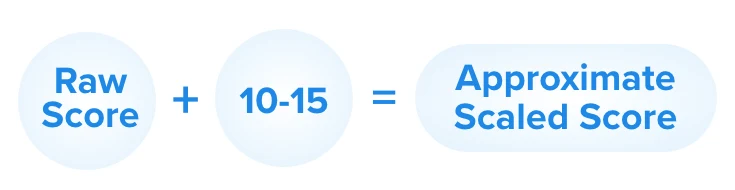
There is no way to accurately calculate your scaled MBE score because the NCBE doesn’t release the details of its scaling process. However, the general rule of thumb is to add 10-15 points to the number of questions you answered correctly. Remember, this is not accurate. It's a simplified way to approximate your practice test scores.
MBE Passing Scores by Jurisdiction
Typically, your written bar exam score can make up for an MBE score below the “passing score.” Passing scores (or passing standards) matter when you transfer your MBE score. MBE transfer passing standards range from 130 to 143.
UBE MBE passing scores
Since the MBE is worth 50% of a total UBE score, you can divide a jurisdiction’s UBE minimum passing score in half to get a “passing” MBE score. For example, the minimum passing score for the UBE in Alabama is 260. Therefore, you want to aim for an MBE score of 130 or higher. However, if you get a 128 on the Alabama MBE and a 132 on the written portion, the sum of your total score is still passing (260).
|
UBE SCORE* |
JURISDICTION |
|---|---|
|
260 |
Alabama, Minnesota, Missouri, New Mexico, North Dakota, Utah |
|
264 |
Indiana, Oklahoma |
|
266 |
Connecticut, District of Columbia, Illinois, Iowa, Kansas, Kentucky, Maryland, Montana, New Jersey, New York, South Carolina, Virgin Islands |
|
268 |
Michigan |
|
270 |
Alaska, Arizona, Arkansas, Colorado, Idaho, Maine, Massachusetts, Nebraska, New Hampshire, North Carolina, Ohio, Oregon, Pennsylvania, Rhode Island, Tennessee, Texas, Vermont, Washington, West Virginia, Wyoming |
Non-UBE MBE Passing Scores
Non-UBE MBE passing scores are more challenging to nail down. For example, California’s bar exam passing score is 1390 out of 2000 points. You should aim for a scaled score of 139, but there is no way to accurately gauge what raw score you need.
If you’re taking the bar exam in a non-UBE jurisdiction, check out the appropriate UWorld state-specific bar exam pages:
MBE Weight by Jurisdiction
All UBE jurisdictions weigh the MBE as 50% of the total bar exam score. Most non-UBE jurisdictions follow suit, except Mississippi, Virginia, and Nevada.
|
% MBE Weight |
Non-UBE Jurisdictions* |
|---|---|
|
50% |
California, Delaware, Florida, Georgia, Hawaii, Wisconsin, Northern Mariana Islands |
|
40% |
Mississippi, Virginia |
|
33% |
Nevada |
Historical Mean MBE Scores
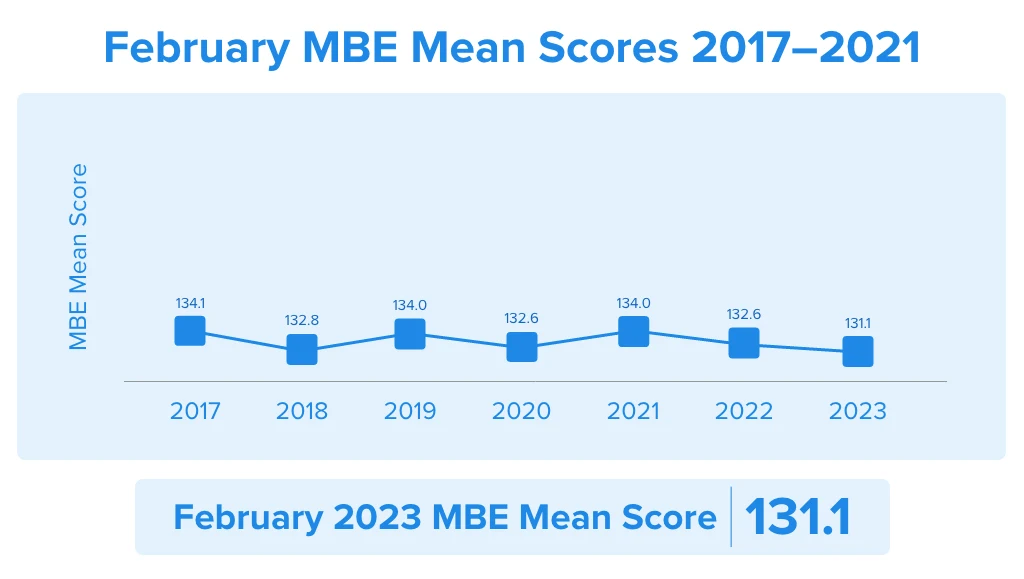
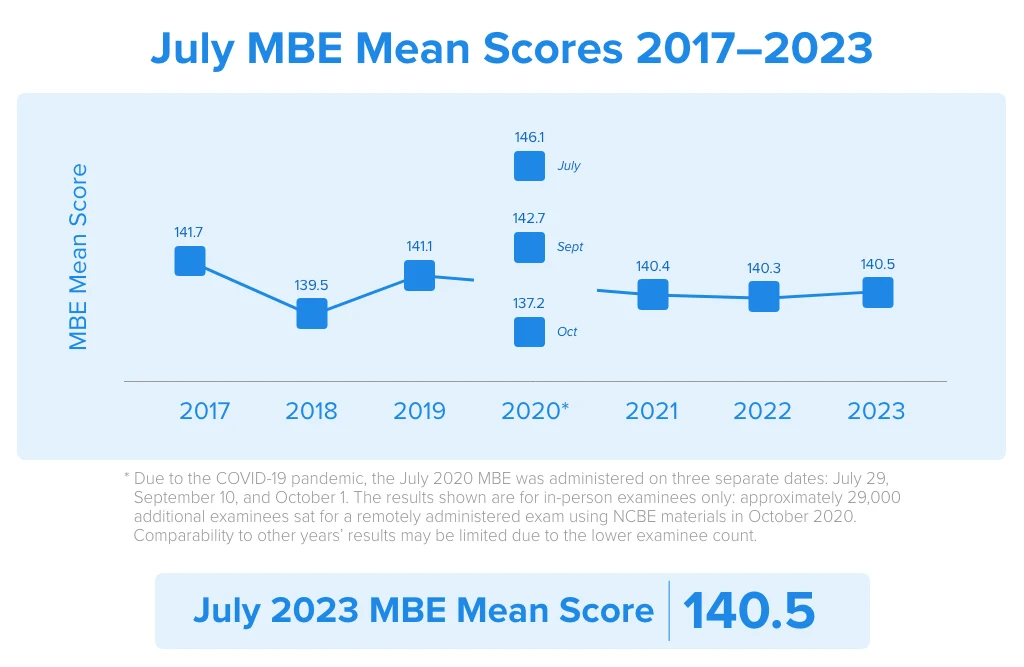
It’s worth separating historical mean MBE scores by February and July administrations rather than showing them by year. February examinees typically pass at much lower rates nationwide, bringing down the annual mean scores.
Why? Because most law school graduates take the bar exam in July. Fewer candidates sit for the February bar exam, and the number of repeat-takers is much higher, leading to these lower pass rates.
Mean February MBE scores
Mean July MBE Scores
How to Improve Your MBE Score
- Practice with NCBE-licensed questions from past exams
- Make sure you have good outlines
- Memorize the black-letter law with spaced-repetition flashcards
- Take practice tests that simulate the exam-day experience
- Routinely identify knowledge gaps and study accordingly
Learn More
- MBE Study Guide
- How to Improve your MBE Score
- 7 Things You Should do on Exam Day
- How to Ace Multiple-Choice Questions
- Tackling the Final Week Before the Exam
MBE Score Transfer: Step by Step
The NCBE submits MBE scores directly to the appropriate jurisdictions. To get your MBE score, you have to ask for it, although not all jurisdictions offer this service.
- Step 1: Determine if the jurisdiction accepts transferred MBE scores.
- Step 2: Determine if your MBE testing jurisdiction authorizes the NCBE to transfer MBE scores.
- Step 3: Log in to your NCBE Account, submit an MBE Score Transfer Request, and pay the $30 fee.
Jurisdictions that Accept Transferred MBE Scores
UBE jurisdictions accept MBE scores as part of your UBE score. In other words, they may not accept MBE scores individually. The following is a list of jurisdictions that accept MBE scores individually:
- Georgia
- Mississippi
- South Dakota
- Virginia
- Wisconsin
- Northern Mariana Islands
- Palau
- Alabama
- Idaho
- Kansas
- Michigan
- Minnesota
- Missouri
- West Virginia
- Virgin Islands