Understanding MBE® scoring can give you a strategic edge in bar exam prep. This guide walks you through how raw scores become scaled scores, what counts as a passing score, and historical score trends. With these insights, you'll be better equipped to interpret your results and plan your study approach effectively.
MBE Question Scoring
Each Multistate Bar Examination (MBE®) question is worth 1 point. The maximum raw score you can get is 175 because 25 of the 200 questions are unscored pilot questions used by the National Conference of Bar Examiners (NCBE®) to test future exam items. There's no way of identifying unscored questions, so all questions should be treated equally. The raw score is then scaled from 0 to 200 to account for variations in test difficulty.
There are 25 questions for each of the 7 MBE subjects, which include:
- Civil Procedure
- Constitutional Law
- Contracts
- Criminal Law and Procedure
- Evidence
- Real Property
- Torts
MBE Scaled Score vs. MBE Raw Score
Your raw score is simply the number of questions you answered correctly on the MBE. Your score report reflects a scaled number. The NCBE uses a statistical “equating” method to calculate scaled scores that adjust for variations in difficulty across different exam versions.
For instance, if exam A is harder than exam B, raw scores would not compare equally. Equating balances the difference, inflating scores from harder versions and adjusting those from easier versions. This ensures fairness across exam administrations.

How to Calculate Your Scaled MBE Score
There is no way to accurately calculate your scaled MBE score because the NCBE doesn't release the details of its process. However, a general rule of thumb is to add 10-15 points to the number of questions you answered correctly.

MBE Passing Scores by Jurisdiction
Your score on the MBE matters, especially if you are trying to transfer it to another state. Passing standards range from 130 to 143. Keep in mind that the MBE score is only part of your Uniform Bar Exam (UBE®) score. A stellar Multistate Essay Examination (MEE®) and Multistate Performance Test (MPT®) scores can help offset a lackluster MBE score.
How MBE Scores Contribute to UBE Passing Requirements
Since the MBE is worth 50% of a total UBE score, you can divide a jurisdiction's UBE minimum passing score in half to get a “passing” MBE score. For example, the minimum passing score for the UBE in Alabama is 260. Therefore, you want to aim for an MBE score of 130 or higher. However, if you get a 128 on the Alabama MBE and a 132 on the other portions, the sum of your total score is 260, which is still passing.
| “Passing” MBE Scores (½ of the UBE score) | Jurisdiction |
|---|---|
| 130 | Alabama, Minnesota, Missouri, New Mexico, North Dakota, Oklahoma, Utah |
| 132 | Indiana |
| 133 | Connecticut, District of Columbia, Illinois, Iowa, Kansas, Kentucky, Maryland, Montana, New Jersey, New York, South Carolina, Virgin Islands, Washington |
| 134 | Michigan |
| 135 | Alaska, Arizona, Arkansas, Colorado, Idaho, Maine, Massachusetts, Nebraska, New Hampshire, North Carolina, Ohio, Oregon, Pennsylvania, Rhode Island, Tennessee, Texas, Vermont, West Virginia, Wyoming |

Non-UBE MBE Passing Scores
Non-UBE MBE passing scores are more challenging to calculate. For example, California's bar exam passing score is 1390 out of 2000 points. You should aim for a scaled score of 139 on the MBE; however, there is no way to gauge the corresponding raw score you need accurately.
If you're taking the bar exam in a non-UBE jurisdiction, check out our state-specific bar exam pages:
- California
- Delaware
- Florida
- Georgia
- Hawaii
- Mississippi
- Nevada
- South Dakota
- Virginia
- Wisconsin
- Guam
- Northern Mariana Islands
- Palau
The MBE accounts for 50% of the total bar exam score in all UBE jurisdictions. However, a few non-UBE jurisdictions have different weightings. In Mississippi and Nevada, the MBE is weighted at 40%, while in Virginia, it makes up 33% of the total score. South Dakota and Puerto Rico do not combine MBE scores with written component scores, which may affect the overall scoring structure in those jurisdictions. It is recommended to consult the official judiciary website of each non-UBE state in order to review that year's scoring structure for the bar exam.
How to Transfer Your MBE Score
The NCBE submits MBE scores directly to the appropriate jurisdictions. To get your MBE score, you have to ask for it, although not all jurisdictions offer this service.
- Step 1: Determine if the jurisdiction accepts transferred MBE scores.
- Step 2: Determine if your MBE testing jurisdiction authorizes the NCBE to transfer MBE scores.
- Step 3: Log in to your NCBE Account, submit an MBE Score Transfer Request, and pay the associated fee.
Jurisdictions That Accept Transferred MBE Scores
The following jurisdictions accept MBE scores individually:
- Alabama
- Florida
- Idaho
- Kansas
- Michigan
- Minnesota
- Mississippi
- Missouri
- South Dakota
- Virginia
- West Virginia
- Wisconsin
- Northern Mariana Islands
- Palau
- Virgin Islands

Historical Mean MBE Scores
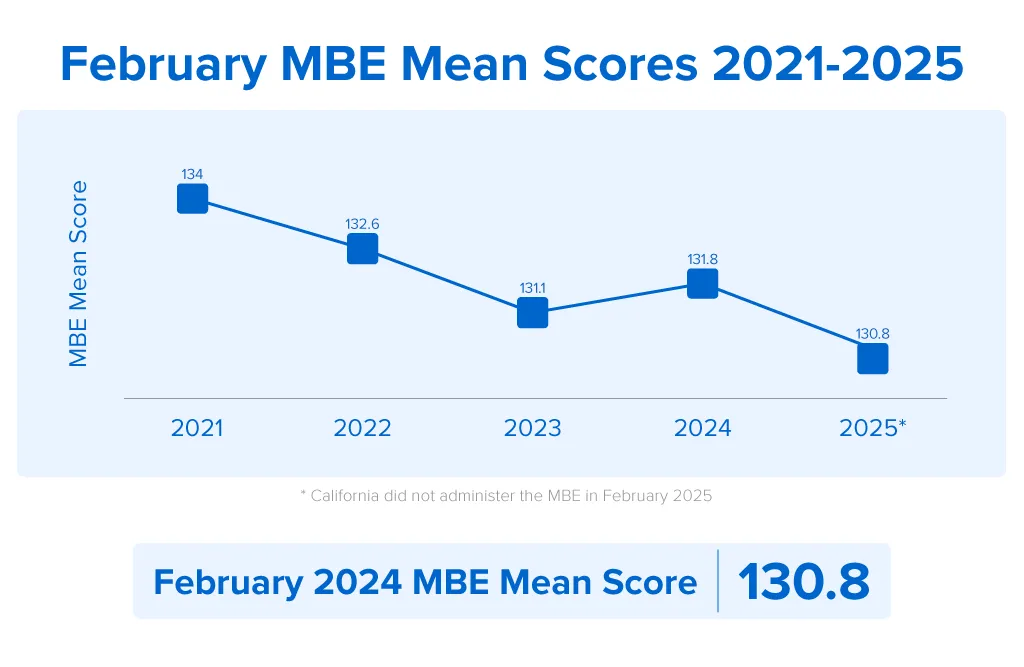
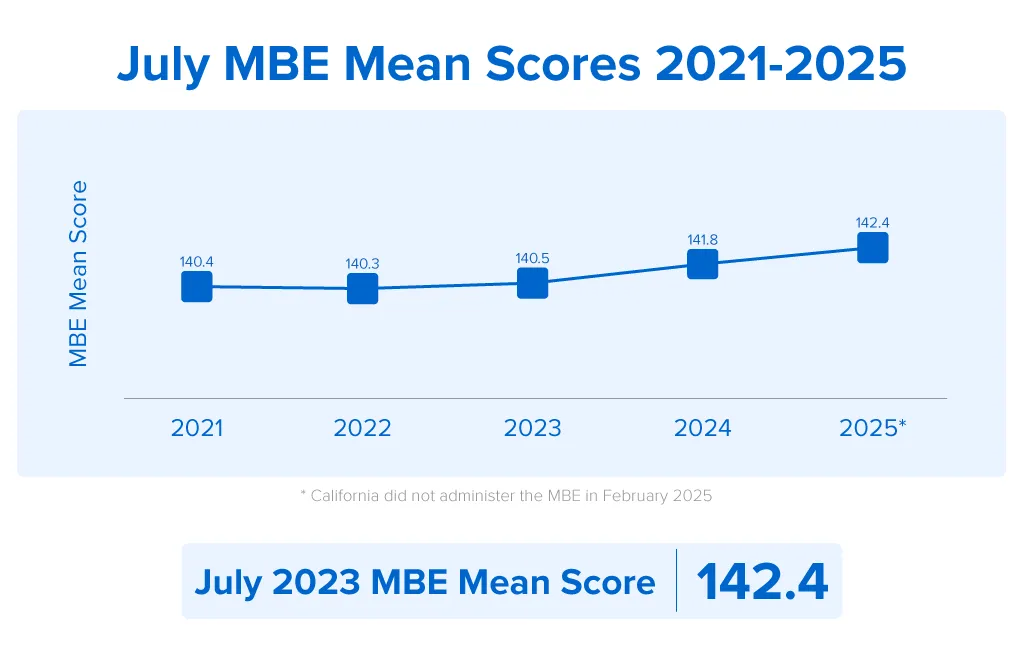
February MBE test-takers typically pass at a much lower rate nationwide, so it's important to separate historical mean MBE scores by February and July administrations rather than showing them by year.
Mean February MBE scores
Mean July MBE Scores
How UWorld Can Help You Improve Your MBE Score
By practicing thoroughly with trusted bar prep resources — including UWorld, Themis Bar Exam, and Aspen Publishing — you can improve your MBE score and pass the bar on your first attempt.
- Practice with NCBE-licensed questions from past exams.
- Make sure you have good outlines.
- Memorize the black-letter law with spaced-repetition flashcards.
- Take practice tests that simulate the exam-day experience.
- Routinely identify knowledge gaps and study accordingly.
Learn More
- MBE Study Guide
- How to Improve Your MBE Score
- 7 Things You Should Do on Exam Day
- How to Ace Multiple-Choice Questions
- Tackling the Final Week Before the Exam
Frequently Asked Questions
What is the maximum age of MBE scores?
MBE scores are generally valid for up to 7 years from the date of the exam. However, the exact validity period can vary depending on the jurisdiction’s transfer and admission policies. Some states may accept older scores under specific conditions, while others may require you to retake the MBE if too much time has passed. If you plan to transfer your score to another jurisdiction or reapply for admission after several years, check directly with the state bar or its official website for the most up-to-date information. Staying informed about these timelines ensures your previous efforts remain valid and can save you from retaking the exam unnecessarily.
What is the lowest MBE score?
The lowest possible MBE scaled score is 40, while the highest is 200. This score represents your performance after accounting for exam difficulty and statistical adjustments made by the National Conference of Bar Examiners (NCBE).
A raw score (based on the number of correct answers) is first calculated and then converted into a scaled score to ensure fairness across different exam administrations. While a 40 indicates minimal correct responses, most test-takers fall within the range of 120–140, depending on the jurisdiction’s passing requirements. Understanding how scaling works can help you interpret your results more accurately and set realistic score goals for your next attempt.
Can you pass the bar with a low MBE score?
Yes, it’s possible to pass the bar exam even with a lower MBE score. Most jurisdictions use a weighted scoring system, where the MBE typically counts for 50% of your total bar exam score, and the remaining portion comes from written essays and performance tests.
If you perform exceptionally well on the written section, you can offset a weaker MBE performance as long as your combined scaled score meets or exceeds your state’s passing threshold. However, if your MBE score falls significantly below the average, it may be harder to balance out. That’s why it’s important to aim for a well-rounded preparation strategy, focusing on both multiple-choice practice and essay writing.
How is the MBE score weighted compared to the written portion?
In most Uniform Bar Exam (UBE) jurisdictions, the MBE accounts for 50% of the total bar exam score, while the written components, such as the Multistate Essay Examination (MEE) and Multistate Performance Test (MPT), make up the other 50%. This equal weighting reflects the importance of both analytical writing and multiple-choice reasoning in assessing legal competence.
However, non-UBE jurisdictions may use different formulas. For example, states like Mississippi and Nevada assign slightly less weight to the MBE, placing greater emphasis on the written sections. Because scoring policies vary, it’s always wise to check your jurisdiction’s official bar exam website to understand exactly how your final score will be calculated and how to allocate your preparation time best.