Bar reciprocity allows eligible attorneys to become licensed in a new jurisdiction without retaking the full bar exam. Depending on where you're licensed and where you plan to practice, you may qualify through admission on motion, score transfer, or another jurisdiction-specific pathway.
The requirements vary by jurisdiction and often include factors such as your years of legal practice, character and fitness review, Multistate Professional Responsibility Examination (MPRE®) score, and prior exam results. Understanding these rules early can help you avoid unnecessary delays, application costs, and licensing surprises when planning your next career move.
Advantages of Bar Reciprocity
Bar reciprocity can help you avoid the time and expense of earning admission through another full bar exam. Whether you're relocating, pursuing a new job opportunity, or expanding your practice into another jurisdiction, reciprocity may provide a more efficient path to licensure while allowing you to build on your existing credentials and experience.
Key advantages of bar reciprocity include the following.
- Lower licensing costs: Avoid many of the expenses associated with preparing for and taking another bar exam, including registration fees, study materials, and months of dedicated preparation.
- Faster relocation: Gain admission in a new jurisdiction more quickly than the traditional exam route, helping you transition to a new state with fewer delays.
- Greater career mobility: Pursue opportunities with law firms, government agencies, corporations, or clients that operate across multiple states.
- Broader client service: Better support clients whose legal matters involve neighboring jurisdictions or multistate business operations.
- Recognition of legal experience: Experienced attorneys may be able to leverage their practice history through admission-on-motion pathways rather than demonstrating competency through another bar exam.
For many lawyers, reciprocity offers a practical way to expand where they can practice while reducing the administrative, financial, and professional challenges of obtaining another law license.
Bar Reciprocity Application Process
Applying for bar reciprocity usually begins with confirming that you meet the destination jurisdiction's admission requirements. Depending on the jurisdiction, you may need to provide proof of active legal practice, complete a character and fitness review, transfer qualifying exam scores, satisfy MPRE requirements, or complete a jurisdiction-specific component.
If you earned a qualifying Uniform Bar Examination (UBE®) score, transferring to another UBE jurisdiction may simplify the process. However, score transfer is not automatic. Each receiving jurisdiction determines which scores it accepts, how long transferred scores remain valid, and what additional admission requirements applicants must satisfy.
Applicants taking the NextGen Uniform Bar ExaminationTM (NextGen UBE) should be aware that score portability will continue to depend on individual jurisdiction rules. While jurisdictions adopting the NextGen exam are expected to allow score transfers among participating jurisdictions, each jurisdiction will continue to set its own policies regarding passing scores, transfer eligibility, score validity periods, and additional admission requirements.
| 1. Verify eligibility in your destination jurisdiction. | 2. Complete any required NCBE character and fitness review. | 3. Transfer qualifying UBE, MBE, MPRE, or NextGen UBE scores if required. | 4. Transfer qualifying UBE, MBE, MPRE, or NextGen UBE scores if required. | 5. Take the attorney oath and finalize admission. |
The following resources may be useful if you're applying for reciprocity.
- Character and Fitness: Many jurisdictions use National Conference of Bar Examiners (NCBE®) services to conduct character and fitness investigations for bar applicants. Requirements and application procedures vary by jurisdiction.
- MBE Score Services: Even if you aren't transferring from, or to, a UBE jurisdiction, most states use the MBE and may require an MBE score transfer via the NCBE.
- UBE Score Services: If you're transferring between UBE jurisdictions, you'll use the UBE score services.
- MPRE Score Services: Nearly all states require that you have an MPRE score that meets their criteria, not the requirements in your current jurisdiction.
Types of Bar Reciprocity
Bar reciprocity is an umbrella term for transfer agreements between states. Generally, states fall into one of the following bar reciprocity categories:
- Admission on Motion Based on Criteria: Allows attorneys from any state to be admitted as long as they meet the set criteria.
- Admission on Motion Based on Reciprocity: Allows attorneys to be admitted if their transferring jurisdiction also allows attorneys from the admitting jurisdiction to be admitted under similar rules.
- Semi-Pure Reciprocity: Allows attorneys to be admitted if their transferring jurisdiction also allows attorneys from the admitting jurisdiction to be admitted under similar rules. However, attorneys face stricter procedures and potential transfer fees.
- Pure Reciprocity: Allows attorneys to be admitted according to the rules of the transferring jurisdiction.
- No Admission on Motion: Some jurisdictions do not offer admission on motion and instead require an examination-based admission pathway or another limited licensing option
Bar Reciprocity by State
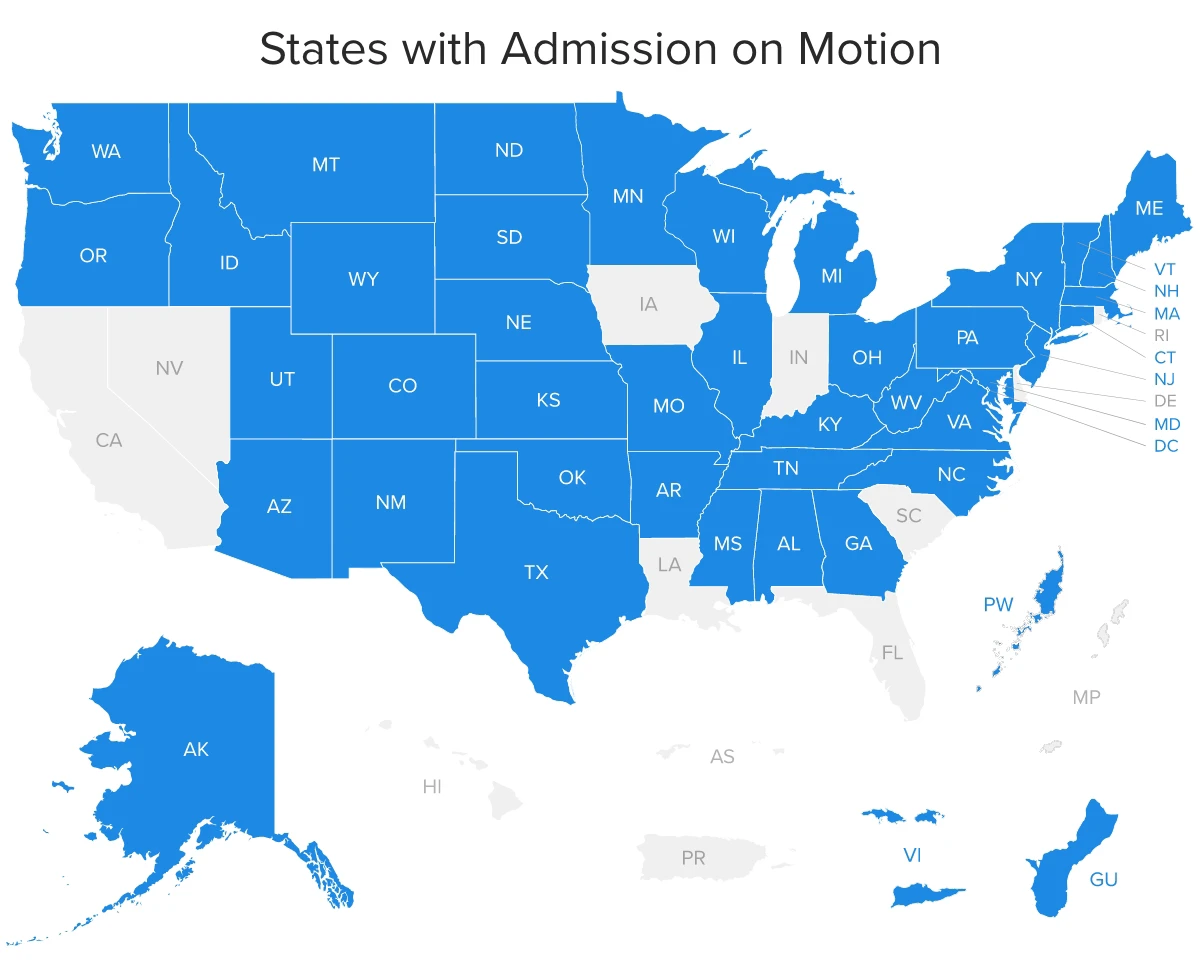
There is no single set of bar reciprocity rules that applies nationwide. Each jurisdiction determines whether it accepts transferred Legacy UBE/NextGen UBE scores, offers admission on motion, and imposes additional requirements such as score-age limits, practice-history thresholds, or character-and-fitness reviews. The chart below provides an overview of reciprocity requirements by state to help you identify potential pathways to admission.
Several large jurisdictions, including California, Florida, and Nevada, do not generally offer admission on motion and instead require attorneys to qualify through an examination-based admission pathway.
Note: Score transfer applies to attorneys with a recent, valid Legacy UBE or NextGen UBE score. It does not by itself determine eligibility for admission on motion. See Types of Bar Reciprocity for that pathway.
States Offering Score Transfer
*Currently administers the NextGen UBE; score transfer terms are set independently by each jurisdiction. See NextGen Bar Exam.
States Not Offering Score Transfer
| California | Delaware | Florida | Georgia | Hawaii |
| Louisiana | Mississippi | Nevada | Puerto Rico | South Dakota |
| Virginia |
Understanding Your Bar Reciprocity Options
The path to practicing law in a new jurisdiction depends on several factors, including where you're currently licensed, whether you earned a UBE score, how long you've actively practiced law, and the admission rules of the jurisdiction where you plan to work.
While some attorneys qualify through score transfer or admission on motion, others must take another bar exam or use a limited in-house counsel registration. The hypothetical examples below illustrate some of the most common pathways.
Note: Effective July 2026, some jurisdictions have begun administering the NextGen UBE, replacing the Legacy UBE in participating jurisdictions. Although NextGen UBE scores are expected to remain transferable among jurisdictions that adopt the exam, portability rules, including minimum passing scores, score transfer deadlines, and reciprocity requirements, will continue to be determined by each jurisdiction.
If You Recently Passed the UBE
Attorneys who earned a qualifying UBE score can often transfer that score to another UBE jurisdiction instead of taking another bar exam. However, each jurisdiction establishes its own passing score requirements, transfer rules, and score-age limits.
For Example:
Sarah passed the UBE in New York three years ago and recently accepted a job in New Jersey. Because both states participate in the UBE system and Sarah’s score still falls within New Jersey’s transfer window, she transfers her UBE score.*
If You’ve Been Practicing Law for Several Years
Attorneys with substantial legal experience may qualify for admission on motion. Rather than relying on a bar exam score, this pathway is based primarily on an attorney’s practice history and compliance with the jurisdiction’s admission requirements.
For Example:
Marcus has practiced law in Texas for six years and plans to relocate to another jurisdiction that permits admission on motion. Because he satisfies the jurisdiction’s practice requirements, he applies through the reciprocity process and does not need to take another bar exam.*
If You’re Moving to a Jurisdiction That Doesn’t Offer Reciprocity
Some jurisdictions do not offer admission on motion and instead require attorneys to qualify through an examination process before they can practice law there.
For Example:
Jennifer has practiced law in Arizona for six years and wants to move to California. Because California does not offer admission on motion, she cannot use reciprocity to become licensed there without taking the California Bar Exam and completing additional state-specific licensure requirements.*
If You’re Relocating to an In-House Counsel Position
Some jurisdictions offer limited registration pathways for attorneys who work exclusively as in-house counsel. These programs allow attorneys to practice for a specific employer without obtaining full bar admission.
For Example:
David works as an attorney in Illinois and accepts an in-house counsel position with a company headquartered in Texas. Because he will be providing legal services exclusively for his employer only, he registers through Texas’ in-house counsel pathway rather than pursuing full Texas bar admission.*
*All examples above are hypothetical and are provided for illustrative purposes only. Actual eligibility requirements, admission pathways, and outcomes vary by jurisdiction and individual circumstances.
Requirements for Bar Reciprocity or Admission on Motion
You will often see the terms bar reciprocity and admission on motion used together. In practice, admission on motion is one of the most common reciprocity pathways. It allows qualifying attorneys to seek admission in a new jurisdiction without taking another bar exam, provided they satisfy that jurisdiction's licensing requirements.
Eligibility provisions for licensure in a jurisdiction without taking the bar exam vary, but typically require you to demonstrate that you:
- Have a Juris Doctor (JD) from an American Bar Association (ABA)-accredited U.S. law school or satisfy each element of a jurisdiction's exemption from the law study requirement
- Have obtained a license to practice law in another state
- Have been actively and substantially engaged in the lawful practice of law as your principal occupation for a required period of time. Many jurisdictions use a five of the last seven years standard, although requirements vary.
Possible additional requirements include:
- Meeting the jurisdiction's minimum passing score on the MPRE
- Satisfying the provisions of the jurisdiction's rule governing good moral character and fitness
- Taking the required attorney's oath
- Completing the jurisdiction-specific component
Admission on motion is often faster than sitting for another bar exam, but it is not a shortcut around the licensing process. Most jurisdictions still require character and fitness review, verification of legal practice history, and satisfaction of jurisdiction-specific admission requirements.
Admission by Exam
Admission by exam is often the primary pathway for attorneys who do not qualify for admission on motion. Depending on the jurisdiction's rules, applicants may be able to transfer a qualifying UBE score, transfer a qualifying MBE score, or complete some portion of the destination jurisdiction's examination process.
This type of admission may allow attorneys to use previously earned examination scores rather than retaking every component of a new jurisdiction's exam. In jurisdictions that have adopted the UBE, qualifying applicants may be able to transfer a portable UBE score rather than sit for another full bar examination.
While UBE scores are designed to be portable, each jurisdiction establishes its own transfer requirements, passing score standards, and score-age limits. Before relying on a transferred score, confirm that the score remains eligible under the receiving jurisdiction's current rules.
Special Considerations for In-House Counsel
Some jurisdictions offer limited-registration pathways for attorneys who work exclusively as in-house counsel. These programs differ from full admission on motion and may allow attorneys to provide legal services solely for their employer without obtaining full bar admission in the jurisdiction.
Because eligibility requirements vary widely, attorneys considering a corporate legal role should review the destination jurisdiction's rules before relying on an in-house counsel registration pathway.
Bar Reciprocity Application Fees
The cost of applying for bar reciprocity varies by jurisdiction and admission pathway. In addition to jurisdiction-specific application fees, applicants may need to pay for character and fitness investigations, score transfers, document requests, and other administrative requirements.
While costs vary, many attorneys spend several hundred dollars on character and fitness reviews alone, and total reciprocity-related expenses can often range from approximately $500 to more than $1,500 depending on the jurisdiction and application requirements. Before applying, review the destination jurisdiction's fee schedule and NCBE service costs to understand the full financial commitment.